Sunday, 7 April 2013

A day with friends

Today we met with our friends Richard and Odette, and their daughter Maia, who are staying in Berlin for 3 months.  We had a nice leisurely lunch, catching up, and then spent the rest of the afternoon wandering around the Museum Insel.  This island, home of some of Berlin's most beautiful museum buildings, has been in a constant state of reconstruction and restoration since the end of the war.  And they still have a ways to go.

Vera with our friends:


Here is a facade that still has bullet marks from the war:


I love the red marble on this facade:


And I still can't resist the colors of construction, especially combined with the old buildings:


The S-Bahn is on the left; it travels right through middle of the island:


The dome of the Berliner Dom, with the Fehnsenturm in the background.


Architecture in Paris

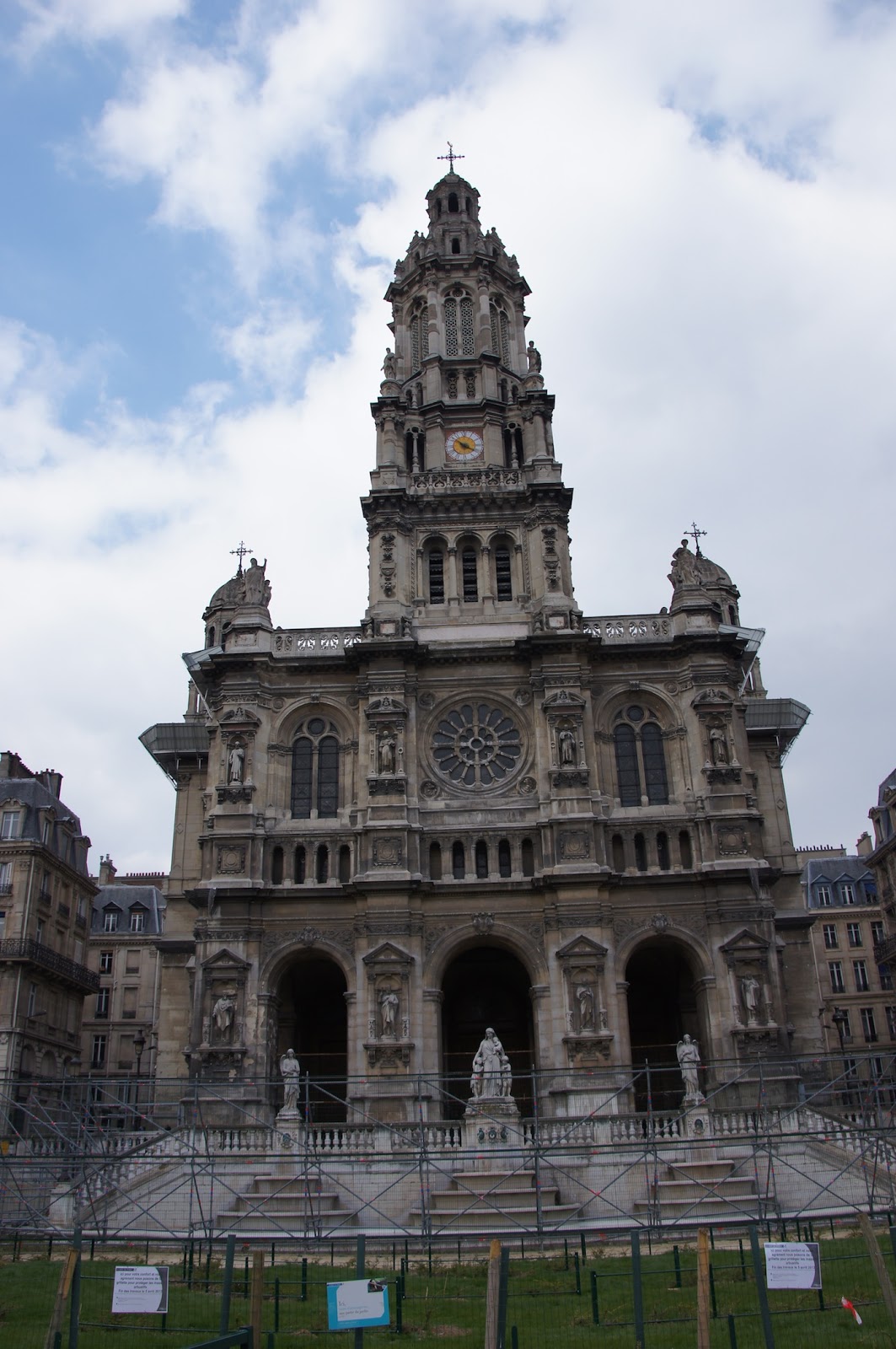
While in Paris, I saw this beautiful church facade:


Actually, that's not really true.  On was on my way to the museum of Asian art, but when I got out of the metro, there was the museum of architecture in the Palais Chaillot, and in I went.   What they have is a large number of plaster casts of the facades of old buildings in France, some of the casts dating back to the nineteenth century, and all of them looking quite realistic.  While it was interesting to see all of the works in close up detail, the overall effect was rather bizarre, seeing all the facades jumbled together in a single space.


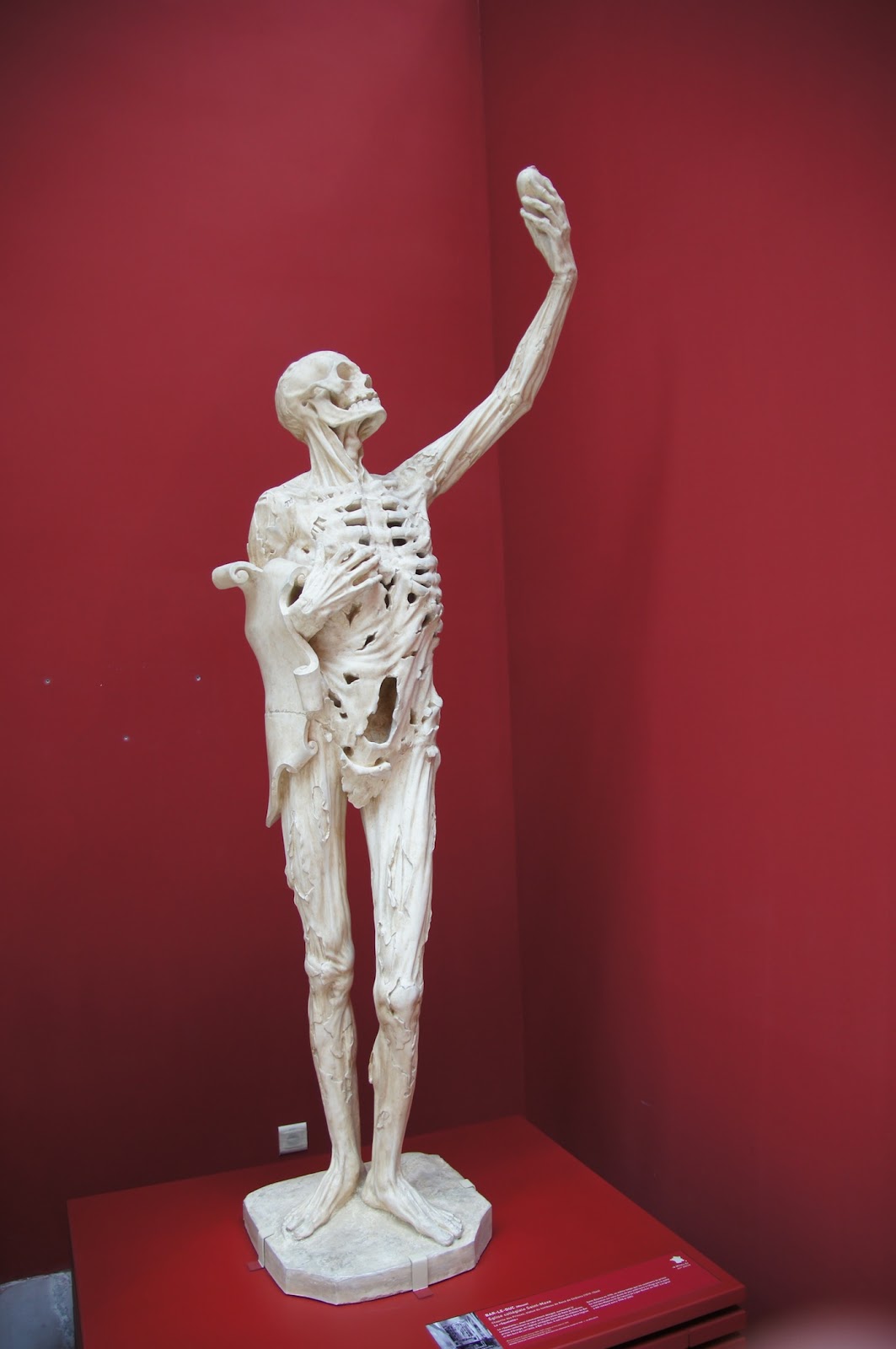
Plus this guy:


Paris Wrapup

Even though we are in Berlin, I still have a few more Paris things to talk about.

One of the things I love about Paris is the sheer variety of stores and storefronts that you encounter as you walk about. I don't know of any other city which sustains such a variety of seemingly marginal retail establishments; I don't know how it is possible.   I know of at least 5 different stores that sell the kind of wooden games and puzzles that I love; this time I noticed a store that sold nothing but things made out of pistachios, and, an old favorite, a store which sells only corkscrews, old and new.   And, of course, coming from a culture where bookstores are almost extinct, there is the seemingly infinite number of bookstores, devoted to anything obscure and with no air of any kind of profitability.   What a treat!

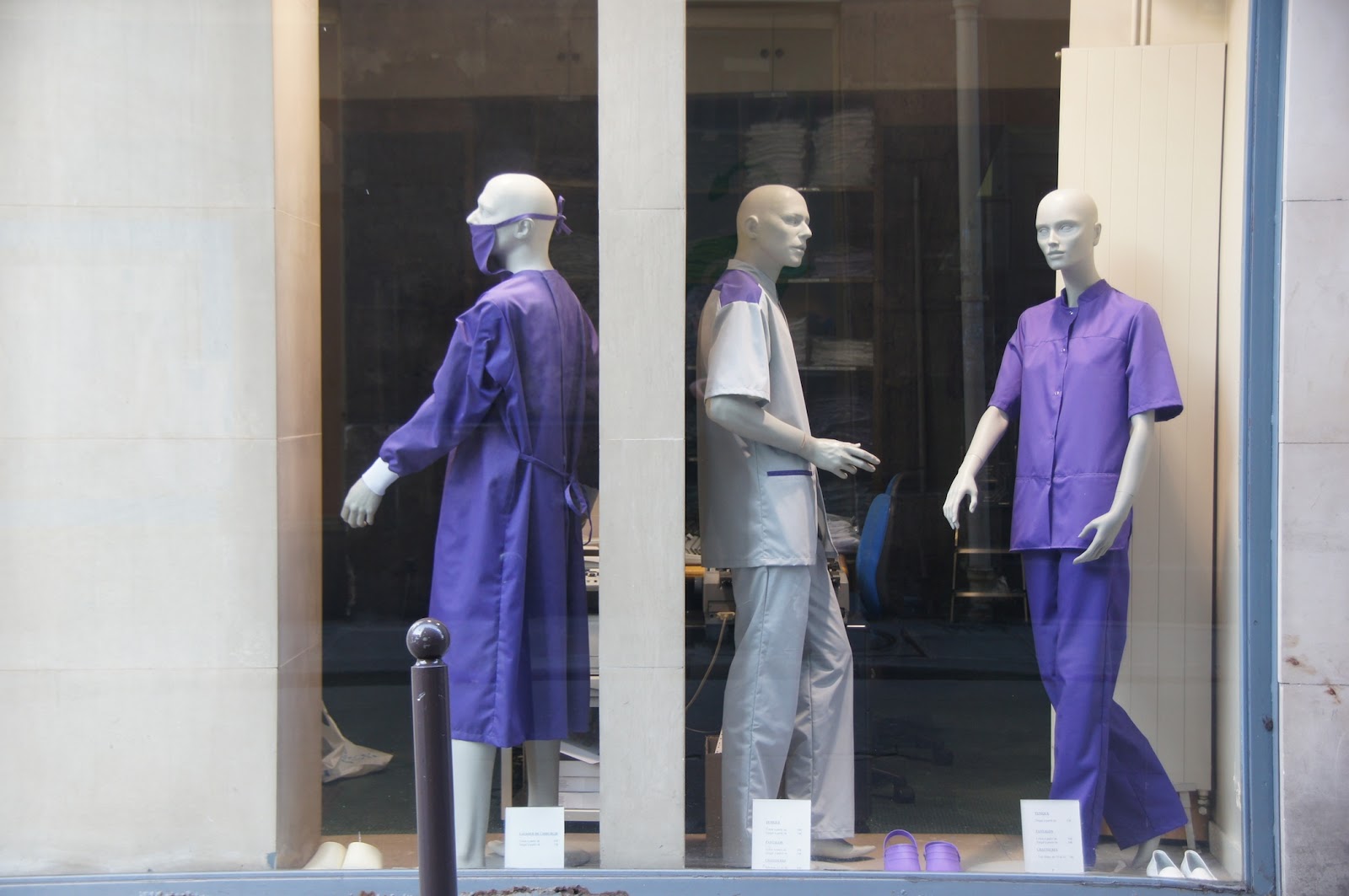
A store for very chic medical uniforms:


On one of the last days I went to see a show at the Fondation Cartier-Bresson, established by the late photographer.  The show was from the collection of Howard Greenberg; a stunning collection of prints from the 1930's onwards.   In an age of the increasing quality of photographic reproductions in books, it is wonderful to be reminded of the visual qualities of a well done silver gelatin print.  There were several by Josef Sudek and others that I loved.

No reproductions.


The stairway in the Fondation:


While I was in Montparnasse, I ended up walking through the famous cemetery.  I wanted to see the grave of Samuel Beckett, but somehow the cemetery map was upside down, which upended my sense of direction, so I couldn't find it.   (What sort of a marker would he have?)   I did see the grave of Serge Gainsbourg, who clearly has an active fan base:


And the grave of someone who was clearly about turkeys:


Another thing I saw in Montparnasse was the Jardin Atlantique.  A kind of "conceptual" garden as only the French can conceive, it was built in the 1990's above the tracks of the Montparnasse Station as part  of a large development.  Now it looks fairly decrepit, especially in winter.  Odd sorts of sculptural elements abound, as do fenced off areas where things have fallen apart one way or another.


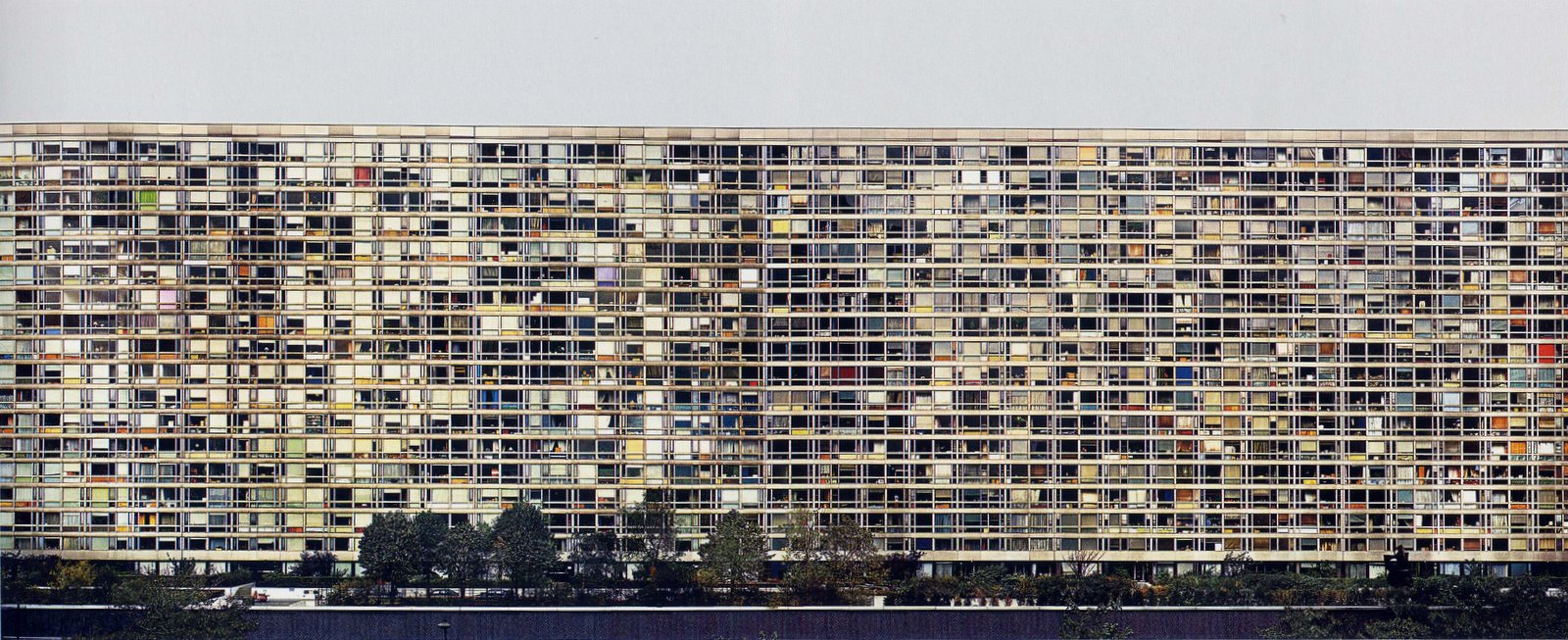
And there was the facade that I had seen portrayed at the Park Avenue Armory show and posted a picture of.   (A facade made famous in a photograph by Andreas Gursky).

Gursky:


Armory show:


  Taken by me, it looks like this:


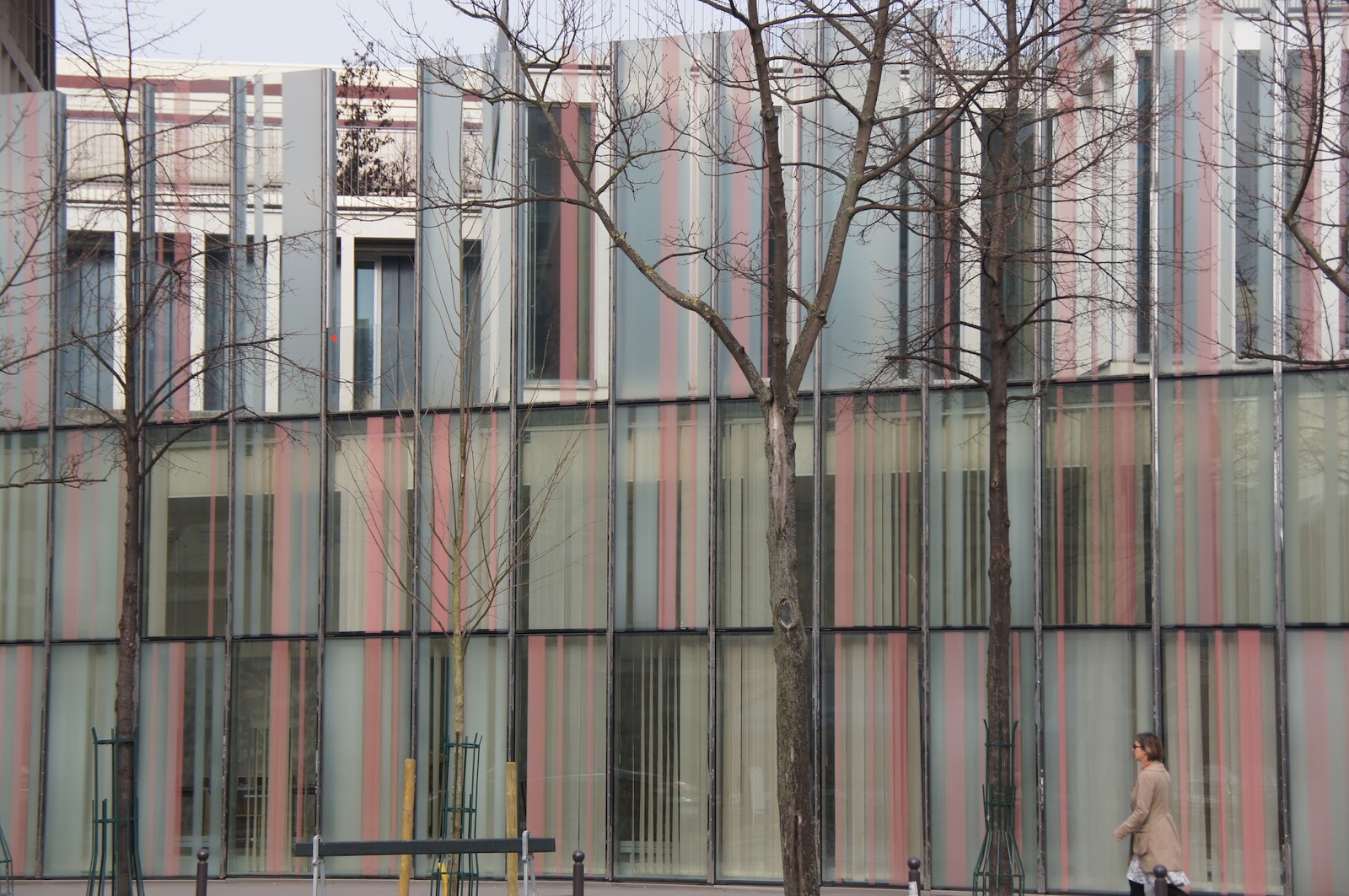
And here is another colorful facade of a non-famous building in Montparnasse, some sort of government building (they have those).


I also went one day to visit an exhibition at the Czech Institute.  The show was an homage to the work of the great Czech artist Jiri Kolar, primarily known for his collages  (and "crumblages").   100 different works by different artists, and I like some of them a lot.  Here is one from my iPhone:


On our last day in Paris, although it was still very cold, at least the sun came out, and people were suddenly sitting outside in cafes, even the blue-haired set:


Until the next time!

Saturday, 6 April 2013

More Berlin Pictures

I went to the outer fringes of Berlin to see a famous cinema, the Titania Palast.   Built in the 1920's, it was a beautiful example of modernism and "New Objectivity".
It looked like this:


Miraculously, it survived the war  As the only intact large theater space in Berlin, it was where the Berlin Philharmonic had its first postwar performances.  So I wanted to see it.   Alas, what Allied bombers failed to achieve, consumer capitalism has.  The front of the theater is now a clothing store, and the theater itself has been multiplexed.  A photo, avoiding the storefront:


I am going to remove those signs in Photoshop!


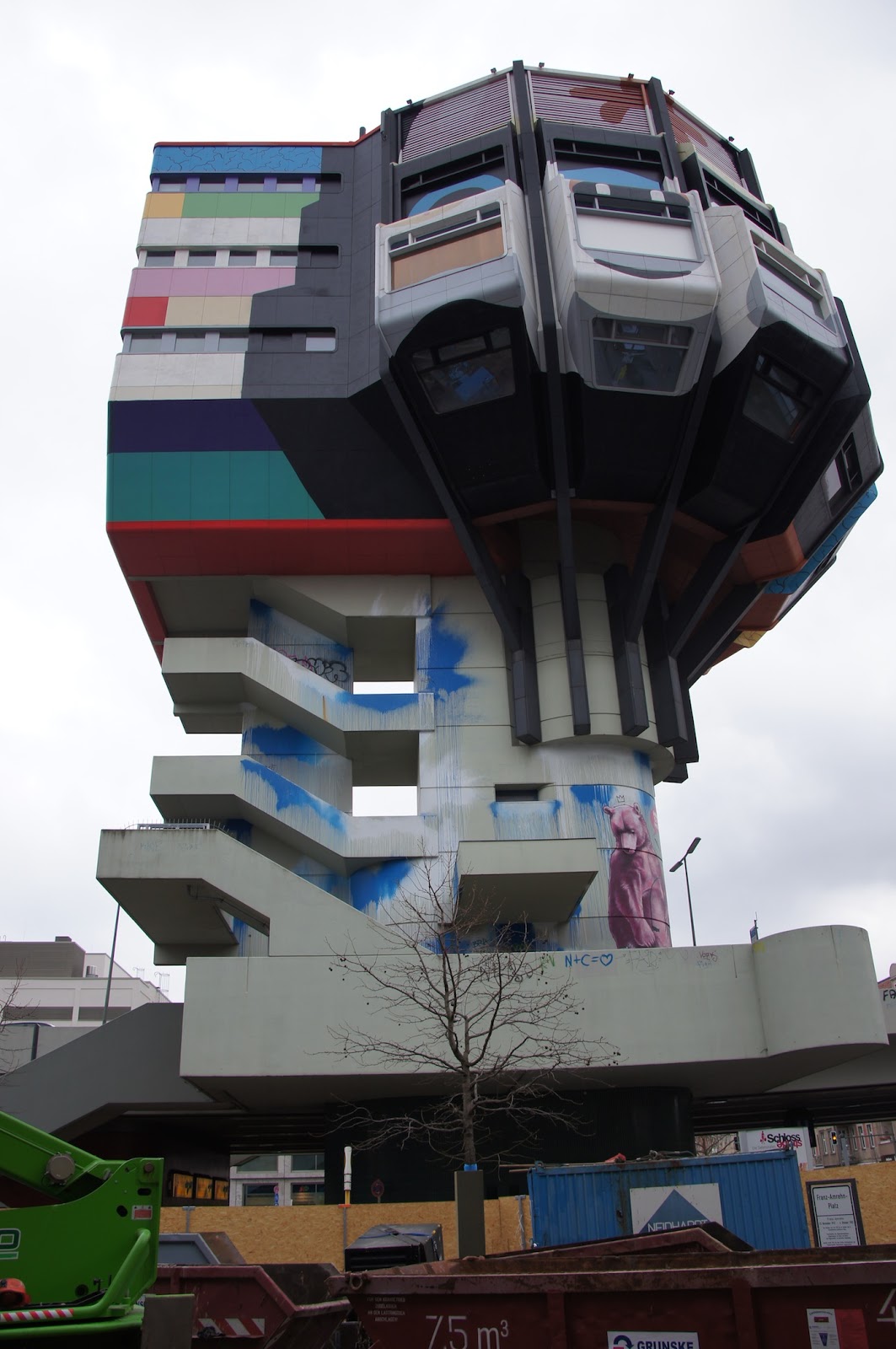
On the way, I saw this crazy structure; at first I thought it might be some war structure that couldn't be torn down (like the flak towers).  But it turns out that it was built in the 1970's as a beer hall/restaurant, and is now empty.  It became an art project for graffiti artists, hence the colors.


More pictures from the Mitte area, which is still being restored  (and more pink pipes).


The beautiful synagogue.   Unfortunately, the sidewalk in front of it is off limits; guarded by security guards.


I took some long rides on the S-Bahn. There were interesting views of all kinds of industrial and transportation structures in varying states of decay.


The famous Fehnsenturm, symbol of East Berlin:
(Somehow, whenever I see bulbous structures with windows, I think of the spaceship in 2001.)


The Hackesche Market S Bahn station:


Berlin Museums

Today we went to Berlin's museum for European paintings, the Gemäldegalerie.  This an amazingly good collection of paintings; housed in a fairly nondescript modern building, it is not a major tourist attraction.  It should be.  In Paris, everyone who visits goes to the Louvre; in Berlin no one seems to go to the Gemäldegalerie.  It was a wonderful viewing experience; quiet and spacious, the museum even has the great idea of setting aside small rooms with comfortable seats and no paintings, so that one can take a breather.  There are about 20 Rembrandts, 2 Vermeers, and a number of iconic paintings such as Breughel's "Proverbs".   Also, several Bosch-like paintings by Cranach, and an excellent collection of works by Durer.

I liked this de Hooch a lot, though the official photo doesn't do it any justice.


I also went to the Berggruen Museum, which contains part of the collection of the eponymous art collector and dealer.  It has over 100 works by Picasso on display, as well as around 70 works by Klee, plus Matisse, Cezanne, etc.   I went for the Klee, and was thoroughly entranced; it was like a retrospective.   I think I began to have a sense of how Klee works with color;  every painting has a different color palette, but within each painting I think there is a sense of "harmony" in the same sense that we think of harmony in music.  Klee may very well have written about this, and I know nothing.  I was particularly excited by the colors in a painting called "Necropolis", as in the Egyptian Pyramids.  I wanted to take it home; if I ever have a career as an art thief, it will have started here.  An iPhone shot:


I was so satiated after looking at the Klees that I skipped the Picassos...


Lastly, I had some time before I was scheduled to meet Vera, and stumbled upon a show at the Emil Nolde Siftung (who knew?) entitled "Nolde and Switzerland".   I didn't know anything about his work, other than the well known early expressionist work.   These were mostly water colors, dating up until the 1950's, semi abstract.  Beautiful colors, and not that different from his early work.  Another iPhone shot:


Berlin Concerts

We went to a sort of opera by Sciarrino, entitled "Vanitas, a still life in one act".   Very correct description.   Not much happened.  Participants were a singer, two elderly, well dressed people who occasionally moved, and a cellist and pianist.  It took place in the workshop of the Schiller Theatre, now the temporary home of the Staatsoper.


The singer spent most of the time stuck in the doorways; when she eventually made it in to the room, she was crawling.   As we were in the front row, the most exciting part was when she was on the floor, about 3 feet away from my shoes, singing.  The texts were incomprehensible as sung.

In a more traditional vein, we went to hear the Konzerthaus Orchestra in the Konzerthaus.  The hall itself is beautiful; I liked the sound of the hall.  Every hall (and every seat, in some cases) has its own special sound.  The Konzerthaus orchestra would not be mistaken for the Berlin Philharmonic, and the conductor was rather idiosyncratic.  The first piece, the Brahms first piano concerto, was subject to some very pronounced tempo shifts.  The second half was Mendelssohn's music for Midsummer Night's Dream; not the melodramas, but most of the rest.   It was delightful, and a great pleasure to hear.  And, of course, there is the famous wedding march.  Rather odd to hear this played in a concert!   The conductor, Ivan Fischer, placed all the members of the chorus seated, interspersed within the orchestra.  It seemed to work well.


Thursday, 4 April 2013

Berlin 2


Here are some pictures from our first days, with commentary.

The outside of a shopping mall (yes, that's snow):


We went to the Hamburger Bahnhof, a vast contemporary art museum created out of an old train station
Some things I saw:

Part of a retrospective by the artist Martin Honert, whose work centers on meticulously crafted versions of his childhood memories.
A dormitory bed:


A realization of the book by Erich Kastner, "The Flying Classroom:


I saw this from the museum window;  is it art or industrial detritus?


Outsider art by George Widener:


A very long gallery, with very clear signage:


The roof of the new Berlin main station:


The new Potsdamer Platz:

I don't know what the purple pipes are for...
Edit:  Now I do.  They are used to drain the water from construction sites, as Berlin is built on a swamp, and this is the most cost-effective way to do it.   And why not pink?


The Sony Center at the new Potsdamer Platz


A bit of an old facade, entombed:


But nearby, there are old buildings still to be restored...


Berlin!

We are now in Berlin, where it is still winter.   There is snow on the ground.   Dinner:  roast pork, cabbage, potatoes, beer.   We are not in Paris any more.

We last visited Berlin in 1997, in the summer time.  It is different in the winter; the openness and plentiful trees are not significant in the winter.  I am struck by how spread out Berlin is; even with all the construction since we were last here, there are plenty of seemingly abandoned lots and empty spaces.   It can take a long time, via walking or Ubahn, to get from one place to another.  Berlin is more like New York in some ways; a mosaic of a city, with pockets of old (and reconstructed) buildings in between blocks of dreary postwar constructions.  It's not a city for strolling in the same way Paris is.
But there is an extraordinary amount to see here, both of cultural and historic interest.  I remember our first visit, a few years after the Wall fell, when we took a bus that went from the west, through the Brandenburg Gate and the site of the Wall and into the older Eastern section, when all the images of history were suddenly real.  Seeing the empty space where Potsdamer Platz was, situated between the two Berlin's was a reminder of all the Berlin had been through;  now it is all rebuilt; and the empty space is mostly gone.  So I don't feel that same weight of history that I once felt.   But we have plenty to see; new museums, memorials, and even a brand new train station.


Monday, 1 April 2013

Messiaen, part 2

Yesterday we went to hear an organ concert at the Eglise de Trinité.  The program was a single work by Messiaen, "Le Livre du Sacrement", his last work for organ.  Though the announcement said the concert was an hour long, what we heard was the complete work, which last 2 hours and 15 minutes.  What made this concert very special was that this was the church and organ where Messiaen was the organist for some 60 years, and that the organ had been renovated and improved according to his specifications, and that he had composed the work with this organ in mind.  And furthermore, the organist, Jon Gillock, was his student.   The concert was extraordinary; the sound of the organ was astonishingly varied and the thundering climaxes were truly awesome in the true sense of the word.  I was totally focused the entire time.  There were moments when it seemed that every stop and every note was being employed; creating 2001 Ligeti-like sounds.  This contrasting with other moments of extreme delicacy (bird songs, of course).  And many sonorities I didn't know you could get from an organ.  The effect of reverberation in the church was amazing; a thundering chord would echo and reverberate for three or four seconds across the church.   It was an event which you could never experience in a recording;  a truly memorable Easter Sunday in Paris!

The church:


I also went to see an exhibit at the Cité de la Musique on Cinema and Music.  It was mostly didactic in nature.  Since I have taught a course in film music many times, there was not much for me to learn.   I did enjoy seeing many original manuscripts of film scores that I know and love.   On the whole, it was extremely well presented, and the film excerpts shown were ones that I would have chosen myself .

The original score for "Breathless"


 Next to the Cité de la Musique, I saw the construction site of the future Philharmonie de Paris, a Jean Nouvel designed concert hall for Paris.   It will be finished sometime this century, but definitely before a concert hall is ever built in Vancouver.