Wednesday, 9 November 2016

Gowanus Canal

I have finally gotten the time to begin wandering around parts of New York that I don't know, so I went to the Gowanus Canal area of Brooklyn.   The Gowanus Canal is a short canal (originally a stream) that is a branch of New York harbor.  It famous for being one of the most polluted sites in the United States, and is now an EPA superfund site.  The pollution was/is both industrial and sewage related. It's the kind of water that if a teenager in a horror movie fell into it, he or she might emerge as a mutant toxic avenger.  It was originally a heavily industrialized site, now very little of that industry is left.   It is, however, between the Park Slope and Carroll Gardens areas of Brooklyn, meaning that it is valuable real estate, so , in the ways of New York, it is being redeveloped.    So next to the stink of the canal, a metal scrapyard and abandoned industrial buildings, there is a Whole Foods and new condos.   There was a New Yorker cover which satirized this phenomenon.


So I went to wander and take pictures, looking as always, for color and geometry, as well as the unusual and unexpected.

Well, the canal looks rather pleasant from this angle, but don't even think of touching the water.


And there is a beautiful old wooden bridge:


New condos, with industrial ruins in the foreground:


An old water tower across from the new condos:


There was an extraordinary old abandoned power plant, which at a certain point became a squatter's paradise, nicknamed "The Batcave"


The blogger Nathan Kensinger posted this photo of the interior:


Then there were lots of other things I saw:


Piles of scrap metal:


And all those water bottles:


Despair and Incomprehension

This blog normally excludes any kind of political commentary, but on the occasion of the election of Donald Trump to the presidency, I cannot possibly pretend that the world is normal.  

David Remnick in the New Yorker puts it clearly:

"The election of Donald Trump to the Presidency is nothing less than a tragedy for the American republic, a tragedy for the Constitution, and a triumph for the forces, at home and abroad, of nativism, authoritarianism, misogyny, and racism. Trump’s shocking victory, his ascension to the Presidency, is a sickening event in the history of the United States and liberal democracy. On January 20, 2017, we will bid farewell to the first African-American President—a man of integrity, dignity, and generous spirit—and witness the inauguration of a con who did little to spurn endorsement by forces of xenophobia and white supremacy. It is impossible to react to this moment with anything less than revulsion and profound anxiety."

I cannot understand how the country I was born in can elect someone who is so manifestly unqualified to be president.   I can understand that people might have different political views from mine, and that in a democracy, people can choose to vote the issues that are important to them.    But I am ashamed to be from a country that would elect such a horrible person to be the president, and I really can't understand how this has happened.  
As Jennine Crucet in the NY Times put it succinctly after conversing with a Trump voting relative of Cuban descent,  "I cannot make sense of these choices.  There is no sense to be made."

The only positive thing I can think of in what is happened is that now that the right wing is totally in charge, they have nobody to demonize any more.   Whatever happens is a consequence of their policies.   Who can they blame for the next catastrophe?  The liberals have no power.   I only hope the people who were conned into voting for Trump begin to realize what they have done when the wall fails to materialize and the coal mines stay closed.

I will continue to write this blog and write about the things that I love, but with a deep-seated anguish about what has happened to the world I live in.    I have no choice but to go on and cherish what still exists.   And I treasure the experience of being in New York City, where, despite all the tensions of city life, I feel reassured by the enormous diversity of humanity around me.

Wednesday, 2 November 2016

Lots of exhibits!

I saw a wonderful show at the Studio Museum in Harlem, a mini retrospective of the work of Alma Thomas.  Thomas was a late bloomer, who only got started on painting seriously late in her life.    Though she was the first African-American woman to have a solo show at the Whitney (in 1974), her work has mostly remained obscure since then, mostly, I think, because her work is abstract and avoids any political issues.    She herself said that she did not want her painting to embody all the terrible things she saw in the world around her, but rather to create her own world outside of these concerns.   The paintings are imaginative, inventive, and intriguing in their use of color and rhythm.
Some samples:


This one was apparently painted after Thomas saw a show of late Matisse cutouts.


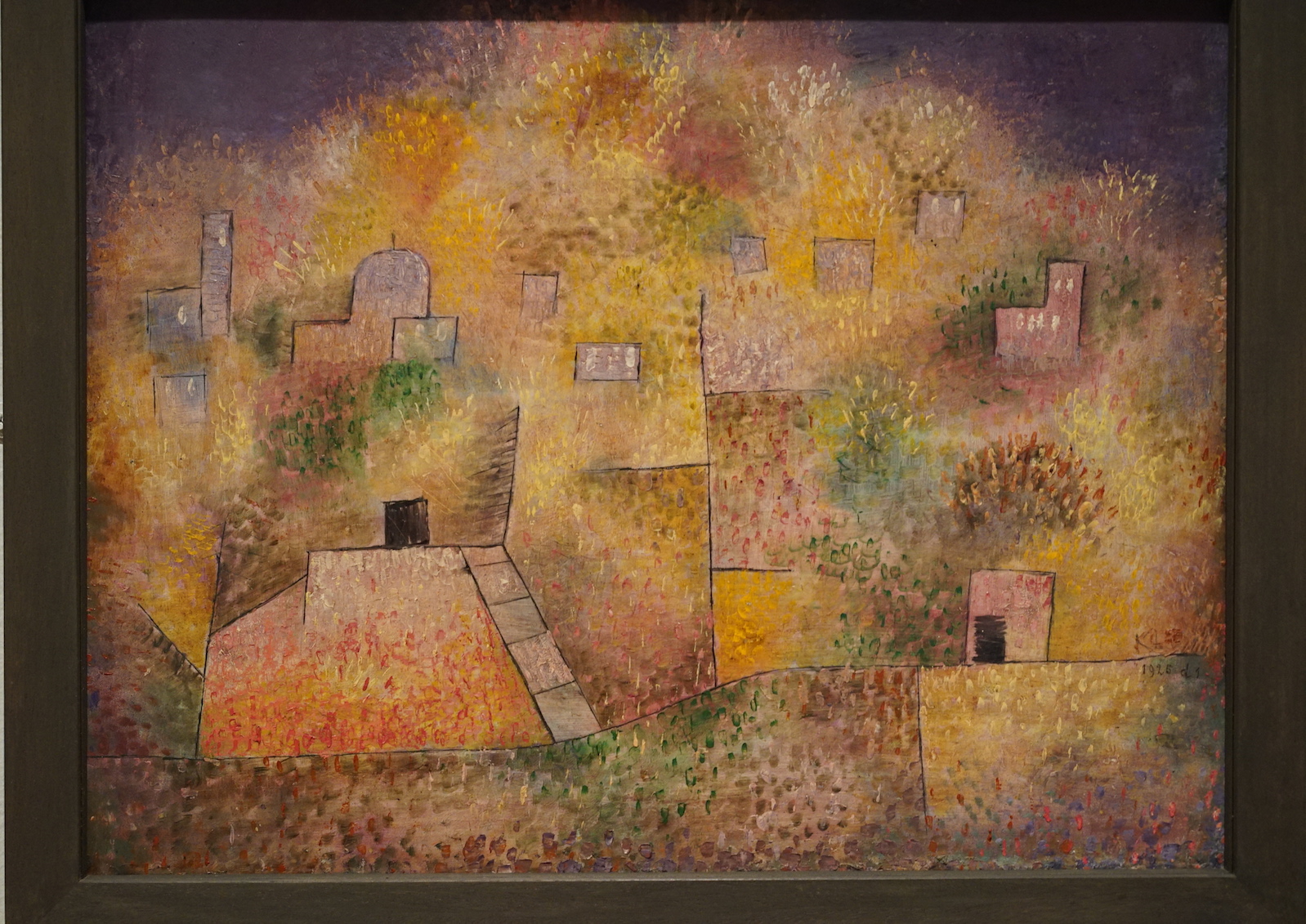
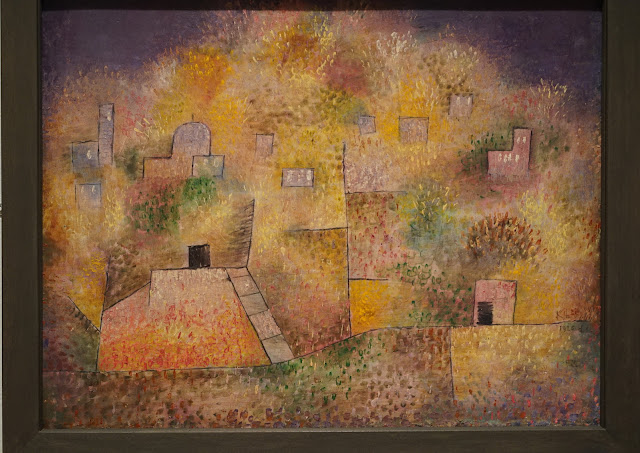
I saw a wonderful exhibit at the Met Breuer of works of Paul Klee from their Berggreuen collection.   They normally don't have the inclination to show them very often, but with their new space, they have done so.    There were quite a few early works, where you see Klee moving towards abstraction.  (The captions noted Klee's statement that he moved toward abstraction in order to keep drab reality at bay.)   The paintings are not drab, to say the least.   One other thing that stuck me this time was how much we see of Klee's "handmade" aesthetic, with "primitive", child-like scribbles and nails hammered into the canvas.  And his sense of humor.


There was also a show at the Met Breuer of early photographs of Diane Arbus.   I'm not a big fan of her work.   In the early work, you see her developing her taste for photographing the fringes of society.   One striking kind of images were those taken inside movie theaters while the film was running.  This was in the 1950's.   The exhibit also included a few of her famous later images; it is amazing how iconic some of them have become, like the image of the two identical twin girls dressed alike.


There was a new show of photography at MOMA.    Surprisingly, there were actually photographs on the walls.   It turns out that it was a show honoring a recent donation of photographs by Joyce and Robert Menschel.    It's a wonderful collection, spanning from the beginnings of photography to the present.  There is nothing like looking at great photographs in their original prints, especially by people such as Harry Callahan and Berenice Abbott. I hope the donors realize that the likelihood of these photographs ever being exhibited again is slim.   The normal photography galleries at MOMA have been closed since April "for renovation" and it is rumored  that they will not re-emerge as photography galleries.  (More room for Bjork shows instead?)   So no more exhibits of works by Atget, Evans, Abbott and the like?  They have a huge collection of great photographs, and none of them are on display.   Not trendy enough for them, I suppose.   Makes me want to give up my membership.   MOMA says it's all part of their ongoing expansion and renovation, but they haven't said what will happen.  (The architecture and design galleries are closed, too, which is provoking outrage in the architectural community.)


I also went to the new incarnation of the famous Maastricht art fair which is now setting up in New York as well at the Park Avenue Armory.  The show  includes old masters, Greek sculpture, African art, illuminated manuscripts, and lots of other things.   Like a mini Met Museum, except, of course, it is all for sale.   It's kind of startling to see something like an ancient Greek statue or an early Sienese painting that is available for purchase.  (And they are probably a lot cheaper than a Jeff Koons.)   But there were some really interesting and beautiful things to see.   Like this map, the first known European map which includes New York Harbor.   It's about six feet long, and absolutely beautiful, with lapis lazuli , etc.   Yours for only ten million dollars.


Or if that won't work for you, how about an ancient Egyptian sarcophagus?  (mummy not included.)  It is very well preserved, and the details on the surface are extraordinary.


Or perhaps an early Mondrian is more your thing...


A Japanese screen painting:


There were quite a few dealers selling African and Micronesian art.


No contemporary art at all, of course, and barely anything from the twentieth century.  But that was the specification for the show.   But fascinating none the less.   One very unexpected object was a collection of samples of different colored marble and other stones of the kind used in pieta dura, all stored in a specially constructed cabinet.


Part of the show was in the upstairs rooms at the Armory, so I got a chance to see some of the locker rooms, which are mostly unrestored, many with beautiful wood paneling.


There was a show of recent paintings and other work by Julie Mehretu at the Goodman Gallery.  I am fond her work, mostly because there are many layers of information, with a depth that intrigues me.   I was especially taken with this large scale "photogravure and etching" entitled "Epigraph, Damascus", which from a distance looks like a Japanese scroll painting.


From closer, it looks like this:


When you get even closer, you find out that it has etchings that are overlaid on architectural drawings, apparently of buildings in Damascus.


There was an astonishing show at the DiDonna Gallery entitled "Paths to the Absolute".  It consisted of only 13 works; two each by Mondrian, Kandinsky, Barnett Newman, Malevich and three by Rothko.  And a Pollock and a Still.


(I was allowed to take installation pictures, but not pictures of the individual works.)

I was the only person there, other than gallery staff and two security guards.  (I always think about the Jem Cohen movie about the security guards at the Vienna Museum, and wonder what it can be like to spend the entire day, for days on end, as a security guard in this exhibit.  There are no windows.)   It was absolutely silent, and I spent a long time in rapt contemplation of the work.   What a treat!
One of the Mondrians was a late work, and fascinating because instead of the normal sharply contrasted black lines, there were some that were only half there, as if the were in the process of being erased.   Is this unfinished?   I have no idea.  I have never seen a Mondrian like it.

Enlarged from my installation view:


Eventually you ask yourself, how is it that this presumably for-profit gallery has assembled this spectacular show for me to see for free?    Are these works for sale?   What's their angle?   Almost all of them are listed as belonging to "private collections".  
Well, some internet research turned up the information that the works are not for sale.   But, on the other hand, maybe for the right sum the owners could possibly be persuaded to part with them.  And that's what it is about.

The gallery estimates the net value of the 13 works to be about 450 million dollars.

So that Mondrian belongs to someone, and when the show is over, it will presumably go back home.
The world of art is certainly a strange place.   But I am quite happy to profit from it in my own way.

Monday, 31 October 2016

Dr. Atomic, Dr. Iyer, Willian Tell, and Steve Reich

We went with David to hear a program by the Juilliard Orchestra, conducted by Jeffrey Milarsky.   The Juilliard Orchestra is an excellent ensemble, and even more so because it plays in Alice Tully Hall, which is much smaller than Geffen Hall or Carnegie Hall and has a very appealing acoustic for orchestral details.   The concert began with Salonen's "Nyx", a fairly recent orchestral work of his.  I had the same reaction I have had to previous works of his; appealing sounds and rhythms, but very unmemorable melodic ideas, with the lack of a compelling dramatic shape on first hearing.  Or, to put it another way, his music lacks (to my ears) a kind of danger or idiosyncratic quality which puts you a bit on the edge of your seat.   The next piece was a performance of Bartok's Viola Concerto, which is certainly a problematic enterprise, as it was constructed out of fragments that Bartok left behind when he died.  I didn't hear a whole lot that sounded like Bartok to me, but the young soloist, Matthew Cohen, was excellent.   But the reason we went to the concert was the piece on the second half, John Adams's "Dr. Atomic Symphony".   Adams composed the work using material from his great opera "Dr. Atomic", developing ideas which he was not able to develop within the constraints of theatrical time.   It was a great piece, and the orchestra did a fabulous job of performing it.   Adams's music has exactly that character which I miss in Salonen's work.  Though you certainly hear things that echo other composers, somehow it all blends together to make something that is uniquely Adams.   There were wonderful clashing orchestral sounds, beautiful solo lines, and many moments of rhythmic chaos.  The piece has a clear dramatic focus, and was in no way a potpourri of themes from the opera.   A great pleasure.

Two nights later, for something completely different, we went to hear (again with David and our friends Krin and Paula) the Vijay Iyer Trio at Columbia's Miller Theater.  Iyer has been awarded every possible jazz award, a MacArthur grant, and is now teaching at Harvard.   Nonetheless, I was considerably disappointed in both his piano playing and his compositions.   In fact, I don't really get what all the fuss is about.    My problem is simply with his harmonic language; virtually everything is modal, and is chord progressions are extremely predictable.   Dissonances are avoided, and his overall harmonic world is constrained to a mild-mannered sort of Debussyian style.   He does work in elements from Monk and Ellington tunes (and a Michael Jackson tune, though I have to be told that, because I am clueless), and they kind of stick out.   In fact, I would have to say that Ellington is far more adventurous as a pianist than Iyer.  What I do like, though, are the rhythmic ideas that he and his ensemble develop (Stephan Crump on bass and Tyshawn Storey on drums).  There are lots of intriguingly complex polyrhythmic ideas going on, and together they develop some wonderfully idiosyncratic grooves.   Story is a talented and exciting drummer, but unfortunately he tends to overwhelm the relatively reticent Iyer when he plays loudly.   The ensemble also had wonderful sense of dynamics, going from very loud to very soft, though eventually the pattern of slowly getting louder, playing loudly, then getting softer enventually became a cliche.  But overall, I was disappointed.
Though, obviously, I am out of the mainstream opinion here, and maybe I just fail to understand what's going on.

And then, three nights later, for something really, really different, we went to hear Rossini's last opera, "William Tell", at the Metropolitan Opera.  I'm not in the habit of going to Rossini operas, and especially five hour ones, but you never know until you try.
William Tell is Rossini's last opera, and was his attempt to write a "grand opera" in the French style.   My resident musicologist tells me that the style had fairly specific requirements; there must be ballet music, etc. and things were done for more for effect than for dramatic integrity.   And that was the case; there were some stunning musical moments, as well as long sections where things were repeated endlessly and the drama lagged.  The title role was sung magnificently by Gerald Finley, and yes, he gets to shoot the apple on top of his son's head.    The chorus plays a big role in the drama, and they were magnificent.   And the orchestra, as always, was superb; their knockout version of the famous overture got an ovation from the audience.  (Was it for the performance, or for the heroic "Lone Ranger" theme?)     And yes, there was a new production, which had some very good moments as well as some peculiarly inappropriate moments.   But after the horrors of the previous week's production of Tristan,  I was happy to see a production which allowed the singers to stand on the stage and sing their parts.  (Is it time to bring back "park and bark"?)

A few days later, we went to an all Steve Reich concert at Juilliard, performed by the student ensemble Axiom.   (Reich was a Juilliard student once upon a time.)
There are many things I like about Reich's music, especially the focus on rhythm and harmony, and on musical patterns that are perceptible.   His early work, in which he basically threw out all conventional notions of music and rebuilt it from scratch, so to speak, was revolutionary.   It certainly paved the way for a retreat from the excessive complexity that characterized some of the music at that time.   (Though the conventional wisdom these days that somehow serialism was the ruling aesthetic at that time is largely overstated.)  He also threw out the conventional notion of music as intensely expressive.   (I can remember sitting countless pieces at that time that were expressing some kind of generic angst; it became extremely tiresome.)   But, at the same time, I have a lot of problems listening to music that is extremely repetitive.  I do not get into any trance-like states, and I become desperate for a break in something.   (A composition teacher of mine, Henry Brant, once suggested that it would be a good idea to go through a score you had written and randomly erase notes to make it more interesting.   Crude, but he had a point.)   Just as a short story writer doesn't have to tell you everything that happens, we can imply rhythms without pounding them out incessantly.
 At the concert, we heard an early work, Music for Mallet Instruments, Voices, and Organ,  which was largely static harmonically and rhythmically, but had wonderfully intricate waving of patterns of short melodic ideas.    It sounded very Balinese gamelan influenced.    The next piece, City Life, is a major work for large ensemble from 1995.   In it, Reich juxtaposes prerecorded samples of city sounds, very much of the period, including car alarms, shouts of protest, etc.   The juxtaposition doesn't work for me; the very literal meaning of the recorded sounds jars with the more subtle, variable meanings of the purely musical elements.    The music is quite expressive, though, and occasionally evokes the musical sound of Copland or Stravinsky.   By the last piece, the Double Sextet, the constantly repeating rhythmic patterns with the two pianos and percussion had began to annoy me; but, at the same time,  I found the complex and intricate ideas that the rest of the ensemble were playing were very interesting, and at times quite dissonant.   I longed to be able to hear them more clearly without the motor rhythms.  
The performances by the Juilliard students and conductor Jeffrey Milarsky were excellent, and I am certainly grateful for the chance to be able to hear all this music performed live.   Reich himself was there to take a bow to a warm ovation from the audience.   It's hard to believe he is eighty years old!

Tuesday, 18 October 2016

Another Three Events

I have been writing mostly of music and dance events.  Because we have Maggie the dog with us this time, and because I have a lot of musical projects to work on, I have done much less city walking (it's all dog walking) and gone to few art exhibits.  I hope to catch up eventually.

We went with David to hear a concert of the music of Kaija Saariaho performed by the New York Philharmonic, conducted by Essa-Pekka Salaonen.  The concert took place at the Park Avenue Armory.  (No sheep were involved, alas.)   The Park Avenue Armory is not a concert hall, but rather an extremely vast interior space which is more suitable for presenting "events".  And it was an event; the program notes for the production included people for the following roles (besides the usual ones):  "Mise-en-espace", lighting designer, sound designer, video and projection designer, seating and staging designer, and assistant director.   The orchestra was seated in the middle of the armory floor, and there was a stadium size video screen behind it.  Speakers were mounted everywhere, soloists and orchestral members would occasionally move down lighted paths.  Orchestral, soloist, and prerecorded sounds were all manipulated and projected into different parts of the vast space.  All of which is to say is that there was plenty going on.
I like Saariaho's music; she has a wonderful ear for sound color, for half-heard, suggestive ideas and elusive, fragmentary gestures.  Hearing her orchestral colors amplified in this vast space, though, was at times problematic.   Was that sound I heard in Saariaho's original conception, or was it a result of the sound designer's actions, or the improbable acoustics of the vast space?   Though, ultimately, it doesn't really matter, I suppose.  I did find, however, that a whole program of Saariaho's music (90 minutes, with no breaks or intermission) became too much of the same thing.  While there are moments of contrast, mostly the music is meditative in mood.
There were video projections for all of the pieces, done by Jean-Baptiste Barriere.  I thought the imagery was interesting, and the visual quality was superb.  On the other hand, the videos moved at the same slowly transforming pace as the music, and I often longed for something that was more contrapuntal.


Is this a concert hall?


I have to say that the people running the Armory are doing a great job of getting the audiences out.   The show was sold out; this for an orchestral concert of an avant-garde Finnish composer.   On the Upper East Side, no less.

I wonder what the late pioneer of spatial music, Henry Brant, would have done in the armory space.   Maybe they should try some time to do one of his pieces.


Two nights later, it was back to Brooklyn to hear and see Anne Teresa de Keersmaeker's "Vortex Temporum".    It was an hour long dance piece, choreographed with a live performance of Gerard Grisey's score "Vortex Temporum".   It was an extraordinary event, the best thing I have seen this fall.   Keersmaeker is my type of choreographer; like Balanchine, she is extraordinarily attentive to the music, and has excellent taste in contemporary music.  Grisey's score, written 1996, is an amazingly inventive piece, moving out from the French spectralist tradition.   Grisey famously said that music is composed with sounds, not notes;  I would add, in this case it is sound in time which matters.
The piece was quite similar to the one of Keersmaeker's that we saw last fall, in that the piece began with a live performance of the first part of the music on stage, with no dancers present.   The musicians were performing from memory, and the performance was extraordinarily good.   Rarely have I heard such a good performance of a difficult contemporary piece.  (The ensemble, "Ictus" is a frequent collaborator with Keersmaeker.)  The musicians left, and then the dancers arrived and danced in silence.   Though not really in silence, though, because we were hearing in our heads the music we had just heard performed.  It was as if we were seeing a kind of visualization of what we had just heard.   Keersmaeker uses the same number of dancers as musicians, and she has said that, in some cases, each dancer is paired with the music of a specific instrument.   My favorite part of the piece is when the musicians return to the stage to join the dancers, and she choreographs these large circular moments of both dancers and musicians across the stage.  Did I mention the ensemble included cello and piano?  The piano moves, too, pushed in circles by a dancer (or was it the conductor?).   The pianist has to play his part standing up, as the piano keeps moving.   And the cellist had some kind of special harness to hold the cello to his chest.   But the overall sonic and visual effect of the dancers and musicians moving in carefully choreographed circles was amazing.  For the last section of the piece, the musicians moved to a more conventional space towards the back of the stage, and the dancers were in front.  
Keersmaeker has said that the choreography was meticulously tied to the music; I would love to see it again and see and hear more.


Then, two nights later, we went to the Metropolitan Opera to hear "Tristan and Isolde", conducted by Simon Rattle.   The musical performance, especially by the orchestra, was phenomenal.   Rattle is very meticulous is balancing all the instruments of the orchestra to make Wagner's musical ideas as clear as possible.   What is amazing is that Rattle can do this while at the same time giving the score all the intensity and momentum that the drama needs.   I came away with a renewed sense of Wagner's musical genius; Tristan is his most radical work.   The "delirium" scene of Act 3 had me thinking of Schoenberg's "Ewartung" (I am sure I am not the first to think that.).  And the singers were superb, as well.  
Oh, and the production.   I hated it.  The director, Mariusz Trelinski, was the same director who added sound effects to Bartok's "Bluebeard".   I can't possibly enumerate all the ways in which he violates the music in Tristan, all in the name his dramatic interpretation.   One example.  Isolde is singing passionately, and suddenly the stage is plunged into darkness, while she continues singing.   Why?   Who knows?   The opening prelude, one of the most extraordinary pieces in all of classical music, becomes a soundtrack to a music video which starts hinting at Trelinksi's invented backstories, etc.   There were numerous other moments when Trelinski's stage conceptions violated the music.
Enough.    Luckily, our seats were partial view, right above the orchestra.   Partial view gradually became voluntary no view as the evening went on.  As Wagner apparently said, all the story is in the music, and that's all I needed.  It was an extraordinary evening.


Sunday, 9 October 2016

When Morty Met Sam: More Music and Dance

I went to a rehearsal of the New York Philharmonic, conducted by Alan Gilbert.  The first piece was a nine minute Ligeti work for solo trumpet and orchestra, "Mysteries of the Grand Macabre".  It's Ligeti in his Ubu Roi mode, verging on slapstick; entertaining, but a divertissement for the most part.   The second was Beethoven's Fifth Symphony, which is of course one of the most famous and well known orchestral pieces in the known universe.   But when was the last time I actually heard it performed?  I can't remember.   So it was exciting to hear a live performance.  Gilbert does favor a big band approach to Beethoven, with a large string section and a powerhouse sound.  This makes for an impressive, and dynamic performance, but with the concurrent loss of details.   I prefer my Beethoven in halls smaller than David Geffen Hall, which normally works better for very large orchestras.   But the second and third movements were absolutely wonderful, and, of course, there are very good reasons why Beethoven's Fifth is cultural phenomenon that it is.  It's an amazing piece.
The best part of the program, though, was Bartok's "Music for Strings, Percussion, and Celeste".   Again, it is one of those works that I think I know very well, but that I haven't heard performed live in I can't remember how many years.   In Gilbert's brief introduction, he referred to the piece as the greatest piece of the 20th century.  That certainly startled me, but after the performance, I was certainly disposed to consider the idea.   I tend to forget how original Bartok's musical world is.   He had both an extraordinary imagination for sound and a rigorous musical intelligence.   Did anyone write his kind of "night music" before him?   He really invented this sound world which has now become a cliche of film scoring.   And how many composers would have the audacity to begin an orchestral piece with a slow, complex fugue for strings.  In the rehearsal, Gilbert ran the whole piece, and then went backwards through the piece, fixing sections here and there.  It was an interesting way to hear the piece, hearing highlights in retrograde after hearing the whole piece.  

We went with David M to a dance show at BAM entitled "Neither", with choreography and set design by Shen Wei.   It was set to the "opera" for soprano and orchestra by Morton Feldman, with a text by Samuel Beckett.   I was hoping for a live performance of the music, but it was set to a recording.   The music is extraordinary; it's one of Feldman's best pieces; he uses a palette of exquisitely balanced orchestral colors.   As is common with most of Feldman's work, the average dynamic is pianissimo, and the very sharp dissonances he employs sound exquisite in the hushed dynamics.   Unfortunately, the recording was set to play at an extremely loud level; thus the "ppp" dynamic of the opening became fortissimo.   What was delicate became apocalyptic.   This was not good.
The choreography had its moments of interest, but there were also many moments where the movement was repetitive and not very interesting.   The whole notion, though, of setting choreography on "Neither" is quixotic, though, or at least problematic.  And given the loud volume, the music tended to dominate.  I'm still glad I saw it, though, and I would love to hear a live performance some day.   Barbara Hannigan, please!


A brief description from the web concerning the origins of Beckett's text for "Neither":

This extract is taken from Damned to Fame. The Life of Samuel Beckett by James Knowlson, published in Great Britain by Bloomsbury Publishing plc, London, at £25.00 hardback and £8.99 in paperback and by Simon and Schuster in New York at $35 hardback and $20 in Touchstone paperback. The extract recounts the 1976 meeting between Feldman and Beckett in Berlin where Beckett was rehearsing his plays Footfalls and That Time. (The numbers in brackets refer to the notes in Knowlson's book, reproduced here at the end of the text.)
Around noon on 20 September, during a rehearsal at the Schiller-Theater, the American composer and Professor of Music at the State University of New York at Buffalo, Morton Feldman came to meet Beckett in the small Werkstatt theatre. Feldman, who wore thick horn-rimmed glasses because his eyesight was so poor, related how he met Beckett and their subsequent conversation:
I was led from daylight into a dark theatre, on stage, where I was presented to an invisible Beckett. He shook hands with my thumb and I fell softly down a huge black curtain to the ground. The boy [who had escorted him] giggled. There were murmurs. I was led down steps to a seat in the front aisles ...(96)
After this unpropitious start, Feldman invited Beckett to lunch at a nearby restaurant, where Beckett only drank a beer.
He [Beckett] was very embarassed - he said to me, after a while: 'Mr. Feldman, I don't like opera.' I said to him, 'I don't blame you!' Then he said to me 'I don't like my words being set to music,' and I said, 'I'm in complete agreement. In fact it's very seldom that I've used words. I've written a lot of pieces with voice, and they're wordless.' Then he looked at me again and said, 'But what do you want?' And I said 'I have no idea!' He also asked me why I didn't use existing material ... I said that I had read them all, that they were pregnable, they didn't need music. I said that I was looking for the quintessence, something that just hovered.(97)
Feldman then showed Beckett the score of some music that he had written on some lines from Beckett's script for Film. Showing keen interest in the score, Beckett said that there was only one theme in his life. Then he spelled out this theme.
'May I write it down?'[asked Feldman]. (Beckett himself takes Feldman's music paper and writes down the theme ... It reads 'To and fro in shadow, from outer shadow to inner shadow. To and fro, between unattainable self and unattainable non-self.') ... 'It would need a bit of work, wouldn't it? Well, if I get any further ideas on it, I'll send them on to you.'(98)
At the end of the month, still in Berlin, Beckett mailed to Morton Feldman in Buffalo a card with a note 'Dear Morton Feldman. Verso the piece I promised. It was good meeting you. Best. Samuel Beckett.'(99) On the back of the card was the handwritten text (Beckett never called it a poem) entitled 'Neither', beginning 'to and fro in shadow/ from inner to outer shadow/ from impenetrable self to impenetrable unself/ by way of neither'. The text compares the self and the unself to 'two lit refuges whose doors once neared gently close' and owes one striking image to the play on which he was working so intently: 'unheard footfalls only sound'.
Beckett did not know Feldman's work at all when he wrote the text for him. But, by a strange coincidence, only a few days after posting 'Neither', and in London by this time, he was listening to Patrick Magee reading his own For To End Yet Again on BBC Radio 3, when he noticed that, in the second part of the 'Musica Nova' concert that followed the reading, there was an orchestral piece by Morton Feldman. He listened to it and found he liked it very much.


Last spring I had the great pleasure of hearing for the first time a live performance of Messiaen's extraordinary "Turangalila Symphony".  Little did I know that I would get another chance six months later, when the Simon Bolivar Orchestra under the baton of Gustavo Dudamel performed it at Carnegie Hall.  The performance was exuberant and full of energy, but unfortunately lacking in the detail and clarity that make all of Messiaen's complex rhythmic juxtapositions clear.  The strings, in particular, were pretty mushy in their articulation.   I suppose it would be uncharitable to compare the performance to that of the NY Philharmonic last spring, where all of those details were wonderfully clear.   I was also not too happy with the pianist Jean Yves Thibaudet.  His performance of the "Jardin du Sommeil d'Amour" was severely lacking in the special poetry of Messaien's birdsong inspired melodies; it felt more like sight reading.  (Though of course, all the fiercely difficult and loudly energetic parts were done very well.)   Still, complaints aside, I heard many things that I have never heard before in the piece, and I remain in awe of the splendid originality of Messiaen's music.  The strange combinations of saccharine cosmic bliss and fearsome dissonance are mind-blowing.  Hindu cowboy music!   Music from another planet!


Tuesday, 4 October 2016

Back in New York, In Full Swing

We are back in New York after an extended period in Vancouver.

The first show I saw was a new piece by the choreographer Pam Tanowitz, whose work we saw last winter and which made me think of her as one of my favorite living choreographers.  The work, entitled, "Sequenzas", was done at the Joyce Theater as part of their "Quadrille" series.  The stage of the Joyce was moved to the center of the theater, and the audience watched from either the remaining existing seats in the auditorium, or from seats on the stage.  Tanowitz's work addressed this idea nicely; it really felt like it was meant to be seen from either side, and it was refreshing to have a change from the normal proscenium viewpoint.  Tanowitz's movement is very much in a post-Cunningham style, both complex rhythmically and quirky and sometimes very witty.  My only problem with the piece was the long stretches with no music, thought the rhythmic thumps of the dancers bare feet were quite fascinating in themselves.  The music was three of Berio's "Sequences" for solo instruments (viola, harp, trombone) and a David Lang duet.  (Tanowitz often favors contemporary music).  The music, however, did not really interact with the movement, but rather served as a kind of background or alternative strand of meaning, in the Cunningham style.   I missed the intricate coordination the movement with the complex rhythms of the Nancarrow string quartets that Tanowitz used in the last piece I saw.   Ultimately, for this musically oriented person, an hour of pure movement was too much for me to keep totally focused on.   I eagerly look forward to her next piece, though!

Vera was not here for this show, as she was in Italy helping a friend.   I also saw/heard another Balanchine-Stravinsky evening at the NYC Ballet, this time with our friend David M from Vancouver.   I tried an experiment this time; balking at the price of the center tickets in the second tier, I bought some very cheap tickets on the side, right over the orchestra.  I missed central perspective of the intricate stage assemblages that Balanchine creates with his large groups of dancers, but there was certainly plenty to see from a different perspective.  And the sound of the orchestra was crystal clear, which at times made me want to shut my eyes and just concentrate on the music.  But my eyes were always drawn back to the stage.   I especially enjoyed the the "Symphony in Three Movements".  The music is one of my favorite pieces of Stravinsky's, and I was struck this time by the similarity in the ways that both Balanchine and Stravinsky use large groups, masses of instruments or crowds of dancers, moving them around, both colliding and dissolving.  The other highlight was "Movements for Piano and Orchestra", a marvel of musical concision and choreographic intricacy which I could watch endlessly if given a choice.

Sandwiched in-between these two dance shows, I heard a concert (also with David) of music of one the 20th century's other great modernists, Duke Ellington.   The Juilliard Jazz Orchestra put on a fabulous concert of all Ellington; the first half was all music from 1930 and before, and the second half all from the now neglected music he wrote after the war.   It was amazing to hear how the arrangers and the Juilliard students managed to recreate the sound of those classic 1920's recordings and bring them to life in live performances.   Ellington had such a brilliant and creative sense of how to compose with his orchestra; each of these short pieces has an astonishing degree of inventiveness.   Banjos and growls aplenty.  And, in the second half, we heard the same inventiveness, although composed with the more conventional jazz orchestral sound of the post war period.   One amazing piece was "The Clothed Woman", which has an extended piano solo which sometimes ventures into Debussy territory, and even, to my ears, 1940's Messiaen.   The students were excellent soloists.  The first half was conducted by Vince Giordano, who has been leading a swing band in New York for many, many years and probably knows more than just about anybody about this music.  (And I do remember back in the 1980's, when Vera and I danced to his band at a party.)

Lastly, it was back to Juilliard at the end of the week to hear a concert done by their new music ensemble. I knew nothing about any of the composers before I went, but sometimes you just have to take a chance to hear what is out there.  The results, were, as to be expected, disappointing.  That's part of the game of going to a concert of new music, though.  I count myself lucky if I hear a single piece on a concert which I really like.  The most striking thing in this concert was that each of the pieces was about 20-30 minutes in length, with no immediately discernible attempt to provide significant contrast and variety;  what ever happened to movements?   It takes a masterful sense of shape and construction to sustain a work over that period of time, and rather what you got  instead were very similar ideas repeated over and over again.  There was one piece for cello and ensemble that had a fairly continuous lyrical line throughout the piece.  At about half way through I realized I had not heard a single staccato or pizzicato note. I wanted one!   I did get some pizzicato in the very last notes of the piece.   I'm being harsh here, but I think all of the pieces could have been much shorter without losing any of their ideas.   Which brings me to a pet peeve of mine, the fact that composers virtually never have editors.   When someone writes a book, there are always (at least there used to be) competent editors who would often get writers to clarify and cut their ideas.  I am thinking of the legendary Max Perkins.  Would that many composers could have the same resources.  Part of the problem, of course, is the nature of the medium.  Complex notated musical scores do not lend themselves easily to sustained advance consideration, and the financial resources available to composers are very slim.  It would be nice if every work was given a rehearsed reading, with the composer then able to return to his or her desk and revise and make an entirely new set of scores and parts.   Operas, though, are often workshopped and edited, perhaps because of the enormous financial resources (and risk) involved in putting on an opera.   But, the music must go on.   There was a healthy crowd on a Saturday night at the concert (it was free, after all), and if people like Joel Sachs (the conductor and programmer) didn't pursue this music, the musical world would atrophy and die.   So I would happily go again, because you never know what you will hear.


Friday, 10 June 2016

Goodbye Japan

We spent our last day in Kyoto wandering around the city somewhat aimlessly.   We saw the Nishiki market, a local food market which has all kinds of indescribable delicacies.
We then caught the 5 PM bullet train back to Tokyo, and then another train to the airport, where we got our late night flight back to Vancouver.   When I was going through security, I removed my shoes (which is not required in Japan) because they have metal in them.   A pair of slippers instantly appeared for me to wear as I walked through the metal detector.  (Never mind that the Japanese slippers are always too small for my very large feet.)
This somehow symbolic of how Japan works; people are incredibly polite, thoughtful, and friendly, and every potential event is anticipated.   In our hotel we were provided with slippers to wear in the room (one is never meant to wear your street shoes indoors), and a separate pair of slippers to wear  in the bathroom.   Everything is incredibly efficient and well run, and the aesthetic value of many things is paramount.     All of this makes for an excellent visitor's experience, but I have no idea how this all feels to someone who lives there.  Does it become oppressive?  Do people get tired of constantly shifting from one pair of slippers to another?    If I were there for a long time would I start to miss the anarchy and rudeness which is part of the essential character of places like New York?   I really don't know.


What does strike me though is that by visiting Japan, you encounter many different ways of thinking about things, from urban spaces to interpersonal relations.   These ideas often challenge our own Western notions, and make you think again about how we conceptualize our world.  Consider, for example, that in general streets in Tokyo don't have names.   (The larger streets have been given names, mostly as a result of Western influences.)  There are neighborhoods, sub-neighborhoods, and gradually smaller chunks of the city that are identified by numbers, and numbered not necessarily according to any logic of adjacency.   While this makes sense to those who live there, I suppose, it represents a whole different way of conceptualizing city spaces than what we in the west are used to.   For me, this is just one somewhat trivial example of how some of the things we take for granted in the West can be thought of differently.  And while Japan has certainly absorbed and in many cases improved on ideas that come from the West, there is a sense in which they still somehow maintain a very distinctive and unique way of doing things which is very Japanese.  And, sometimes, you think they really do have a better way of doing things that we in the West could learn from.

I can't wait to go back to Japan and see more.


Sunday, 5 June 2016

Kyoto Temples and Gardens


Kyoto abounds in both Buddhist temples and Shinto shrines.   In the context of Western religions, one of the striking things about Buddhist temples is that they almost always include a garden component. In fact, in some cases, it is the garden which is the focal point of the temple.  How different from our Christian churches!   I won't try to understand why this difference exists, but, needless to say, for me it makes the whole experience of visiting a religious site very different.   So in Florence we spent our time visiting churches; in Kyoto we spent our time visiting temples with gardens.   One can specifically seek out the most famous and spectacular of the the temples, and one can also just wander the neighborhoods, checking out many of the unrenowned yet often intriguing local temples.  And there are a lot of them!

But we did visit some of the most famous ones.   For example, there is the famous "Golden Pavilion" (Kinkakuji), which is an impossibly picturesque building, covered in gold and set next to a small lake and beautiful gardens.   It should be noted that my pictures carefully disguise the fact that the site is extremely crowded with tourists, which certainly interferes with but does not destroy one's appreciation of the beauty of the landscape.


This path is closed to the public, which is why it is empty.  Standing behind me are selfie-snapping hordes.


One of the things we learned about Buddhism during our trip was the fact that there are many, many different sects of Buddhism.   Thus Zen Buddhism was founded, and then gradually many different variants of Zen Buddhism emerged, each, of course, with its own temple.
We visited one of the oldest Zen temples, Kenninji Temple, founded in 1202.   This was much less crowded that the more famous ones, and you could wander at will in most of the rooms and garden.  The garden featured the famous Zen style of raked gravel and rocks for contemplation.


An interior room with a screen painting:


View of an interior courtyard with a rock garden; the three stones in the middle represent Buddha and two Zen monks.


 This part of the temple had a recently painted extravagant ceiling.


We also went to a suburb of Kyoto called Arashiyama, famous for its bamboo groves and temple gardens.   The bamboo groves are visually striking;  


We also visited a temple in the area, Tenryuji.  It is famous for its gardens, which were laid out in the 14th century, and have stayed more or less as they were conceived.  (The buildings are not the originals, and date to the 19th century.)   The gardens are famous for the rocks and the concept of "borrowed" scenery, as the view of distant mountains are part of the whole plan of the garden.

More leaning and propped up trees:


In scroll paintings one often sees what I think are very stylized and exaggerated depictions of trees.   When you see trees like this in person, you realize the the images are more realistic than stylized.


 Another impossibly twisted tree:


The trunk of the same tree:


Leaving the town of Arishiyama, we took a wonderful old two car urban train through suburban Kyoto neighborhoods.  It was like riding an old trolley.


We saw a special exhibit at the Kyoto National Museum entitled  "The Art of Zen".   It was displayed in a beautiful new building that houses special exhibits for the museums.  The older part of the museum, a building built in the 1890's, was close for renovation, so we didn't see the permanent collection.   The exhibit had some wonderful landscape paintings which allowed your imagination to fill in the details.  But there were also too many portraits of important people in the history of Zen Buddhism.  They weren't very interesting for me.


We also visited Sanjusangen-do Temple.  It is famous for its 1,001 statues of the Thousand Armed Kannon, dating from the 13th century.   It is a remarkable sight, housed in a temple built at the same time, a building reputed to be the longest wooden building in the world.  They are very strict about not allowing picture taking, as it is a religious site.   But it is a very special and obsessive vision; each of the statues are slightly different.  
Here is a picture from the internet.   The statues in front are Hindu deities; I'm not quite sure what they are doing there.