I have been eager to hear a string quartet for a while, and the perfect opportunity came along with the recital by the Artemis Quartet at Zankel Hall, playing a concert of Mendelssohn's F Minor Quartet, Ginastera's String Quartet #2, and Schubert's Quartet #15 in G major. While I have not heard of the Berlin based Artemis Quartet before, they turned out to be an amazingly good ensemble; one of the best string quartets I have heard. The performance of the Schubert G major quartet was a revelation; the quartet is demanding in its exposed details and ensemble coordination. I remember when I first heard recordings of the Schubert, and I was searching for an ensemble that could play the high notes in tune. These guys can; the performance was flawless, among other things. The level of ensemble playing in this group is phenomenal; they play standing up (cellist excepted!), and are constantly listening to each other. It is almost hard to believe that an ensemble can play this well; I want to be reincarnated as a member of this group.
The Schubert quartet is one of those late Schubert pieces that show him heading in new and strange directions, with the depth of late Beethoven, but inhabiting a very different musical planet. It doesn't develop like Beethoven, but it does something else which it will take me a long time to understand. It feels symphonic at times, and, at other times, especially in this performance, it has Feldman-like moments of stillness and inaudibility. A performance I will long remember and cherish...
The Ginastera quartet, dating from 1958, was Bartok-like in some ways, especially in the pulsating rhythmic movements and in the "night music" movement. It also sounds somewhat serial at points. The Artemis gave it an impassioned, ferocious reading, and it was a pleasure to hear.
This was also my first trip to Zankel Hall, which is underneath Carnegie Hall. It was carved out of the space occupied by the old Carnegie Hall Cinema, with addtitional blasting into the Manhattan bedrock. (I remember seeing many a Bergman double feature there back in the 1970's!) It is a nicely configured space with lots of wood, but, to my ears, a little too dry for chamber music. But kind of a strange feeling to be so far underground.
Monday, 18 March 2013

Sunday, 17 March 2013
Maggie stops traffic
Maggie (our dog) tends to attract attention in New York (perhaps as part of her repertoire of food gathering skills), and I frequently get either a smile or a "What a cute dog!" when we are walking down Broadway. Today, however, we were coming from our walk, crossing the street, when a city bus driver stopped his bus, rolled down his window, and shouted out "What a nice dog!" She never gets that in Vancouver. She is going to miss New York.
Note: I just talked to our friend Leo, who often walks his dog. Someone came up to him, admired his dog, and he was so flattered that he didn't notice that his cellphone was being stolen.
Maggie guarding New York, with assistance.

Note: I just talked to our friend Leo, who often walks his dog. Someone came up to him, admired his dog, and he was so flattered that he didn't notice that his cellphone was being stolen.
Maggie guarding New York, with assistance.

Thursday, 14 March 2013
Matisse and others at the Met
I finally got around to seeing the Matisse show at the Met, gathering my courage to deal with the crowds. It is indeed a fascinating show, one that you look at in a very different way. Because the subject is multiple versions of the same scene or subject, you look at a set of paintings, usually two or three, rather than at just one painting. Or, at least, you are looking at a painting with the awareness of the different version of the subject which is next to you. In the early paintings, for example, you see a still life, painted in either a Signac version or a Cezanne version. But later, it becomes more interesting, as you see Matisse refining his ideas, so that he does one painting, and then does another one on the same subject; the process usually involves removing details. Here is one of successive versions of the view from his studio towards Notre Dame:

(The one in the middle is in fact the latest one.)
Is this like a musical theme and variations? I don't know. But it is an interesting concept; why should anyone make a definitive version of a scene. Why not make multiple versions (assuming the artist can afford the canvas and paint; if they couldn't, they would be more likely to paint over the earlier version.)
I liked these two versions of a Cezanne-like still life:

I also saw a video, which is the kind of thing that you don't normally see at the Met. It is a work called "Street", by James Nares. It is a video taken from a camera mounted on a vehicle cruising through the streets of New York, focusing on people walking on sidewalks. It was shot with a very special high-speed camera, which allowed Nares to slow the footage down to very slow speed without any of the normal problems with blurring in slow motion. (You can rent this camera for $3,000 a day.) It is accompanied by some guitar strumming by Thurston Moore (of Sonic Youth), which increases the hypnotic effect, but doesn't do much and becomes tiresome after a while.
What struck me on watching this was this it was a kind of art version of Google's street view still cameras. But on Google, of course, all the faces are blurred, out of concerns for privacy. But not here. I wondered how the people videoed,whose images are now appearing live at the Met, feel about being photographed. I did some research on this, and it is considered legal to photograph and display images of people without their permission if they appear in a public space. The exception would be if the images are used for "commercial" purposes, commercial purposes being the implied endorsement of something. Interesting...

(The one in the middle is in fact the latest one.)
Is this like a musical theme and variations? I don't know. But it is an interesting concept; why should anyone make a definitive version of a scene. Why not make multiple versions (assuming the artist can afford the canvas and paint; if they couldn't, they would be more likely to paint over the earlier version.)
I liked these two versions of a Cezanne-like still life:

I also saw a video, which is the kind of thing that you don't normally see at the Met. It is a work called "Street", by James Nares. It is a video taken from a camera mounted on a vehicle cruising through the streets of New York, focusing on people walking on sidewalks. It was shot with a very special high-speed camera, which allowed Nares to slow the footage down to very slow speed without any of the normal problems with blurring in slow motion. (You can rent this camera for $3,000 a day.) It is accompanied by some guitar strumming by Thurston Moore (of Sonic Youth), which increases the hypnotic effect, but doesn't do much and becomes tiresome after a while.
What struck me on watching this was this it was a kind of art version of Google's street view still cameras. But on Google, of course, all the faces are blurred, out of concerns for privacy. But not here. I wondered how the people videoed,whose images are now appearing live at the Met, feel about being photographed. I did some research on this, and it is considered legal to photograph and display images of people without their permission if they appear in a public space. The exception would be if the images are used for "commercial" purposes, commercial purposes being the implied endorsement of something. Interesting...
Wednesday, 13 March 2013
Grand Central Station
A few photos:


Sunday, 10 March 2013
Why a Duck?
On Saturday I took a long walk, starting in Hamilton Heights (where there are Canadian pianists around..) and then walking through what is called Manhattanville. The main thing I wanted to see was the famous Riverside Drive Viaduct, which spans the valley between 123rd Street and 135th Street. There is also a wonderful subway viaduct, as the IRT line emerges from underground to cross the valley. The area is also now a subject of controversy, as Columbia University is expanding and constructing a very large new campus in this area, and has demolished a lot of the old buildings in the area. The viaduct dates from 1900, and considered a major work of engineering at the time.
Some pictures:


The Columbia construction site has some interesting colors which attracted my eye:


I don't want to know what these yellow tubes are for:

An example of the subway viaduct, nicely painted:
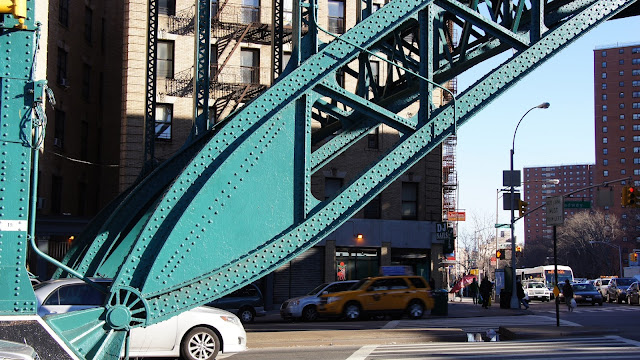

And finally, one of the old buildings which will most likely be torn down:

It was a sunny day and a great walk..
Note: The title of this post comes from a famous Chico Marx interpretation of the word "viaduct"....
Some pictures:


I don't want to know what these yellow tubes are for:

An example of the subway viaduct, nicely painted:


And finally, one of the old buildings which will most likely be torn down:

It was a sunny day and a great walk..
Note: The title of this post comes from a famous Chico Marx interpretation of the word "viaduct"....
Friday, 8 March 2013
Park Avenue Art Show
There are three big art shows in town this week. These are basically shows with a large number of art galleries exhibiting in a convention-style space, with each gallery having its own exhibition space. The purpose, of course, is to sell art. But going is a fascinating experience, as you walk from booth to booth, never knowing what to expect. There is a lot of high end schmoozing going on, as dealers cultivate their customers. I saw the show in the Park Avenue Armory, and I saw many things that I liked, some by people I had heard of, and others I had never heard of. For the most part, the aesthetic is about things that rich people would want to buy and hang on their walls, which is not necessarily a bad thing.
A few things that caught my eye, mostly captured via my phone camera.
A stunning Schoenberg painting, entitled "Vision", painted in 1923:

Very entertaining repainting of New York Times front pages by Fred Tomaselli:

Three dimensional works created by Kelly Heaton out bits and pieces of circuitry:
(detail)

A recreation of the facade of a famous building near the Gare Montparnasse:
(detail):

A clay model of a mixed-up game board (even the cards are made of clay)

And much more...including drawings by Klimt and Schiele, and a lot of interesting American modernists from the 1930's.
A few things that caught my eye, mostly captured via my phone camera.
A stunning Schoenberg painting, entitled "Vision", painted in 1923:


Three dimensional works created by Kelly Heaton out bits and pieces of circuitry:
(detail)

A recreation of the facade of a famous building near the Gare Montparnasse:
(detail):

A clay model of a mixed-up game board (even the cards are made of clay)

And much more...including drawings by Klimt and Schiele, and a lot of interesting American modernists from the 1930's.
Tero Saarinen
The second piece was much more interesting, it was a solo danced to a complete recording of Stravinky's "Rite of Spring". Stravinsky's music is so powerful that it is notoriously hard to choreograph; Pina Bausch's version is about the only successful one of have ever seen. Saarinen's piece begins in darkness, and he moves extremely slowly, even as the music becomes more and more frantic. Saarinen's solution, ultimately, is to kind of dance against the score; when the sacrificial dance begins at the end, he stops moving entirely as a video is projected against his body and the very large sort of skirt he is wearing. There are stunning effects with strobe lights at the end, so that as the music reaches its climax, what we see are occasional strobe flashes illuminating the dancer, and mostly darkness. It was a provocative and contrary version of the Rite. Unfortunately, hearing a recording of the Rite blasted at high volume on served to bring back memories of the extraordinary live performance we heard with Alan Gilbert conducting the NY Phil last fall, and the recording cannot compare.
The skirt:

With video projections:

Monday, 4 March 2013
A Very Short Concert
We went to hear a concert at MOMA, staged in association with the exhibit "Inventing Abstraction" and curated by David Lang of Bang On a Can. I went because I wanted to hear a very rare Schoenberg piece "Herzgewächse" which I have never heard performed. The piece is scored for soprano, harmonium, celesta, and harp. Unfortunately, Lang's idea of an interesting concert to connect with this exhibit was to perform the 4 minute Schoenberg piece and a 50 minute Morton Feldman piece for solo voice and pre-recorded voice. What a ridiculous choice! (A piece by someone like Webern would have been far more appropriate.) I like Feldman (see elsewhere in this blog..), but I don't have the patience to sit through a solo vocal piece of that length. Since the concert was at MOMA, I went to the galleries, and popped into the concert to hear the Schoenberg, and then left. The Schoenberg was a huge disappointment, because all the instruments and voice were AMPLIFIED! This ruined all the delicate balances, as the harmonium was overamplified. I was really annoyed. In addition, Lang's long spoken introduction was idiotic. Institutions such as MOMA should learn to treat music with a little more respect.
Update: Be sure to read David Lang's comment. I do regret calling his talk idiotic, what I should have said was that the talk was pitched more at the level of a high school audience than at what one would presume to be an artistically oriented and sophisticated New York audience.
Update: Be sure to read David Lang's comment. I do regret calling his talk idiotic, what I should have said was that the talk was pitched more at the level of a high school audience than at what one would presume to be an artistically oriented and sophisticated New York audience.
Sunday, 3 March 2013
Crazy people in New York
Every day I take Maggie for a walk in the morning in Riverside Park, and we spend a fair amount of time stalking the squirrels. People leave bird food at the base of trees, which also interests the squirrels, who are often torn between the desire to get some of the food and the need to evade Maggie. Normally, they climb up the tree, and gradually start climbing down again, until they get to close to Maggie, and then they retreat. The other day, there was what seemed to be a young squirrel, who was stuck in a very small tree, with no apparent method of escape. I was resigned to dragging Maggie away, when I saw the squirrel climb to the highest branch of the tree, and begin to contemplate a flying leap to the nearest tree. I cheered the squirrel on, and loudly voiced my congratulations when it made it to the tree. I then turned around to see another dog walker standing close to me, who was probably wondering about this crazy person who was talking to squirrels. So what's wrong with talking to squirrels?
Maggie and a squirrel contemplating each other:

Maggie and a squirrel contemplating each other:

Saturday, 2 March 2013
Music from Canada
The other night I went to hear the Aventa Ensemble at Roulette in Brooklyn. The Aventa Ensemble is an excellent new music group based in Victoria BC that frequently tours across Canada and Europe. (Though for some reason, they never play in Vancouver. Musical politics?) And here they were in New York. The best part of the program was a piece entitled something like Black Box by a young Danish composer. This featured a live video on stage of a camera that was inside a black box, with various objects being manipulated by a pair of hands, and a large ensemble spread around three sides of the room. The music was percussive, lively, and inventive. But the effect was eventually spoiled by mickey-mousing music that responded to the hand gestures in the video. The two Canadian pieces on the program were both overly long, self-indulgent, and uninteresting.
Friday, 1 March 2013
Gutai
I went with our friend Christopher to see the Gutai exhibition at the Guggenheim. This show is about a movement in postwar Japan, that like many postwar movements, sought to upend any traditional concepts of what art was supposed to be about, with an emphasis on the spirit of play and engagement with the materials. I was expecting a series of conceptual and gestural statements; we got those, but there were also a large number of paintings. They looked something like abstract expressionism, but without philosophy and psychology. It was more about things like painting with feet, and with bodies (this before the famous body paintings of Yves Klein), and pouring buckets of paint here and there. This painting was made by painting with a remote controlled little electric car with a paintbrush attached:

Some other paintings:

This one has a bear skin in it:

I liked the show; the exuberance of the art was exciting; there were also some interesting installation type things, and I learned about an art movement I had known nothing about.
A few more:


Some other paintings:

This one has a bear skin in it:

I liked the show; the exuberance of the art was exciting; there were also some interesting installation type things, and I learned about an art movement I had known nothing about.
A few more:


Parsifal
A few images


The pool of blood, and the flower maidens, in a very wide screen image:

Tuesday, 26 February 2013
The Mingus Orchestra
Last night we heard the Mingus Orchestra at the Jazz Standard, a club at 27th and Lexington which serves excellent food and has great music. The Mingus Orchestra is a group of musicians, organized by Mingus's widow, Sue Mingus, that is devoted to playing the more esoteric music that Mingus composed. (There is also a Mingus Big Band.) The ensemble includes French Horn, Bassoon, Bass Clarinet, and Flute along with all the instruments one would normally expect in a big band; it's a kind of hybrid big band. The music they played ranged from a film score to a vocal number written for Billie Holiday. Mingus's music is always interesting; rather that the traditional tune followed by individual solos, we often hear the ensemble return in the middle of the solos with new material. The ensemble itself plays with a kind of improvisatory informality which is exciting; someone may yell out in the middle of the tune to tell the musicians to do something. Clearly a labor of love on the part of the musicians, (though they do get paid) it is wonderful to hear this music played live. Mingus is one of my favorite composers.
Sunday, 24 February 2013
Powder Her Face
Last night we heard a performance of Thomas Adès's opera "Powder Her Face" at BAM. This opera, written in 1994, is notorious for its fellatio scene; it chronicles the decline of a duchess, based on the true life story of the Duchess of Argyll. The opera begins with a series of raucous, debauched episodes, with music that frequently alludes to popular styles, but transformed by Adès into something quite his own. The famous fellatio scene was overstaged by the director, who has some 25 fully nude men emerge from various places in the Duchess's hotel room, so while she goes about her business of seducing a waiter, there are these 25 men crowding the stage, not doing very much. Makes for great publicity, though. The opera really comes in to its own in the second act, with the Duchess's downfall, and her very moving aria, which resembles that of Berg's Lulu. Indeed, the whole second act echoes Berg's Lulu, both character-wise and musically, with a haunting, elegiac quality which clearly shows Adès's empathy with his main character. The staging, which emphasizes the sort of tawdry, sordid celebrity-driven aspects of the story, detracts from the music here, which I think is profound and moving.
Wednesday, 20 February 2013
Wandering the neighborhood with a dog
For the last week, I have had a terrible cold, and have only been out to walk Maggie, which is four times a day. After doing this for a while, I am getting a more detailed sense of the neighborhood than I have ever had before. We either go to Riverside Park, with its abundant and bold squirrel population, or to Broadway, with all the stores and everpresent crowds of people. Maggie likes both of them, and so do I. I enjoy looking at the sculpted contours of Riverside Park, and the curved fronts of the apartment buildings that border it. Between Riverside Park and Broadway there are both apartment buildings of varying degrees of pomposity and some charming old townhouses, including some nicely detailed old brownstones. All the buildings date from the 1920's or before, and all feature some kind of ornamental decoration. (Ornamentation will be the subject of a future post, once I get the right pictures) Broadway itself has all kinds of stores, and including our 24-hour supermarket, which features brightly lit piles of fruits and veggies outside; quite a vision on a frigid, windy night.
Today, when I took Maggie on for a walk on Broadway, she stopped in front of a shoe store that had floor to ceiling windows. She gives me her look that says. "I want to go in here." I say "No, Maggie, that's a shoe store!". Maggie then sits, and gives me that very determined look "I really, really want to go in here!" I pull on the leash, and she won't budge. She really wants to go in there. I explain that there is a sign that says "No pets, please". Finally, I get her to move, and we go on to the next store, which is a pet store, which is what I think she had in mind in the first place. (The one with a parrot inside that says "hello" constantly, which gets Maggie very curious.) We had only been in that store once before, but I am wondering if she actually had a sense of where it was and was just off by one store. Or else she really did want a pair of shoes....
One other thing I have noticed that I hadn't really thought about before is that New York's system of garbage collection involves all the apartment buildings putting their garbage out on the street in plastic bags the night before. And with the recent blizzard, garbage collection got behind. For me, that means that Maggie wants to sniff every garbage bag there is, especially the ones that might have been chewed a bit by rats. There has to be a better way. (Though in Tokyo, they do it exactly the same way, and the Japanese have most urban things figured out..)
Today, when I took Maggie on for a walk on Broadway, she stopped in front of a shoe store that had floor to ceiling windows. She gives me her look that says. "I want to go in here." I say "No, Maggie, that's a shoe store!". Maggie then sits, and gives me that very determined look "I really, really want to go in here!" I pull on the leash, and she won't budge. She really wants to go in there. I explain that there is a sign that says "No pets, please". Finally, I get her to move, and we go on to the next store, which is a pet store, which is what I think she had in mind in the first place. (The one with a parrot inside that says "hello" constantly, which gets Maggie very curious.) We had only been in that store once before, but I am wondering if she actually had a sense of where it was and was just off by one store. Or else she really did want a pair of shoes....
One other thing I have noticed that I hadn't really thought about before is that New York's system of garbage collection involves all the apartment buildings putting their garbage out on the street in plastic bags the night before. And with the recent blizzard, garbage collection got behind. For me, that means that Maggie wants to sniff every garbage bag there is, especially the ones that might have been chewed a bit by rats. There has to be a better way. (Though in Tokyo, they do it exactly the same way, and the Japanese have most urban things figured out..)
Monday, 11 February 2013
Art in different places
I did another round of Chelsea art galleries last week, and also did a MOMA visit. One of the interesting things about going to art galleries is that what you see is guided by the instincts of the people that run the galleries; instincts that run back and forth between the need to sell art and the need to support artistic quality. (The name of one gallery I checked out was "Guided By Invoices") Which means that, unlike a museum, where all the works have received some sort of curatorial stamp of approval (whatever that is worth), visiting galleries can sometimes mean that you are seeing stuff that is really about making money; except that how do you actually really know? What is the difference between a big name artist like Damien Hirst, who markets to high-end collectors, and someone who sells tacky paintings of flowers to make money? So it is fun to wander into a space and think about what it is that you are seeing.
At MOMA I did the 1940-1980's galleries, that are organized around the official MOMA approved categories; a room for pop art, a room for abstract expressionists, etc. I saw the newly installed Rauschenberg combine "Canyon", which includes a stuffed bald eagle sticking out of the canvas. The eagle makes the work unsellable in America, so the family that recently inherited it was forced to donate it to MOMA. A crazy, wonderful painting. (My own family inherited a considerable amount of junkyard taxidermy ((a stuffed ibex, etc.)) from my father, which the IRS valued highly, but which we ended up sending to the junkyard because it could not be sold.)

Another pleasure was a room curated by the artist Trisha Donnelly, where she upends the MOMA curatorial rules. This room featured a number of exceedingly large diagrams of microprocessor chips in vivid color and detail (donated by Texas Instruments, HP, etc. in the 1990's). These were juxtaposed with an odd assortment of photographs, a wheelchair from the design department, an art nouveau table, etc. Made you think...


I also revisited the abstraction show; it has wonderful stuff in it, but still seems to broad for my taste. Including people like Georgia O'Keefe and Marcel Duchamp as part of inventing abstraction seems spurious to me. They very well may have made art that was abstract in some sense, but that what not really what either of them was about...
At MOMA I did the 1940-1980's galleries, that are organized around the official MOMA approved categories; a room for pop art, a room for abstract expressionists, etc. I saw the newly installed Rauschenberg combine "Canyon", which includes a stuffed bald eagle sticking out of the canvas. The eagle makes the work unsellable in America, so the family that recently inherited it was forced to donate it to MOMA. A crazy, wonderful painting. (My own family inherited a considerable amount of junkyard taxidermy ((a stuffed ibex, etc.)) from my father, which the IRS valued highly, but which we ended up sending to the junkyard because it could not be sold.)

Another pleasure was a room curated by the artist Trisha Donnelly, where she upends the MOMA curatorial rules. This room featured a number of exceedingly large diagrams of microprocessor chips in vivid color and detail (donated by Texas Instruments, HP, etc. in the 1990's). These were juxtaposed with an odd assortment of photographs, a wheelchair from the design department, an art nouveau table, etc. Made you think...


I also revisited the abstraction show; it has wonderful stuff in it, but still seems to broad for my taste. Including people like Georgia O'Keefe and Marcel Duchamp as part of inventing abstraction seems spurious to me. They very well may have made art that was abstract in some sense, but that what not really what either of them was about...
Sofia Gubaidulina
On Saturday night we went to another of the Miller Theater's composer portraits, this one of the Russian composer Sofia Gubaidulina. I have heard Gubaidulina's music when she came to Vancouver a while ago (back in the days when people played notated contemporary music there). She was born in 1931, and has lived through tumultuous times in Russian life and music. My previous impression of her was as a Christian and somewhat mystical composer through works like "Offertorium". This concert, however, showed a more modernistic composer; one work written in the early 1970's, was serial sounding, and full of dissonant sound effects characteristic of the period. The highlight, though, was a concerto for bassoon, with an orchestra of 4 cellos and 3 basses. Low strings! This proved to be extremely original and quirky, often frequently upending conventional notions of the relationship between soloist and ensemble. Full of striking ensemble effects, it received a wonderful performance from the soloist. Another piece, for harpsichord and string quintet, was based on a Bach chorale, and was also intriguing to hear.
When we go to these new music concerts, we are also looking carefully at the audience, to see if we find people that we might have known 25 years ago (which involves trying to imagine what they might look like 25 years later...) We were delighted to find at this concert our old friend Leo Treitler (who we last saw a year ago..) So we went for a drink, and caught up.
When we go to these new music concerts, we are also looking carefully at the audience, to see if we find people that we might have known 25 years ago (which involves trying to imagine what they might look like 25 years later...) We were delighted to find at this concert our old friend Leo Treitler (who we last saw a year ago..) So we went for a drink, and caught up.
Saturday, 9 February 2013
The Night Across the Street
Last night, we went to see the last film of one of my favorite directors, the Chilean Raoul Ruiz. The film, "The Night Across the Street" was the last film he made before he died recently, and has just been released. It was a snowy and stormy night, this month's "Storm of the Century", and the Mayor told everyone to stay home. So we went; the subways were practically empty, but running smoothly. There were two other people in the theater. Ruiz's films have a unique quality which is almost impossible to describe; a kind of shaggy-dog, poetic surrealism which can be at times breathtakingly beautiful, inscrutable, and bizarrely funny. "The Night Across the Street" is a non-narrative cinematic poem which centers around an aging poet and his earlier childhood self. As a child, he freely converses with his heroes, Beethoven and Long John Silver. At one point, he takes Beethoven to the movies. The movie floats freely backwards and forwards in time. The music is truly wonderful; Ruiz's frequent musical collaborator, Jorge Arriada, is a master of orchestral textures and sounds. While the film has its slow points, I have a strong feeling that it is some kind of cinema/poem/musical masterpiece.
When we got out of our dream state experience, there was New York, transformed into a glorious blizzard state, with lights and blowing snow and the distinct quiet that emerges in New York during the snow.
A seance, with Long John Silver on the left, and Beethoven on the right.

When we got out of our dream state experience, there was New York, transformed into a glorious blizzard state, with lights and blowing snow and the distinct quiet that emerges in New York during the snow.
A seance, with Long John Silver on the left, and Beethoven on the right.

Thursday, 7 February 2013
A Concert for Ralph
We heard a concert the other night that was dedicated to the memory of the late Ralph Kaminsky, a noted patron of new music. What was novel about the concert was that it presented a tasting menu of new music groups of New York City; each ensemble played a piece. Strikingly, all the pieces were by European composers (perhaps that reflected his taste). Highlights were two pieces for chamber orchestra. One, by Olga Neuwirth, entitled "Hooloomooloo", was a very lively stereophonic piece, featuring two almost identical large ensembles on stage left and right, with a piano in the middle. Lots of very striking back and forth effects between the two orchestras, and a lot of dissonant energy. The other large piece, "Fantasies" for cello solo and chamber orchestra by Dalbavie, was equally lively, featuring an extremely virtuosic (in the traditional sense) cello solo; lots of scale figures, and a kind of post-Debussy accessible spectralism. The cello was surrounded by string instruments that acted as a kind of extended version of the soloist.
The concert concluded on a disappointing note with an embarrassingly bad Arvo Part piece, nothing but scales and three note arpeggios that a child of five could have written (Groucho would have said, "bring me a child of five")
One thing that struck this veteran of new music concerts who has long been absent from new music in New York was the age of the members of the ensembles. Virtually all of them appeared to be under the age of thirty; I am so used to seeing the aging new music advocates of my generation on stage. (Or am I getting so old that everyone looks young???). Also worth noting was that the place was packed; over 300 people.
The concert concluded on a disappointing note with an embarrassingly bad Arvo Part piece, nothing but scales and three note arpeggios that a child of five could have written (Groucho would have said, "bring me a child of five")
One thing that struck this veteran of new music concerts who has long been absent from new music in New York was the age of the members of the ensembles. Virtually all of them appeared to be under the age of thirty; I am so used to seeing the aging new music advocates of my generation on stage. (Or am I getting so old that everyone looks young???). Also worth noting was that the place was packed; over 300 people.
Sunday, 3 February 2013
Patricia Barber
We heard the Patricia Barber Quartet at the Jazz Standard last Friday. She is a singer/songwriter/pianist, and played with drummer, guitarist, and bassist. She is a truly unique artist, and you never know quite what to expect next. In performance, it is immediately evident that she is totally immersed in what she is doing; there is never anything routine or slick. (She is notably averse to performing, apparently.) Pieces range from jazz classics to her own compositions. In one piece, she put a few menus into the piano, and suddenly we were in a Cageian prepared piano mode. But all grounded in the jazz traditions. Her original lyrics are both witty and obscure, and she delivers them in a way that seems as if they are coming to her on the spur of the moment.
We have heard her in concert performances before, but never in the more intimate space of a small club like the Jazz Standard, where you can hear her ask for some more (brandy, scotch?) in the middle of the show. It was a great pleasure to hear.
We have heard her in concert performances before, but never in the more intimate space of a small club like the Jazz Standard, where you can hear her ask for some more (brandy, scotch?) in the middle of the show. It was a great pleasure to hear.
Subscribe to:
Posts (Atom)