Sunday, 15 November 2015

Art exhibits in New York

In both August and October, there were interesting art exhibits to see in New York.

The Neue Galerie had a show entitled "Berlin Metropolis 1918-1933".  This is a huge topic, when you think of all of the activities in the various arts that happened there during that period.   And, unfortunately, the Neue Galerie tried to cover them all in six small rooms.  There were paintings, photographs, drawings, costumes, set designs, film stills, posters, magazines, collages, architectural drawings, popular recordings, films, etc.  You could reasonably make an exhibition out of any of these media; to see all of them crammed together was to much for me, and particularly without any particular thematic overview.  But still, there were some interesting things I had never seen before; the wonderful collages of Hannah Hoch were accompanied by some of her paintings which were painted versions of the same kind of visual ideas as her collages.  Less effective, but fascinating.   There were also some intriguing collage-like set designs for a staging of a ballet for Debussy's "Jeux" by Teo Otto; I will need to look in the catalogue to find out more.   (A web search turns up virtually nothing.)

Hannah Hoch:


MOMA had a fascinating exhibit by the Uruguayan artist Joaquin Torres-Garcia, who was active in Paris and Uruguay between the 1920's and the 1940's.  It was the kind of exhibit I really like, a career retrospective where you can see an artist's ideas developing out of imitative beginnings  and watch as things transform over time.   Torres-Garcia was part of the artistic ferment of the 1920's as ideas were developed at a rapid pace, including something called "vibrationism", which was somewhere between futurism and cubism, according to the exhibit.  There were a lot of wonderful constructivist-style painted wood three dimensional "paintings".   His later style involved frequent use of grids, usually in black, with all kinds of different visual motifs lodged in the spaces in between the grids.  Apparently he called this "cathedral" style, since the facades of cathedrals often feature a mosaic of different figures.


"Cathedral" style:


I also saw an exhibit by the Ethiopian artist Elias Sime at the James Cohan gallery.  What Sime does is to hang out at the enormous markets in Ethiopia and accumulate different materials; in this show most of the art was made out of discarded electronic circuit boards, which Sime has carefully deconstructed and assembled into some stunning large scale works.

From far:


closer:


even closer:


Detail from another work:


In August I saw the wonderful exhibits of abstract paintings by Stanley Whitney at the Studio Museum in Harlem and at the Karma Gallery.   Whitney has been developing and refining his approach to painting for many years; his work now focuses on series of colored squares in what might be called a post-Mondrian style.  The pictures seem fairly straightforward at first, but the longer you look at them, the more the colors start to come alive and you start to see rhythmic patterns and structures.


In August we finally made it to the new Whitney museum and saw the exhibition showcasing their entire collection.  The building is as good as all the critics have said it is: an excellent  place to view art.  From the outside it could almost be called ungainly, which, I think is probably a virtue in this case.  We don't really need a lot more slick architectural showpieces.  The opening show attempts to represent everything they have got, and most of the movements in American art in the last one hundred years or so.   Which means there are all kinds  examples of mediocre and derivative early American art (or mediocre political art from the sixties), and room for only one Rauschenberg.   While I did enjoy seeing some things I had never seen before, the overall effect was muddled and all over the map.  It was an exhibit without much of a point of view; its main reason for existing being the occasion of the new building.
And it really is a cause for celebration that the building exists, especially in comparison to places like Vancouver, where the art gallery is trying to build a new, more appropriate building for contemporary art, with the likelihood of it ever being built being extremely slim.

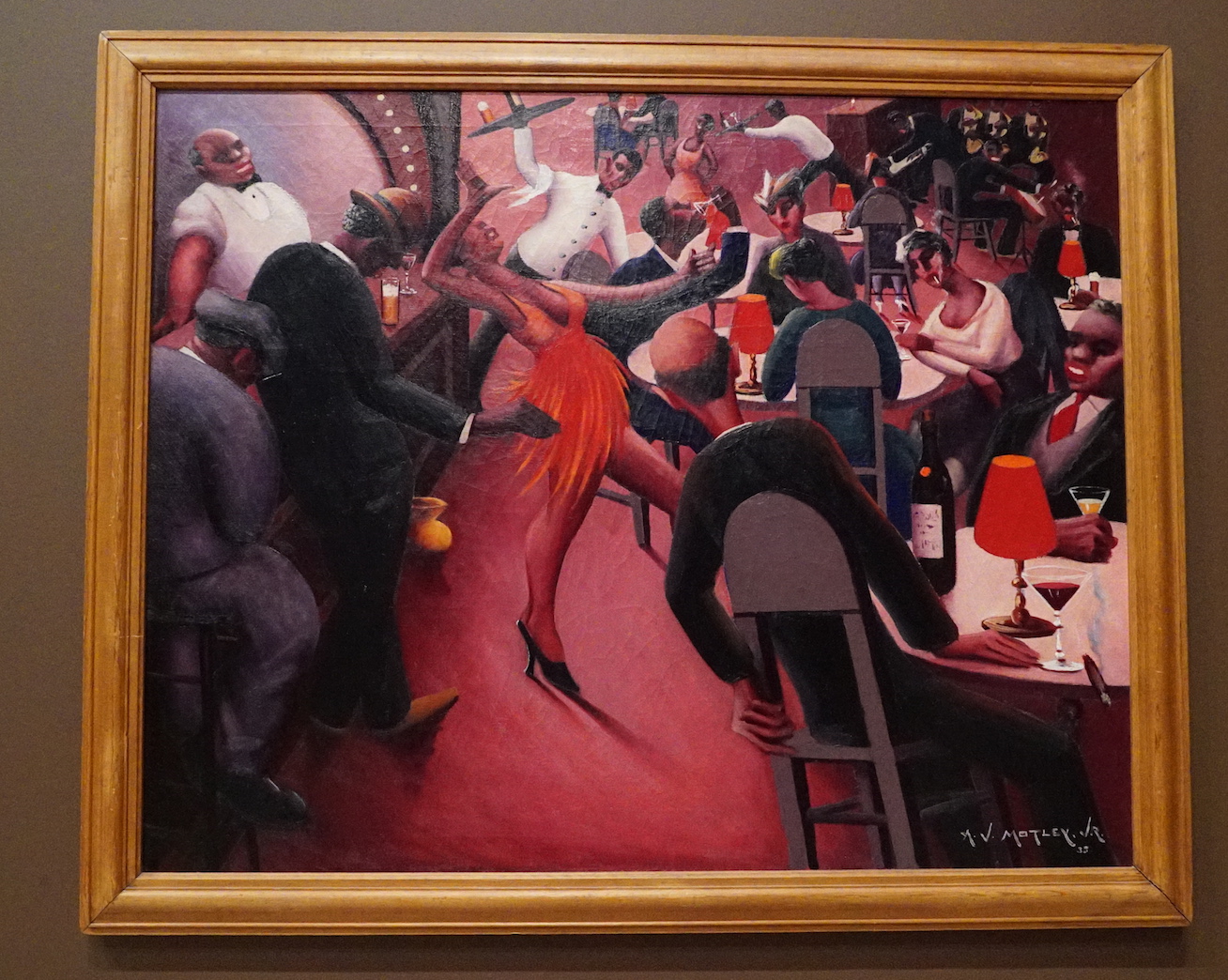
We went back to the Whitney in October to see two new shows, a Frank Stella retrospective and an Archibald Motley retrospective.   My opinion of the building remains the same.   The Stella was definitely stimulating; I loved some of it, and hated other parts.   The curators have taken an interesting approach; rather than follow a straight chronological narrative, they have mixed thing up.  What you get is that Stella clearly loves abstract painting; from his pioneering minimalist canvases to his later outlandish, three dimensional mishmashes, it's all about painting.   (It's interesting to read some of the critical takes on this show; Stella is sometimes taken to task for ignoring any ideological or sociological aspects of contemporary art.)  It is confusing, however to see both wonderful and terrible works by the same artist put next to each other.  My favorites were the three dimensional works that used metal and color in very dynamic ways.


This is two Stellas:


The Archibald Motley retrospective was fascinating.  A Chicago-based African-American painter; he was active from the 30's through to the 60's.  (Normally, I wouldn't mention any artist's ethnicity, but in this case, being African-American and painting African-American culture is what it is all about.)    I enjoyed this visual dynamism of the paintings, but I was less comfortable with Motley's deployment of African-American stereotypes.



In August we also saw the celebrated exhibit at the Met about the influence of China on costumes (at least I think that was what it was about).   I normally would have avoided it, but since one of my favorite film directors, Wong Kar-wai was involved, I thought I should check it out.

The horror!

Seriously, it was like being at an overdecorated high end shopping mall, with a constant assault to the eyes and ears.  The exhibit featured costumes, mirrors, and extravagant lighting, all techniques seemingly borrowed from fashion shows.  Music and film sound tracks were playing everywhere, overlapping.  I realized at a certain point I was simultaneously hearing a Morricone soundtrack and the soundtrack from Minnelli's "Ziegfeld Follies".   Tan Dun overlapped with Billie Holiday, and there was lots of ghastly new age sounding stuff.  The show featured a number of video screens playing classic Chinese films.  The beautiful Astor Court Chinese garden was flooded with water and  turned into a fashion display.

Needless to say, the show was a huge hit...


What's this, a Matisse?   No, it's a large scale illuminated reproduction:


The Astor Court, with water on the floor:


Visual overdose on mirrors; it looks like more fun than it was:


 What are these people doing here?


A Short Visit To Queens

Last summer I went to see a show by the artist Robert Seydel at the Queens Museum in Flushing Meadow Park.  This was the site of the 1964 Worlds Fair, which I remember going to.   But I haven't been back since; several of the monuments and buildings remain, including one which is now the Queens Museum (which was actually built for the 1939 World's Fair).

The Unisphere, which I last saw close up 50 years ago.


The park itself is mostly a flat, featureless space with some trees, a neglected part of the city park system.  But it is open green space.

One of the feature attractions of the museum is the giant scale model of New York City, which theoretically includes every building in all 5 boroughs.  It is quite amazing, though not all the lighting was working the day I was there.  Strangely, all of lower Manhattan and part of Brooklyn was in the dark...


We live in one of those buildings..


Midtown:


A transparent floor allows you to hover directly over Queens:


Elsewhere in the museum there is also a large relief map of the NY watershed:


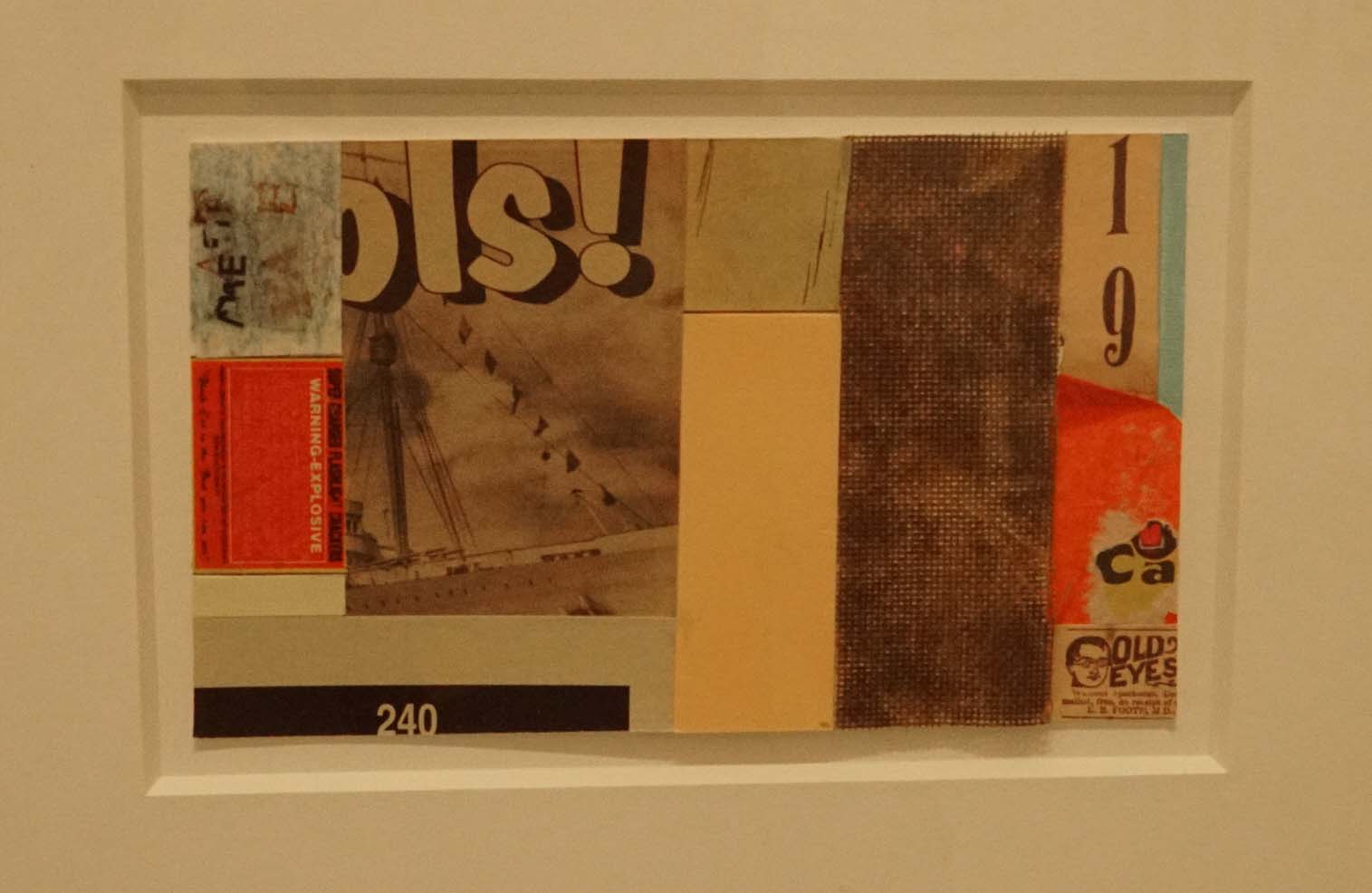
The show of works by Robert Seydel was interesting.  The works were primarily collages, working in the mode of Schwitters and evoking the worlds of Joseph Cornell.   He created a whole sort of fictional world with characters who lived in Queens.  He also created books with written texts along with collages.


Then it was back to Manhattan on the 7 train.

Saturday, 14 November 2015

More Music, More String Quartets

I went to Zankel Hall to hear the St. Lawrence String Quartet; the program was potentially a great one, featuring a Haydn quartet from the inventive Op. 20, Beethoven's late Op 131, and the New York premiere of a new quartet by John Adams.
The Adams work was confounding; the first movement takes two short phrases from Beethoven's Piano Sonata Op. 110, and develops a whole movement out them.  To begin with, it is fascinating.  We hear the very recognizable fragments repeated endlessly and subjected to all kinds of rhythmic and harmonic transformations.  Sometimes we are in a somewhat Beethovenian landscape, and other times we are in recognizable Adams territory, with gradually shifting and disjunct rhythms and clashing harmonies.  It builds to an energetic climax.  The second movement does very similar things with a vert small fragment from the Diabelli variations, starting slow and building up to a dense and energetic climax.  But at the end, I was thinking, so what was that all about?  Adams, to my ears, never really transcends the initial notion of using the Beethoven motives; the piece feels very uncomfortably in between the two worlds.  Is he channelling Beethoven?   Emulating him?  Commenting on him?  Who knows?   Maybe that's the point?

Or maybe the quartet's performance had something to do with it.   For the truth of the matter is that, starting from the opening Haydn quartet, I really didn't like the quartet's style of playing, which emphasized intensity over almost anything else.  There was little in the way of ensemble balance, phrasing, and sensitive interaction between the players.  The first violinist was consistently and flamboyantly louder than the other players, and the violist was played constantly without any sense of expression at all.  These tendencies really took a toll on the Beethoven; one of the great masterpieces of chamber music, it was pretty much slaughtered by the end, with ragged ensemble work and intonation messing up the whole thing.  Just because you play loud and fast doesn't mean that the music is more intense.  I was not happy.

We went to Juillard to hear Axiom, a student contemporary music ensemble, play pieces by Thomas Adès, George Benjamin, and Oliver Knussen  (AKA British prodigy composers of the 1980's).   The two Adès pieces were early ones; "Catch", and "The Origins of the Harp".   They were both inventive and compelling, particularly "The Origins of the Harp" (which has no harp in it; the title refers to a 19th century painting. )
The piece is something of a super clarinet concertino, with a solo clarinet and two supporting clarinets (of different sizes) having the main solo line.   The most exciting piece, though, was George Benjamin's "Three Inventions for Chamber Orchestra".  The dry title conceals the fact that these are extremely dramatic pieces.  The first begins with a kind of tone color melody which brought Webern's "Ricercar" to mind, and gradually adds contrapuntal complexity.   The last piece was almost Bergian in its expressive quality.  Benjamin works with complex and intricate musical ideas, but, at the same time, there is a clear sense of expression, and he always creates unique and special tone colors.  In this case, a euphonium solo and two sets of gongs, stage left and stage right were among the sonic highlights.  (We heard a lot of George Benjamin last summer at the Mostly Mozart Festival.  I am trying to write something about what we heard.  He is probably my favorite contemporary composer right now.)

My faith in string quartets was restored by hearing a performance by the Michelangelo Quartet.   This quartet features violinists from Romania and Russia, a cellist from Sweden, and a violist from Japan.   (What language do they speak in rehearsals?)  Like every other quartet concert I have heard lately, they opened with a Haydn quartet, in this case the very late Op. 77, # 1.   The performance was excellent, and the adagio sounded almost Schubertian at times.   The concert closed with magnificent performance of Beethoven's Op. 59, #2.  The slow movement was as sublimely beautiful as anything I have heard in years.   The quartet played with great subtlety in timbre and phrasing, and wonderfully judicious use of vibrato.   In between was Shostakovich's Quartet #3.  I am woefully ignorant of Shostakovich's music, having come of age in the musical era was Shostakovich was distinctly out of fashion, so I can't say too much.   But my first impressions are not favorable.  His mode of expression does not sit well with me; the alternations of ironic, sardonic, and pathetic or whatever don't work to my ears.    But I will reserve judgement until I hear more.

Sunday, 8 November 2015

Arnie Hits the Big Time: Schoenberg's "Erwartung" in Times Square

There it was; in the catalog listing works being performed in the 2015 biennial of Performa, a interdisciplinary/performance art organization:

"Robin Rhode performs Austrian composer Arnold Schönberg's atonal opera Erwartung (Expectation), transforming it to reflect the experiences of women who have been separated interminably from their husbands by the migrant labor system, political exile, activism and/or imprisonment."

The performance was to be done in the middle of Times Square at 5:00 PM. The whole idea seemed so impossibly far-fetched that, of course, we had to go see it.   How in the world could you do ""Erwartung", one of Schoenberg's quintessential expressionist works, written for large orchestra and soprano solo, in the middle of Times Square?
Well, they did it.   There was an orchestra (reduced and amplified), and an excellent soprano.   It fact, it was a fairly straightforward production; luckily the artist Robin Rhode, who was listed as "performing" and "transforming" the piece did very little of that.
The production was well done; and they even handed out a glossy large type booklet with the libretto and an English translation (not the normal thing that gets handed out to you in Times Square).   But, needless to say, hearing and seeing this in the middle of Times Square is a totally strange experience.  (Though I can hardly imagine how strange it might have seemed to the average denizen of Times Square.)   To begin with, the amplification was uneven, so that some instruments sounded loud and clear, while others were inaudible.  And of course the low roar in the background was always there.   The lighting effects created by all the huge illuminated sounds, though, were extraordinary; and the juxtaposition of all the advertising language (Revlon "Love Is On") with the woman protagonist hallucinating made for some very strange contrasts.   But simply the effect of seeing this dense Expressionist musical work that is over a hundred years old performed in the sensory maelstrom that is contemporary Times Square is something I will long remember; a kind of strange cultural dissonance in which the two elements resonated in the best possible way.  It certainly made you think differently about the Schoenberg.

Photos:
(The costumes were apparently based on Schoenberg's own sketches; I have no way of knowing whether this is true.)

The setting, staged in the round, with the orchestra on the left:


Singer, audience, signs:


Singer, arms, Police Dept.:


Suddenly, the lighting was pink:


There was a mute actor playing the part of the missing lover:


 Singer with the orchestra in the background:


While we were in Times Square, I wandered and took a few photos.  The general chaos of pedestrians, stores, and lighting was increased by a large amount of construction in the middle of it all.   I am always intrigued by the odd things that are left around, all of them transformed by the strange light effects:


Erwartung was not the only music being performed:


Do these endless souvenir stores ever sell anything?