Sunday, 24 September 2017

Vienna Art Museums

We did the full round of Viennese art museums.  That's a lot of art to look at, and I have to say that by the end I was oversaturated with art.  We began with Vienna Kunsthistorisches Museum, one of the world's great art museums.   I was also curious to see it after seeing Jem Cohen's wonderful film "Museum Hours".  The film is about a guard there and his relationship with a Canadian woman, but it's also about the museum itself and how people look at the art.  The building itself, constructed by the Hapsburgs to be an art museum for their collections, is so elaborately decorated that it seems to want to compete with the art itself.


They really love their marble:


The collection is somewhat limited in its range, compared to some other encyclopedic museums; there is little in the way of Italian pre-renaissance art, for example.   And there are virtually no works by Austrian painters; it's mostly what the Hapsburgs collected.  Though I can't think of any Austrian painters before 1870.   One of the highlights is a room full of Breugels; they are truly wonderful seen in person.  Other highlights include some late Velasquez works, and Vermeer's "The Art of Painting".   And much, much more.


I had expected the museum to be quite crowded, especially during the height of the tourist season.   But it was very quiet, and even empty in some spots.   And there are those wonderful couches, a balm to exhausted museum goers.


Vienna's most famous native painter is Gustav Klimt, and Vienna makes sure that you know it.   He is everywhere.  There is even this:


We visited the Belvedere Museum, which has a wonderful collection of Klimts, including the world famous "The Kiss", which has almost achieved the iconic status of the Mona Lisa and the like.   It's behind bulletproof glass, and there is even a separate room where they have a full size reproduction that can be used for taking selfies.


Beyond all the hype, though, the Klimts are wonderful to look at, and it is nice to be able to see the details which get lost in book size reproductions:


The Belvedere Museum is in yet another spectacular Hapsburg palace.   It has some elaborate trompe l'oeil ceilings, which when photographed become even more confusing.


The applied arts museum (MAK) has the original sketches for Klimt's Beethoven Frieze.  Some details:


The museum of applied arts is yet another lavishly decorated Vienna museum building.


And amazing stained glass windows:


In both the Belvedere Museum and the Leopold Museum there are many paintings by Vienna's other iconic painter, Egon Schiele.   Mostly what we see of Schiele's work in North America is his graphic and expressionistic nudes and self-portraits (at the Neue Galerie in New York).   While Schiele's work certainly still evokes a tormented soul, in Vienna there is a great deal more of his landscapes and other works, which to my mind, show Schiele as a painter with a much greater range of expression than I had previously thought.


Detail from above:


I also visited a smaller museum, attached to a church (I have forgotten the name) which had a collection of medieval paintings.   No photos were allowed in the museum, but when I opened a closed door which said something like "Natural Specimens" on it, this is what I saw:


There are many, many other museums that we did not see.  Vienna has an extraordinary number of museums of all kinds that I suspect would be fascinating to see.   Next time!


Vienna


The third part of our Central European trip was a week in Vienna.   We rented an apartment in the inner city.  The inner city is a delightful maze of narrow streets, pedestrian zones, and large squares.   Like the transition from Bucharest to Budapest, the difference from Budapest was striking; we were now in the heart of modern Europe.   Vienna is traditionally ranked as one of the best places to live in the world.  It is indeed a very civilized place, where the consumer has infinite choices, and the public transport and cultural amenities are first class.   Like Paris, Vienna seems to have an infinite number of small shops catering to refined tastes (this includes bookshops as well as jewelry stores), shops that would not exist in the cutthroat real estate environments of places like New York and Vancouver.  
Vienna, of course, is filled with history, given its place at the center of the Hapsburg empire. It is filled with huge grandiose buildings and monumental squares, most of which I find unappealing, other than the fact that they often allow for open space in the city.  A lot of the grand buildings are covered with endless baroque decorations which become tiresome very quickly.  Pomposity reigns.  The Hapsburgs did not lack for either the money or the will to create monuments to themselves and their empire.  The most interesting areas to walk in are the narrow streets in the older part of the city, where something unexpected is always lurking around the corner.   It's also worth noting that large parts of Vienna were destroyed by bombing in WW2, and often what you see is either a reconstruction, or, in some cases, a new, bland modern construction.

But Vienna is indeed saturated with European culture, both with classical music and with art museums. and we took full advantage of both during our stay there.   We went to the Vienna Opera twice.   It was my first experience in the fabled Vienna Opera House, which was rebuilt after the war.  The first thing you notice, besides all the ornate hallways and corridors, is that the actual auditorium is small.  The seating capacity is 1,709 people, plus about 500 standing places.   Compare that to the Metropolitan Opera House, which is about 4,000.   So hearing and seeing an opera in Vienna is a much more immediate and intimate experience.   If only our North American opera houses were that size!   We heard Mussorgsky's "Khovanshchina", which is a long and fascinating opera about the troubles of the Russian people in the 17th century.  The singers and the orchestra were fabulous, and there was a chorus of some 150 people which made an impressive sound in the small hall.   The production was rather strange, in that all the people on stage came and went via elevators,  and spent their time on the stage in various configurations resembling cages and platforms.  (Well, we were in Europe after all.)  I got the point that people were constrained as prisoners; but after four hours you want to see the singers move around a bit!  When they sing passionate  duets from adjacent platforms, it somehow doesn't work.    We also saw Strauss's "Salome", which was to have been conducted by Yannick Nézet-Séguin, but he bailed out with a doctor's note.  I have to confess that I don't like Salome, or much of Strauss for that matter, but I was willing to give it a chance since I hadn't heard it for a very long time.   The orchestra was brilliant, but I still find the libretto somewhat ridiculous and the orchestral score vastly overwritten.  Though perhaps with Yannick conducting it might have been different.
More exciting for me (and Vera) was a performance of Mahler's 6th symphony by the Vienna Philharmonic under Daniel Harding.  The orchestra, while a bit ragged at times, was absolutely amazing, and it is the first time that I have heard some of the special sounds like the offstage cowbells come off perfectly.  And some of Mahler's evocations of popular music sounded more idiomatic in this performance.    Harding was excellent, and to my ears, this was the first performance that made the very long last movement's shape sound clearly.  (I usually get lost somewhere in the middle of this movement.)   We heard the orchestra not in its traditional home, the Musikverein, but in the Vienna Konzerthaus.  The auditorium, which seats about 1,700, has great acoustics.   Vera had nothing but superlatives to offer, as well.   
We also heard another concert (in a smaller hall in the Konzerthaus) by the venerable Viennese new music group Klangforum Wien.   This sold out concert featured four works with an astounding array of percussion and a large ensemble.   Pieces played were Schoenberg's "film music" score, an early film score by B.A Zimmerman, a very theatrical work by Unsik Chin, and an indisputably strange piece by Kagel.   The performances were first rate, and the packed crowd was very enthusiastic.   I felt like I was on a different planet than the one I customarily live on, one where contemporary music is a vital, living part of the culture.   (And, needless to say, generously supported by the government and other entities.)  

Vienna, of course, is proud of its musical history, and there are endless plaques on the buildings, marking every single place that Beethoven, Mozart, or Schubert ever sneezed.  When I first visited Vienna many, many years ago, I was annoyed that Vienna seemed to be living in its past glory.  Now, though, it pays more attention to the contemporary.  There is no better example than the Arnold Schoenberg Center, which is probably the best possible resource devoted to any composer in the world.  It hosts exhibits, concerts, and forums, and has a library and a store where you can buy scores and recordings.   We visited and saw an interesting exhibit of photographs. And where else can you pick up your Arnold Schoenberg refrigerator magnets?

There are also many museums or houses dedicated to the classic Viennese composers.   I went to Haydn's house, which is slightly removed from the center, and which has stayed more or less as it was. (That's not the case for almost all of the places associated with Beethoven and Mozart.)   It was the last place he lived before he died.   There is not much of anything left from his time in the interior, but I did learn that he decorated his sleeping quarters with manuscripts of canons that he had written.

The interior courtyard:


Curiously, there was some furniture that belonged to Brahms.  Well, I suppose you have to put it somewhere.  The ladder did not belong to Brahms.


Saturday, 23 September 2017

Budapest Art Museums

Unfortunately, two of the main art museums in Budapest, the Fine Arts Museum and the Applied Arts Museum, were closed for restoration while we were there.   (As was Budapest's famous opera house.)  But it's nice to know they are being restored.    We visited the Hungarian National Gallery, though.  (Why do so many countries segregate their own art from art of other countries in their museums?  I don't know.)   As always with national museums in smaller countries, one sees paintings that look very similar to the more famous ones in larger countries with a bigger claim on the art history narrative.   But what impressed me in Hungary's National Gallery was the number of excellent paintings I saw by painters I had never heard of (because they were from Hungary?).   Reflecting on that and reading about these painters, I realized that I had tended to underrate the role of Hungarian culture in Europe.  Certainly Hungary was part of the mainstream of European culture both before and after World War 1, with artists fully participating in all the extraordinary changes happening during that period.   But perhaps because of the post World War 2 isolation behind the Iron Curtain, Hungary somehow slipped out of the mainstream, and became a smaller, "other" country.    I wonder if MOMA in New York has any paintings by Hungarian painters on display (besides the obvious emigres like Moholy-Nagy).  In any case, I saw many interesting works created during the pre World War 2 period.

Here are a few paintings that interested me:


The above painting had some interesting notes.   "Constructive surrealist thematic"...


Notes for the above:


Another Bela Uitz:


More examples:


The museum also has an amazing collection of Late Gothic winged altarpieces.  Some of them are really flamboyant.   Gold and color abound.


Monday, 18 September 2017

Budapest Synagogues and Churches

Budapest has the largest synagogue in Europe, as well as many other synagogues and churches.   The ones we visited were quite extravagant in their decoration.

This is the Great Synagogue, the largest in Europe.  It was built in the 1850's, and shows the relative prosperity of the Jewish community in Budapest at that time.


Yes, this is an organ:


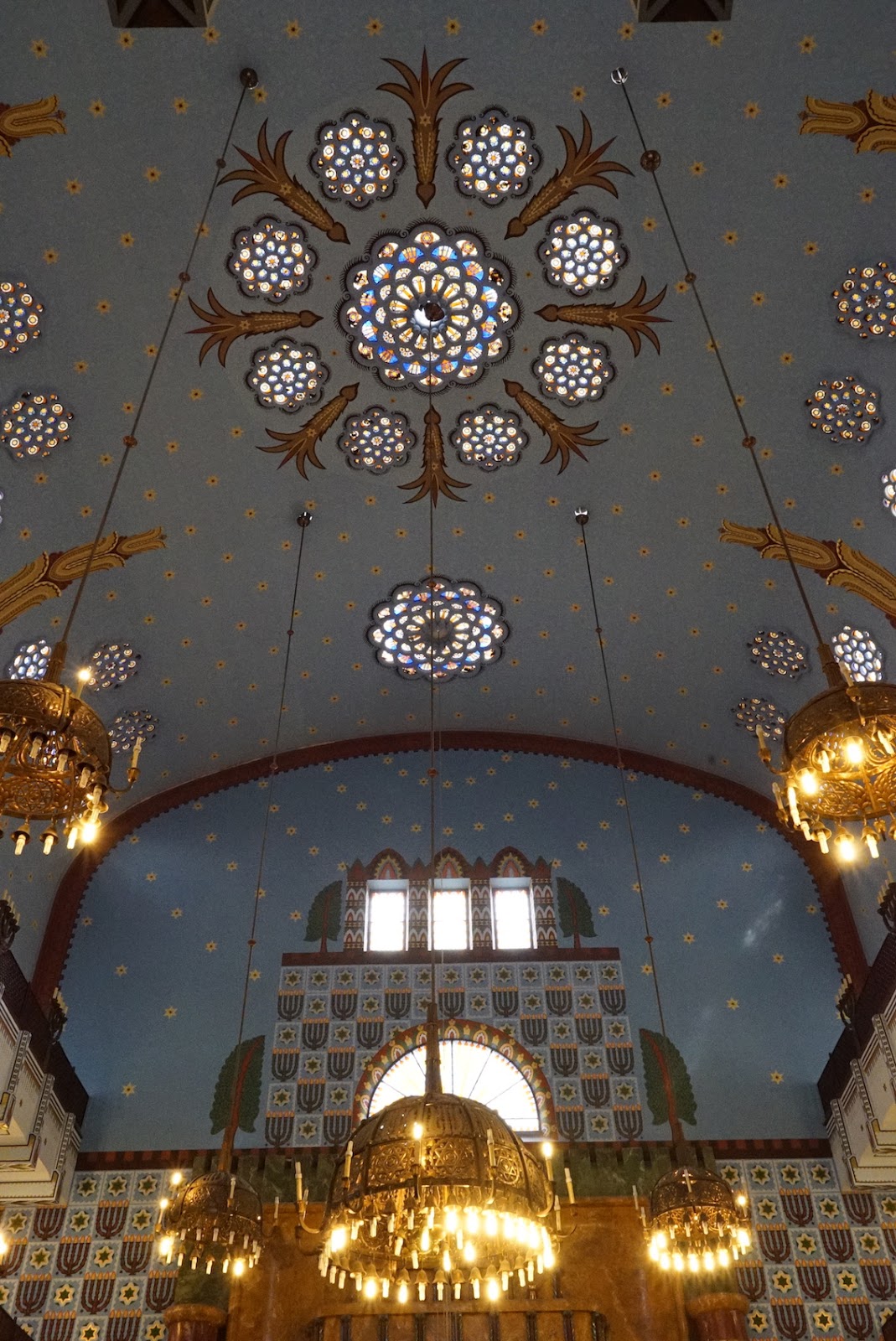
There was also a smaller, Orthodox synagogue built nearby around 1911, which was quite startling in its use of contemporary arts.  When you enter an Orthodox synagogue, you don't really expect to see some kind of Art Nouveau fantasia!


And there is the Matthias Church in the Buda Castle district.   Originally a late Gothic church, the church has been restored and redone a number of times.   Like many Italian churches, it is some sort of mash-up.   Inside, the decorations are extensive; no bare gothic stone walls for this church.


Ceiling:


The ceiling of a side chapel:


Wow!