Sunday, 8 February 2015

Cubism, Janacek, Chimay

We went to see the Cubism show at the Metropolitan Museum.   Actually, I have never been that fond of Cubism, but the show is certainly interesting, with its focus on the cubist work of Braque and Picasso, and the subsequent cubist influenced work by Juan Gris and Leger.   Cubism has always felt too pedantic to me, more about exploring the nature of painting than actually creating works of art.  And I get tired of brown and black and white.  I suppose one can train oneself to recognize which line represents a violin and which line represents cafe glass; but I have to work hard to see them myself.   The show demonstrates Braque's roots in Cezanne's landscapes, and Picasso's roots in almost everything, but especially African art.  Nonetheless, the work is still fascinating to look at, as you see notions of representation being confounded and uprooted.   But it seems that for both Picasso and Braque, Cubism was kind of a dead end; their subsequent work went in mostly different directions.

Braque does Cezanne:
Picasso does Africa:


One Picasso and one Braque; which is which?


I'm not telling..


After the Cubism show, we had a light snack in the American Court, and then went to a concert at the museum's auditorium.  The Attaca Quartet was performing Janacek's two string quartets.  I have loved these two pieces for a long time, but have never heard them live.  The Attaca Quartet's performances were superb, a combination of precision and passion that brought out all the amazing things that happen in these quartets.  Janacek wrote both quartets in his 70's; they sound like the work of an inspired young composer, and are musically unique, to my ears.  He uses short melodic fragments, but rather than develop them, he constantly recombines them in ways that are audacious, both harmonically and rhythmically.  
The quartets were supposedly inspired by Janacek's passionate (but platonic) love for a young married woman.   The Attaca Quartet, playing the accessibility card, attempted to illustrate that connection by reading excerpts from the Jancek's letters while playing short bits of the music.  (I think Vera shuddered quietly.)   I was grateful to be told that Janacek was "just a dude", and not a dirty old man.
Despite the pre-performance talk, I have nothing but praise for the Attaca Quartet; these were immensely committed performances, and they aced all the numerous technical difficulties. It was very moving.


After our double feature at the museum, we went to a Belgian restaurant on the Upper West Side and had a late dinner, lubricated by a very tasty draft Chimay ale from Belgium, and then walked home on a cold and blustery night.


Thursday, 5 February 2015

The Lower East Side

One of my favorite places for walking these days is the Lower East Side.  What I like is the wonderful mix of things.  You find evidence of the past in the old buildings and the remnants of when the area was the center of New York Jewish life, and of all the other immigrant cultures that have passed through.  And now you see contemporary manifestations of nightlife, art galleries, high end restaurants, as well as social housing, wholesale clothing stores, and restaurant equipment dealers.  There is the touristic "Little Italy", which exists more as a tourist destination than anything else; and, of course, the ever expanding Chinatown.   I took a few pictures:

(As always, click to enlarge photos)

Here is the former Kletzer Brotherly Aid Association, set up to help newly immigrated Jews from Kletz, Poland.  It is now a Chinese funeral home, but still has the original name on the facade:


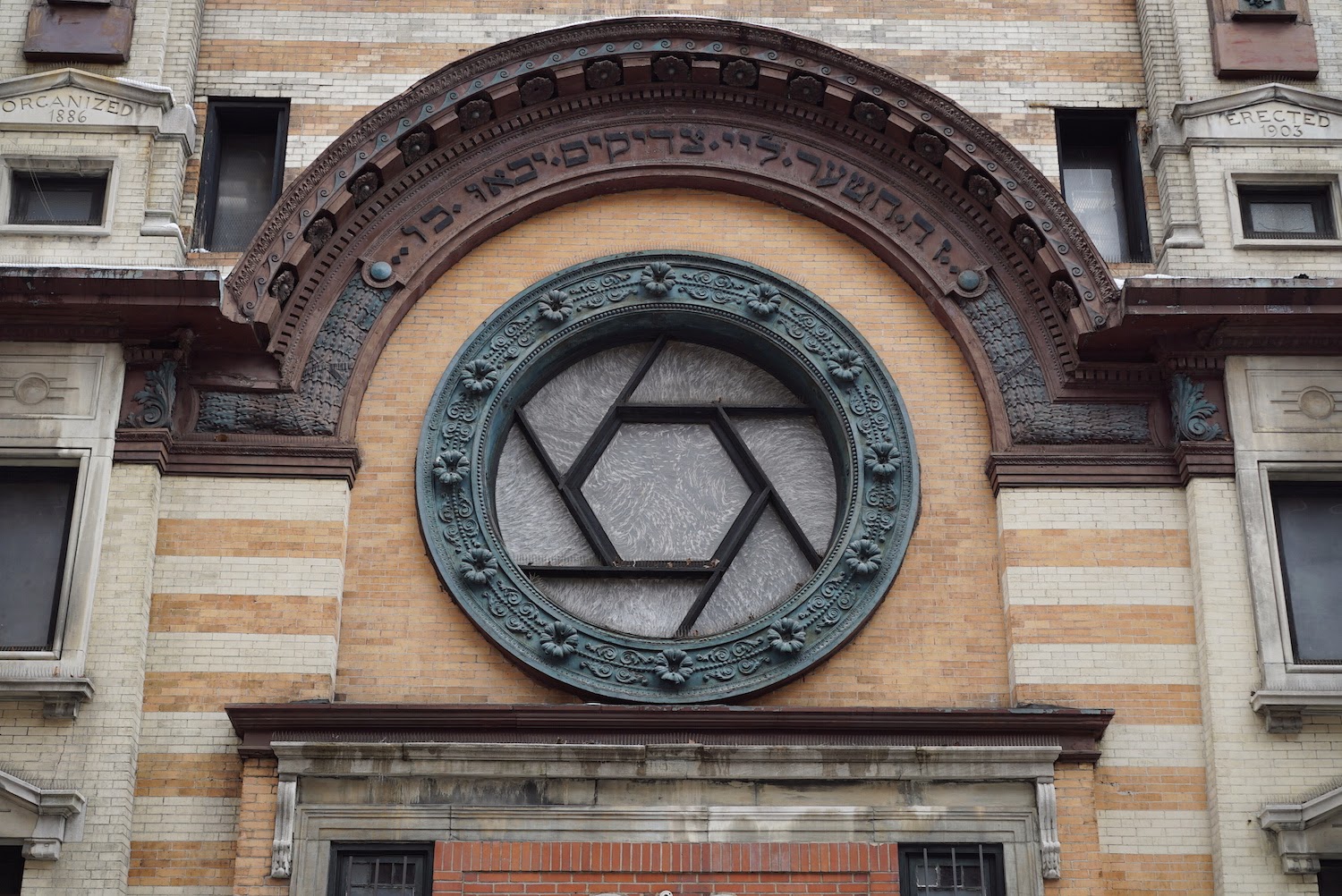
A beautiful synagogue facade:


And its peculiar side door:


A Ukrainian Orthodox church:


The Bowery Savings Bank, designed to impress:

Self-portrait with peculiar undergarments:


A primary school gets primary colors, as Jean-Luc Godard would have painted them back in the day:


Always something to see!


On a previous walk, I saw the new Fulton Street subway station, with its geometric ceiling:


It certainly doesn't look like your normal subway station in New York.

But this is what it does:


Calatrava's giant prehistoric beast continues to grow; maybe some day it will be an actual station:


Here it is reflected in a window:


A nearby colorful facade, newly restored:


More Balanchine

Readers of this blog will know of my fondness for the work of George Balanchine.   We went to hear and see a program of three pieces at the New York City Ballet.   The first, "Donizetti Variations", was designed by Balanchine as a kind of opening divertissement, set to some fairly generic ballet music from Donizetti's last opera.   But with Balanchine, there are always pleasures to be found, even with mediocre music.  Some of the subtleties of how he contrasts movement with music were exciting; there were some three part canons in the dance happening while the music was chugging along in some routine fashion.  Even the way Balanchine arranges his ensembles is endlessly inventive; in this case, the permutational possibilities of  corps of three men and six women (and two soloists) made for always unexpected groupings.  There is even a bit of slapstick humor when one of the dancers pretend to hurt her foot.
The last piece on the program "Chaconne", was set to Gluck's music from Orpheus and Eurydice.   It has a peculiar shape; it begins with a breathtaking duet, Orpheus and Eurydice seemingly in the underworld, one of the most extraordinary things I have ever seen; after that, there is a long series of celebratory numbers from Gluck's ballet music for the last act.  It's the Orpheus story with the happy ending.    The structure is both unexpected and borderline incoherent.
The highlight of the evening was a piece set to Ravel's "La Valse" and other Ravel waltzes.  Vera really loved it.  It was much more dramatic than the other pieces; death makes an appearance.  There are  some very striking movements for the arms; and eventually the piece climaxes in frenzy of waltzing.   I usually don't think about the costumes; but in this case, they contributed a lot to the ballet; skirts that somehow changed colors with the movement.


So why do I like Balanchine so much?   There is something about the way he matches movement to music which speaks to me.  When I am fully engaged (and the dancers are), I experience the music and the movement as somehow being a single manifestation; escaping the reality that watching bodies move and hearing music in fact two very different kinds of experience, one involving the eyes and the other the ears.  

Sunday, 1 February 2015

Alexander Nevsky

We heard the Chicago Symphony this afternoon perform Prokofiev's Cantata "Alexander Nevsky", conducted by Ricardo Muti.  It was thrilling.   The music was arranged by Prokofiev from his score for the film "Alexander Nevsky", made with Sergei Eisenstein in 1938.  The music, which Andre Previn once characterized as the greatest film score ever trapped in the worst recording of a film score in history, was composed in close collaboration with Eisenstein as the film was being made.  The strange thing about the score is that it was made at the height of Stalin's purges, when paranoia was rampant, and both Prokofiev and Eisenstein were certainly in danger of being exiled to Siberia or worse.  The plot is a simple one about a great Russian hero, Alexander Nevsky (i.e.Stalin), who leads the Russians to grand victorious battle against the evil Germanic invaders.   In spite of this pressure, both Eisenstein and Prokofiev were interested in the theoretical concepts of the relationship between music and moving image.  Eisenstein wrote an extended and mostly incomprehensible essay about their work.   And apparently, when the film was almost finished and the score wasn't properly recorded, Stalin requested a viewing and pronounced it excellent, and after that, nothing could be changed. For example, one of Prokofiev's experiments was to record the brass close up and distorted, so as to simulate how horrible and harsh the Germans were.   A number of years ago, the score was rerecorded in modern sound and synced with the film and its original dialogue and released on laser disc, but for some reason this version has never shown up on DVD.

I have taught this score many times when I was teaching a film music course, but I have never heard it live.  Hearing the inventive details of the dissonant orchestrations played by the Chicago Symphony was ear opening; this is really amazing music.  And the famous Battle On the Ice was truly spectacular, with the famous Chicago brass section rattling the rafters in Carnegie Hall.   I don't know why this isn't a regular repertory showpiece; with a true crowd pleasing and rousing finale with great choral writing.   Perhaps because it is, after all, a paean to Russian heroism.     And, of course, after the Stalin pact with Hitler, it suddenly became "unfashionable", and later international audiences were not necessarily predisposed towards celebrations of Stalin.

The hero:


Imaginary instruments, designed by Eisenstein, which inspired Prokofiev:


Eisenstein's analytical chart of music and images in the opening of the Battle on the Ice:


Evil German soldiers:


Decadent German, with suspicious insignia on the hat:


Battle formations:

Eisenstein:


The concert began with Scriabin's "Symphony No 1",  50 minutes long, with a final movement with vocal soloists and chorus.   To my ears, aside from a few interesting harmonic clashes, this was largely generic late romantic music, wandering from one beautifully sounding moment to another, with little sense of direction, and largely devoid of memorable themes or ongoing sense of movement.  It in fact reminded me of some of the neo-romantic symphonies one hears composers write today in an attempt to please some audience which wants that kind of thing.   I don't really understand why Muti would be interested in that music.   But, needless to say, the orchestra sounded wonderful.


Sunday, 25 January 2015

Art Exhibits Around Town

We are gradually catching up on all the art shows in town.

We saw the Matisse cutouts show at MOMA.  One can't help but be entranced by all the inventiveness of Matisses's late career work; all the exuberance of the colors and shapes are wonderful.  He takes what is basically a limited repertoire of shapes and colors, and subjects them to all kinds of permutations.    But it is, in essence, decorative art, and there is a little churlish part of me that wants to complain about that.   And it would have been interesting to see a little more context in connection with Matisse's previous work.  (At one point Matisse himself quotes his famous early work featuring dancers.)

The Schiele portrait show at the Neue Galerie was fascinating, in that it showed some sides of Schiele that I hadn't seen before.   While I am quite familiar with the expressionist, morbid work; I hadn't seen some of the drawings he made for his patrons, which are considerably more traditional.  It seems that he adjusted his style, depending on who he was drawing.   In fact, he had a small number of committed patrons who commissioned him for portraits.   What also comes across is the sheer artistic talent, the guy could really draw.

There was a wonderful portrait of Schoenberg:


As well as one of Webern:


The Metropolitan Museum has redone its galleries featuring art from 1900-1950.
They have followed the model of the Tate Modern in arranging things thematically, rather than the traditional standard groupings by various "isms".   In addition, they mix together some relatively unknown American painters with the better known European ones, which makes for some interesting juxtapositions.  And photographs are in the mix as well.   The thematic notions are, as is to be expected, a bit forced at times, but they can be ignored and you can make up your own associations.   The relatively empty (of people) galleries make for a nice, contemplative atmosphere, and I enjoyed my time there.


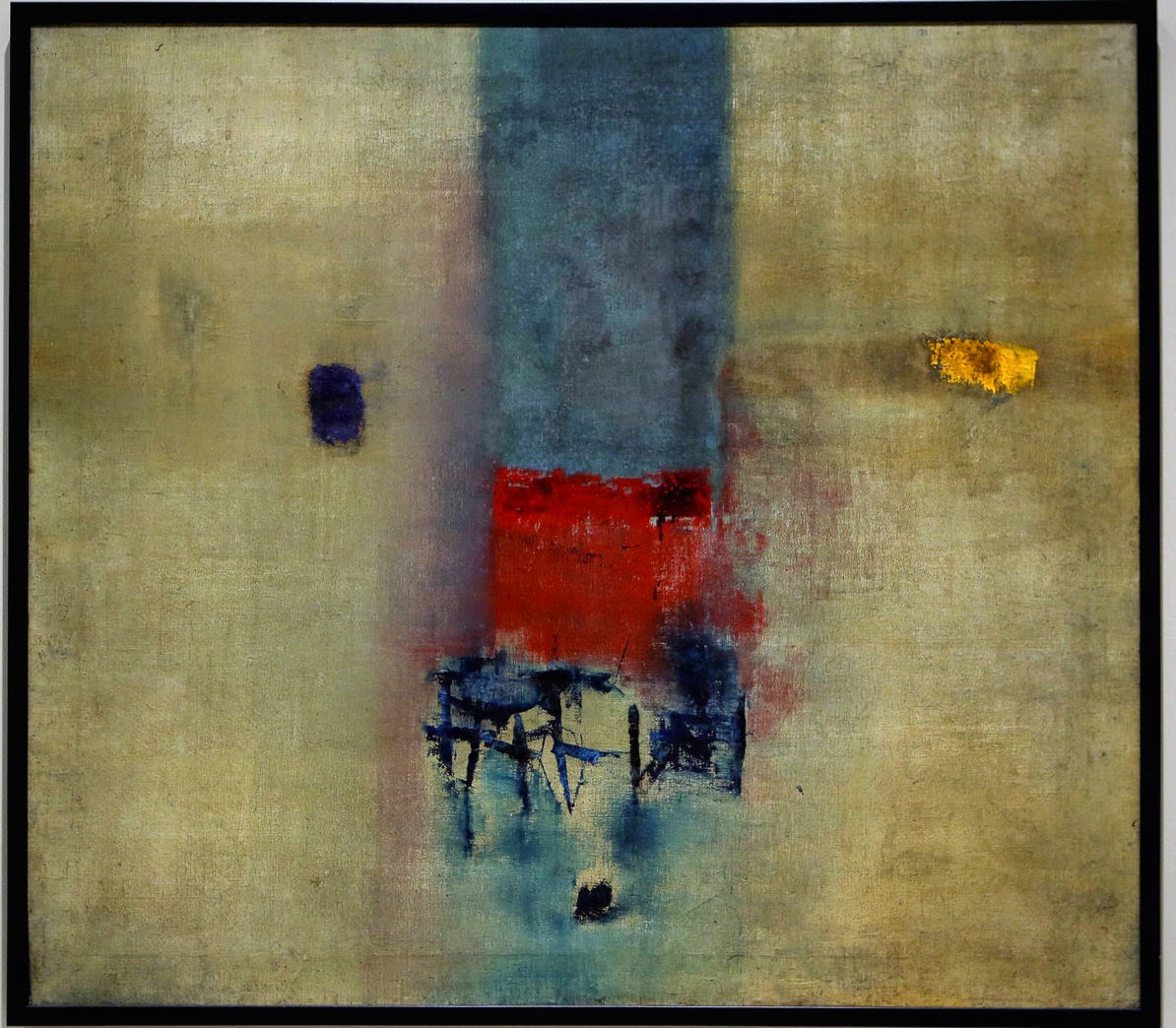
Another fascinating exhibit was one featuring the paintings of V. S. Gaitonde at the Guggenheim.   Gaitonde was an Indian abstract painter who died in 2001.   Looking at the paintings without knowing anything about the artist, I would be hard pressed to say where he was from; there is nothing "Indian" about them, at first glance.     This thought brings to mind the extended discussions in Stoppard's "Indian Ink" about being an "Indian" painter, and should an Indian artist paint like a European or an Indian (whatever that might mean).  And,  in fact, the son of the Indian artist in the play is also a artist, who paints abstract paintings, much to the disappointment of the elderly Englishwoman he is conversing with.   In any case, the paintings are absolutely mesmerizing; Gaitonde apparently worked slowly, applying a number of innovative techniques to his work.

Photos, which don't do any justice to the luminescent quality of the paintings:


Monday, 19 January 2015

Roosevelt Island

It was a sunny October day, and I went to Roosevelt Island, located in the middle of New York's East River, to see the Louis Kahn designed Roosevelt (FDR) Memorial. It was also a nostalgic trip for me, since we lived on Roosevelt Island in the 1980's, and I hadn't been there for quite some time.   The memorial was designed by Kahn in the 1970's for the southern tip of Roosevelt Island, and, given the slow pace of getting these kinds of things done in New York, was only completed a few years ago.

The memorial is nicely done, with straightforward lines,  culminating in a view to the river at the extreme southern point of the island.
 
(That almost looks like a statue of a man, but it is not..)

Looking north to the Queensboro Bridge (with French style rows of trees):


Manhattan seen from the memorial (you can't see the river):


The view towards the point:


Parts of the island are still in a wild, natural state, which makes a very nice juxtaposition with Manhattan being close by:


And tugboats and barges go by:


And there are even Gothic ruins:


Other parts of the island are residential, with high rise condo developments, green grass, parks, etc.,  far removed from the hectic and noisy streets of Manhattan.  It seemed familiar to me; suddenly, I realized it looked just like Vancouver!    But instead of mountains, you see this:


And you get to see what the Queensboro bridge looks like from underneath:


Madame Cezanne

There is a great show at the Met of paintings and drawings that Cezanne made of his wife.  
When we think of Cezanne, of course, we don't think of psychologically revealing portraits, and we certainly don't get that with his pictures of his wife.   Someone once said that he was more interested in her dresses than her face.  She was simply a subject for him, like a still life, I think.   The most striking part of the show is the row of four full size paintings he made of her in the same red dress.   (Apparently Cezanne once said, "Only I know how to do reds".)  

Here are they are:


Seeing all of the works together is a strange experience; in fact, her face looks different in every picture, and only in the sketches and drawings do we get a real sense of what she looked like.  We end up knowing very little about her.  

And I couldn't resist the fruit in the next room (detail of a watercolor):