Friday, 27 February 2015

The Alhambra!

We went to the Alhambra in Granada, and it was a thrilling experience.   The best part was the Nasrid Palace, a rambling series of exquisitely designed and decorated rooms dating from the 13th and 14th centuries.   The sheer inventiveness of the constantly varied patterns is overwhelming, and the notion of decorating the walls with such an excess of ornamentation is hard to comprehend.

I'll let the images speak for themselves:

Alhambra from a distance, with the Sierra Nevada in the background:


Interiors:


Details:


Debussy, Radeau, Preljocaj in Paris

We have been to three very different evening events.   The first was the Paris Opera production of Debussy's "Pelleas et Mellisande", in a production by Robert Wilson.   "Pelleas" has always been one of my favorite operas, and always something of an enigma for me.  Every time I hear it, I come away with a different idea of the opera. Our previous experience with Simon Rattle conducting the Metropolitan Opera orchestra was sublime; his sense of pacing and forward propulsion really made the opera come to life.   In this performance, all the performers and conducting were excellent.  I was very aware of how the opera moves musically, from one motive to another without any sense of forward harmonic rhythm.   The climatic moments in the last two acts were Wagnerian in their very brief intensity, but not in their length.
The production, by Robert Wilson, featured his trademark lighting and minimalist, stylized movements.   It didn't really work at all; I don't think "Pelleas" benefits from such a minimal style.  For example, in the scene where Melisande's hair is hanging out the window, and Pelleas reaches some sort of sexual ecstasy with her hair, Wilson has them 20 feet apart, on pedestals, which of course makes no sense.  You can of course justify such an approach easily, but really, "Pelleas" needs all the help it can get stage-wise to make it work dramatically.   And the poor singers who had to hold their hands and arms in very stylized ways for the whole opera, and not doing it in a very convincing way.   And the blue light virtually never changes.

These might look really cool as still images, but the actual movements were awkward and somewhat ridiculous.


We also went with our friends Michael and Pam to something called "le radeau" at a small theatre up in Belleville.   What it is is a kind of very French variety show, with a sequence of various acts, comedians, trained dogs, acrobats of sort, chansons, magic acts, etc.   The whole thing had a wonderful casual feeling about it, and some of the acts were really entertaining.  We had a great time.


Thanks to the recommendation of our friend Santa in Vancouver, we saw the Preljocaj Ballet in a piece called "Empty Words".  It was one of the best dance shows I have seen in years.   To begin with, the score is a recording that was made in Milan in the 1970's of John Cage reading a realization of his "Empty Words", which is a scheme for applying chance procedures to a text of Thoreau's.   What you get is 1 hour and 45 min. of Cage singing and mumbling syllables.  But what is interesting is that the performance caused a riot, as the 3,000 Italians present began shouting, making noise, and eventually mobbing the stage, while Cage continues as if nothing was happening.  All of this is on the recording.   This makes for a fascinating juxtaposition with the dance, which consists of four dancers who are onstage continually for the duration, and moving in constantly changing, intricate patterns involving all four dancers.  I have seldom been so impressed with such continuously inventive choreography; I was never bored.  And the dancers were truly extraordinary in the way they moved together.  I can't really fathom how they do it.   (Water bottles emerged twice as part of the choreography.)    The piece owes quite a bit to the Cage-Cunningham aesthetic.   It was interesting that the two young professional dancers with us (Maya T. and a friend) could not relate to the piece at all.   What does it all mean?  I don't really know, but I loved it.
A few web photos showing some of the few posed moments in the piece:


Tuesday, 24 February 2015

Paris Musee Guimet

I went to the Musee Guimet of Asian art in Paris, which I had never been before.   It's a huge collection; I couldn't possibly see it all in one day.   There was a special show of artifacts from the Han dynasty, from around 200 BC, serving to remind us that civilization was elsewhere besides in the west. It is always amazing to encounter objects that are more than 2,000 years old.
A few things I liked:

A jade burial suit; I'd prefer that to being mummies.


A series of bells, obviously tuned to different pitches.  I wanted to hear them!:


A dancing figure:


Elsewhere in the museum I was intrigued by some examples of Korean art, about which I know nothing.

These date from the 19th century:
The sign of the bear:


Decorative boxes:
 Screen paintings of a cabinet:


And a close up of a Japanese screen painting of books:


Tuesday, 17 February 2015

Contemporary Painting Dilemma

I saw the show of contemporary painting at MOMA entitled "Forever Now".   It seems that this is the first show of contemporary painting at MOMA in some 20 or 30 years, which is certainly indicative of the status of painting in certain territories in the world of contemporary art.  (I remember a Whitney Biennial from a few years ago where there was only one painting, which was accompanied by copious annotations to justify its existence.)   Like any group show, I found paintings I really liked, paintings I hated, and stuff that I was indifferent to. What is interesting is all the critical rhetoric surrounding the show, beginning from the curator's thesis, which, briefly summarized, is that painting exists in a world independent of the progression of art history, and that it freely borrows from and works in the context of many different eras.  In other words, it is not in the critical vanguard of today's art.  On the other hand, it is popular among galleries because it sells for more money than, say, conceptual art.
Reading various critical reactions to this exhibit online is quite entertaining.  While critics will generally agree that they like some stuff and not others; most of them engage in heated criticism of this or that aspect of the exhibit; they shouldn't have included this person, there are too many of these kinds of painters, how could they not have included this person, it's too safe, etc. etc. etc.   Checklists, counting the gender representation numbers, etc. etc. etc.  And, according to one critic, Jerry Saltz, at the opening of the show, there were actually dealers standing in front of their artist's paintings, taking orders.
But the criticism does bring up an interesting aspect of contemporary painting, about abstraction, and how it has become part of the world of high end art deals.   The best example would be Mark Rothko, who has now become the quintessential hedge fund magnate's trophy artist, with his paintings selling for many millions dollars, and hanging as decorative art on the walls of the penthouses of said magnates, and guaranteed not to offend anyone (assuming the colors blend with the interior decorator's choices).  The dilemma is that seeing Rothko's art is for many people, a deeply satisfying and spiritual experience.  (I will never forget the first time I saw all the assembled Rothkos in Washington's National Gallery, or the major Rothko retrospective some years back.)   And I would guess that Rothko would not be pleased to see his work become decorative art for the rich.   Another example would be Julie Mehretu, who creates compelling large scale abstract paintings that I like very much.   She was commissioned by Goldman Sachs to create a painting for their new office building; the public cannot see it. (Does her painting depict the greedy titans of wall street devouring the proletariat?   I doubt it.)   And now some critics refer to her art pejoratively as "decorative".   Is she a corporate lackey, or is she simply doing what artists have done over the years, responding to commissions to make a living?  How are we to judge?

In the beginning of the 20th century, abstraction was seen by the artists who created it as moving art to a higher, purer state, elevating art to a realm beyond the realistic portrait of objective things.   Now it as seen as a way of avoiding ideology and politics and ideas, thus second rate.    "Real" contemporary art engages with ideas about art, and cannot be decorative in any sense.  The worst thing that can happen to any artist is to be creating beautiful objects for rich people.

Well, critics cannot criticize Rothko because he is dead and in the pantheon, but newer artists who do such things have been described as creating "zombie abstraction", or "zombie formalism".

I'm going to quote the critic Jerry Saltz, from New York Magazine, to give the full flavor
this attitude.

Jerry Saltz:  Zombies on the Walls:

For the past 150 years, pretty consistently, art movements moved in thrilling but unmysterious ways. They’d build on the inventions of several extraordinary artists or constellations of artists, gain followings, become what we call a movement or a school, influence everything around them, and then become diluted as they were taken up by more and more derivative talents. Soon younger artists would rebel against them, and the movement would fade out. This happened with Impressionism, Postimpressionism, and Fauvism, and again with Abstract Expressionism after the 1950s. In every case, always, the most original work led the way.
Now something’s gone terribly awry with that artistic morphology. An inversion has occurred. In today’s greatly expanded art world and art market, artists making diluted art have the upper hand. A large swath of the art being made today is being driven by the market, and specifically by not very sophisticated speculator-collectors who prey on their wealthy friends and their friends’ wealthy friends, getting them to buy the same look-­alike art.
The artists themselves are only part of the problem here. Many of them are acting in good faith, making what they want to make and then selling it. But at least some of them are complicit, catering to a new breed of hungry, high-yield risk-averse buyers, eager to be part of a rapidly widening niche industry. The ersatz art in which they deal fundamentally looks the way other art looks. It’s colloquially been called Modest Abstraction, Neo-Modernism, M.F.A. Abstraction, and Crapstraction. (The gendered variants are Chickstraction and Dickstraction.) Rhonda Lieberman gets to the point with “Art of the One Percent” and “aestheticized loot.” I like Dropcloth Abstraction, and especially the term coined by the artist-critic Walter Robinson: Zombie Formalism.
Galleries everywhere are awash in these brand-name reductivist canvases, all more or less handsome, harmless, supposedly metacritical, and just “new” or “dangerous”-looking enough not to violate anyone’s sense of what “new” or “dangerous” really is, all of it impersonal, mimicking a set of preapproved influences. (It’s also a global presence: I saw scads of it in Berlin a few weeks back, and art fairs are inundated.) These artists are acting like industrious junior post­modernist worker bees, trying to crawl into the body of and imitate the good old days of abstraction, deploying visual signals of Suprematism, color-field painting, minimalism, post-minimalism, Italian Arte Povera, Japanese Mono-ha, process art, modified action painting, all gesturing toward guys like Polke, Richter, Warhol, Wool, Prince, Kippenberger, Albert Oehlen, Wade Guyton, Rudolf Stingel, Sergej Jensen, and Michael Krebber. I’ve photographed hundreds of examples this year, at galleries and art fairs, and a sampling appears on these pages.
 This work is decorator-friendly, especially in a contemporary apartment or house. It feels “cerebral” and looks hip in ways that flatter collectors even as it offers no insight into anything at all. It’s all done in haggard shades of pale, deployed in uninventive arrangements that ape digital media, or something homespun or dilapidated. Replete with self-conscious comments on art, recycling, sustainability, appropriation, processes of abstraction, or nature, all this painting employs a similar vocabulary of smudges, stains, spray paint, flecks, spills, splotches, almost-monochromatic fields, silk-screening, or stenciling. Edge-to-edge, geometric, or biomorphic composition is de rigueur, as are irregular grids, lattice and moirĂ© patterns, ovular shapes, and stripes, with maybe some collage. Many times, stretcher bars play a part. This is supposed to tell us, “See, I know I’m a painting—and I’m not glitzy like something from Takashi Murakami and Jeff Koons.” Much of this product is just painters playing scales, doing finger exercises, without the wit or the rapport that makes music. Instead, it’s visual Muzak, blending in.
Most Zombie Formalism arrives in a vertical format, tailor-made for instant digital distribution and viewing via jpeg on portable devices. It looks pretty much the same in person as it does on iPhone, iPad, Twitter, Tumblr, Pinterest, and Instagram. Collectors needn’t see shows of this work, since it offers so little visual or material resistance. It has little internal scale, and its graphic field is taken in at once. You see and get it fast, and then it doesn’t change. There are no complex structural presences to assimilate, few surprises, and no unique visual iconographies or incongruities to come to terms with. It’s frictionless, made for trade. Art as bitcoin.
Almost everyone who paints like this has come through art school. Thus the work harks back to the period these artists were taught to lionize, the supposedly purer days of the 1960s and 1970s, when their teachers’ views were being formed. Both teachers and students zero in on this one specific period; then only on one type of art of this period; then only on certain artists. It’s art-historical clear-­cutting, aesthetic monoculture with no aesthetic biodiversity. This is not painting but semantic painterbation—what an unctuous auction catalogue, in reference to one artist’s work, recently called “established postmodern praxis.”
Apologists offer convoluted defenses, saying that certain practitioners differ from all the others. Lucien Smith uses fire extinguishers to make his little drips; Dan Colen uses M&Ms for his; Adam McEwen deploys chewing gum; Parker Ito paints fields of hazy colored dots. There are many artists who make art that looks printed but is handmade; others make it look handmade when it’s printed. We’re told that a painting is made by cutting up other paintings, or that it was left outdoors or in a polluted lake or sent through the mail, or that it came from Tahrir Square. We hear that the artist is “commenting on” commodity culture, climate change, social oppression, art history. One well-known curator tried recently to justify the splattered Julian ­Schnabel–Joe Bradley–Jean-Michel Basquiat manquĂ© of Oscar Murillo—the hottest of all these artists—by connecting his tarp- or tentlike surfaces to the people living under makeshift canvas shelters in Murillo’s native Colombia. Never mind that he was educated in England and largely grew up there. At 28, obviously talented, Murillo’s still making his student work and could turn out to be great. Regardless, so many buyers and sellers are already so invested in him that everyone’s trying to cover his or her position. In one day at Frieze last month, three major art dealers pulled me aside to say that, although they agreed that we’re awash in Crapstraction, their artist was “the real deal.” I told each dealer what the other had said to me, and that each had named a different hot artist.
I’ll admit that I don’t hate all of this work. Frankly, I like some of it. The saddest part of this trend is that even better artists who paint this way are getting lost in the onslaught of copycat mediocrity and mechanical art. Going to galleries is becoming less like venturing into individual arks and more like going to chain stores where everything looks familiar. My guess is that, if and when money disappears from the art market again, the bottom will fall out of this genericism. Everyone will instantly stop making the sort of painting that was an answer to a question that no one remembers asking—and it will never be talked about again.
End of quote..

All of this was brought home to me when I saw an exhibition of the work of Richard Pousette-Dart (a contemporary of Pollock, etc.) at the Pace Gallery.   Pousette-Dart was deeply involved in the notions of creating a spiritual experience with his paintings, following in the lineage of Mondrian and Kandinsky, among others.   His large and carefully painted canvases do have, for me, for lack of a better word, a "spiritual" quality, which does not come across in reproductions (like Rothko's depth of color).
There are two issues for me here; one is simply, given the number of painters around; how can we enjoy what is good quality abstract art when the world is awash in bad quality abstract art.  And how can we enjoy that which makes hedge fund titans and their decorators salivate?
The first issue is easy; you just have to ignore the bad stuff and focus on the good stuff.  As an experienced contemporary music concert goer, I get to do that all the time.  (Except that we can't so easily skip the bad stuff in a concert!)
And ultimately the second issue comes down to something like this; Say I like this painting a lot, it turns out that Vladimir Putin really likes it a lot, too, does that mean I shouldn't like it?  For me, then, I think I want to ignore entirely the surrounding social and political aspects of any work of art, and concentrate on what I see in front of me.   (Musicians have had a lot of practice at this in dealing with the work of Richard Wagner!)  If said work of art invokes political or social ideas, that I will consider that as part of the work. But I don't want to read the labels.   I am not of the persuasion that good people with noble ideas create good art and bad people with perverse ideas create bad art.    A painting by Mother Teresa would not necessarily be great art; and a painting by a convicted felon might not necessarily be bad art.


Julie Mehretu:


Monday, 16 February 2015

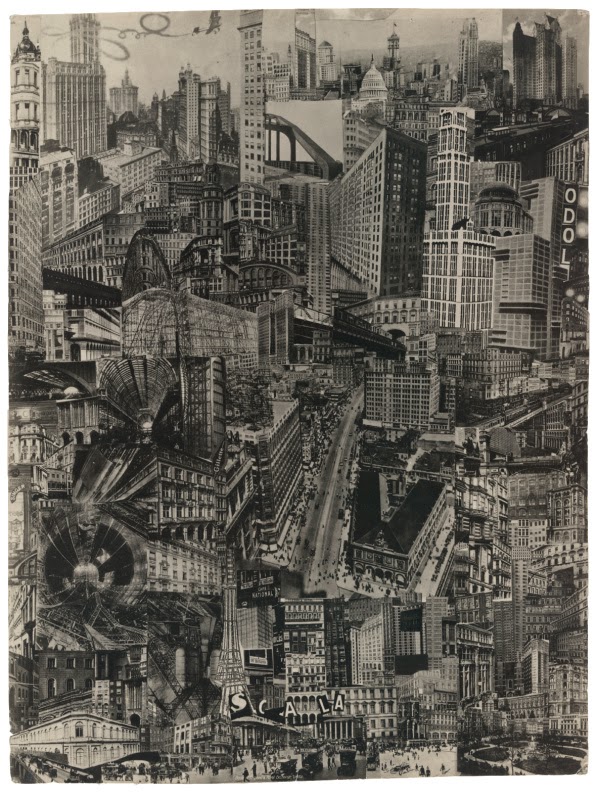
Modern Photography

I saw a wonderful show of photography at MOMA. It consisted of work, primarily from the 1920's and 1930's, focusing on "modern" photographs.   That period was when photography really came of age as an art form.  I think it was a combination of technical advances and, more importantly, in these photographs, an urge to capture the modern world as the artists saw it.  My favorites among the works shown were those that tried to capture the dizzying changes in urban life and the visual complexity of new constructions in the city.  And the new perspectives afforded by views from high rises, etc.   As always, MOMA can't just put up the pictures and be done with it; they have got to be contextualized somehow.  In this case, they put a lot of effort into creating a web site which allows one to look at the photos and make connections.   This is a good thing.  

A few favorites:


A Saturday Walk

It was a Saturday, and after working hard at home for a few days, I needed to get out.   I decided to do a bookstore walk; visiting three of my favorites; Dashwood Books, the bookstore at the New Museum, and McNally-Jackson.   Unfortunately, this meant braving the Saturday shopping crowds in Noho and Soho and Roho; apparently everyone desperately needs new clothes.
Dashwood Books is on Bond Street between Lafayette and Bowery (in Noho), a block which has a lot of memories for me.  Back in the 70's, it was a pretty desolate area, but home to the avant-garde saxophonist Sam River's performance space.  I remember many a concert there; and afterwards, wandering out late at night in the deserted streets, feeling somewhat nervous.  (It was the 1970's, after all.)   In the 1980's, we had good friends who lived in a loft on that block.  By then the streets were less deserted at night; instead, crack dealers and their customers populated the block at night.   I remember the police coming by and, by their presence, chasing them all away; ten minutes later, they would all be back.  Now, the building our friends lived in has been torn down, and the block is dominated by Ian Schrager's high end condo building designed by Herzog and de Meuron.   Fancy boutiques, etc. now line the street. I hope Dashwood Books survives; they are in a basement level shop, which might help.


Progress?

The same general narrative applies to Soho, though it all happened earlier.   Now Soho functions as a giant shopping mall, which is sad, because the architecture is still there.   And if you can ignore the retail throngs, you can look up and begin to imagine what it all looked like 50 years ago.  There are still some amazing buildings.

MacNally Jackson Books in Soho is a fantastic bookstore; discerning taste and a large selection make for wonderful browsing.

And the Bowery is following the same trends as well, though the restaurant equipment stores that used to dominate the area are still around, and the architecture is not really that interesting.   (There was a reason that it was the neighborhood for "bums".)   And now the "bums" can go to Whole Foods.  (I get disconcerted whenever I go in to a Whole Foods in Manhattan; there is too much room in the aisles, I can't possibly be in New York.   I must be in a suburb, or Vancouver. )  The New Museum (on Bowery) has a great bookstore, which includes not only books about new art, but a carefully curated selection of literature, etc.   Take that, MOMA!

Looking up in Soho:


It never ceases to amaze me how much elaborate decoration they put on these barely visible upper stories:


And you never know what you will find when you are walking around:


Opera Times Four

We heard the Metropolitan Opera double bill of Tchaikovsky's "Iolanthe" and Bartok's "Bluebeard".   (We were originally planning on seeing this in January, but the performance was cancelled on account of the Great Non-Blizzard of January 2015.)   Not knowing anything about "Iolanthe", we were quite impressed.   It's a late work, premiered on a double bill with something called "The Nutcracker".   Apparently the audience liked the opera better; little did they know.   The story is about a blind princess (in medieval times) whose father decides that he will isolate her from the world so that she will never know that she is blind; thus all the servants, etc. are forbidden to mention anything that has to do with sight.   This makes for an interesting libretto; as well as a different take on patriarchal relations.   The music is wonderfully varied, like a tone poem, and occasionally, to my ears, foreshadows Debussy's "Pelleas".   The singers were superb, especially Netrebko, who has an amazing voice; and in the pit was the ever-present Putin buddy, Gergiev.
The second half of the double bill, Bartok's "Bluebeard's Castle", was gripping and intense.  The orchestra was truly phenomenal; this 1911 work, written before Bartok was really Bartok, is full of extraordinary sounds.

The production, unfortunately, was in fact quite bad; the director's work is a good example of the kind of outrageous stuff they routinely do in Europe.   He had the idea of adding really tacky sound effects to the Bartok; creaking noises, and things like that.   Where were the grownups when he decided to do this?   On what planet does Bartok need to have sound effects added?  In addition, he demonstrated his Eurotrash credentials by having Judith (the main female role) suddenly appear in a bathtub, full of water, taking a real bath on stage (and seemingly nude).   Then she had to get out of the tub, put on her bathrobe, and sing for fifteen minutes while barefoot in a wet bathrobe.   Apparently all this (and the Tchaikovsky, too) was set in some sort of "film noir" world.   And why does the heroic count who rescues Iolanthe first appear in the forest with a pair of skis on his shoulder?  And the director often puts the singers in odd and peculiar places where they can't be seen.

But most of this doesn't matter too much when you have singers and an orchestra of such extraordinary caliber.

Judith in her bath:


So what do the grey antlers mean? From Iolanthe:


From Bluebeard:


Earlier in January we were invited by my stepmother to see the Met production of Lehar's "A Merry Widow', which I had never heard before.   It's an operetta, which means there is quite a bit of dialogue.   Written in 1905 in Vienna, this is, for all intents and purposes, a musical, complete with hit songs (the "Merry Widow Waltz")  It's interesting to realize that this formula was present so long ago.    I enjoyed myself (Vera much less so).    And I also realized that the Marx Brother's film, "Duck Soup" is in part parody of the "Merry Window".  (Rich widow needed to save the small country from ruin.)  So seeing Renee Fleming on stage, I was thinking Margaret Dumont.


The Marx Brothers had cooler sets...


And lastly, we heard Gluck's "Iphigenie in Aulide" at Juilliard in a semi-staged concert version.   It was an extraordinary experience.   The performance was a collaboration between the Met and Juilliard, featuring young up and coming singers and instrumentalists from Juilliard's early music program, all brilliantly conducted by Jane Glover.  I have seldom heard such a wonderfully nuanced performance from an orchestra. Because the opera was done in the relatively intimate space of Juilliard's theater, you could hear every detail.   The singers, too were excellent; and I would guess that some of them will become famous singers some day.
The opera itself, based on Euripides and Racine's versions of the tale of the god's demand that Agamemnon sacrifice his daughter Iphigenia, is a serious drama with a happy ending. Gluck, famous for his reform of the excesses of 18th century, combines the music and the drama in a perfect way.   I heard a lot of what Mozart did subsequently in his operas, especially in the ensembles.   The only problem with Gluck is that in his zeal to combat the excesses of opera at the times, he sometimes extinguishes those very excesses that people love about opera.   He could certainly write a great tune, but if the drama didn't call for it, it wouldn't happen.   Which is why you rarely see his operas at your neighborhood opera house.   
So involving was the music and the drama that I scarcely noticed that there were no sets or costumes; sometimes, I think opera would be better off without them.
Anyone reading this would be well advised to check out any of the opera productions at Juilliard.