On a Sunday afternoon we went to hear a staged performance of Kurtag's "Kafka Fragments" for soprano and violin, done by a new company in New York called Heartbeats Opera. The piece, written as a concert work, is a setting of 44 very different short fragments from Kafka's writings. It was not conceived of as a theatrical work, but this was not its first theatrical realization. Peter Sellars (with Dawn Upshaw) among others, has staged this work. (I have no idea what the composer thinks of the idea of staging the piece.)
The musical performance of this very demanding work (a virtuoso violin part, and lasting about 70 minutes) was close to excellent, but the staging was, in my opinion, entirely misguided. Where to begin? To begin with, the music itself is vivid and imaginative throughout; it really does not need anything else to come across. That's how Kurtag wrote it. But OK, so people want to stage it. So what should the violinist do? Singers are naturally acting on stage; but violinists are to busy fiddling to do much. In fact the violinist spent far to much time gazing into the eyes of the soprano; to me it started to look like those violinists who play in restaurants and approach the customers (women) and play romantic music while gazing with amorous desire. Not good. Or, in the midst of looking intently at the singer, he has to deal with a few loose hairs on his bow. Other problems include a far too literal interpretation of the text. A fragment mentions "a great horse', and out comes a small model horse. A fragment mentions a seamstress, and out comes a spool of thread. Ugh! Between each section (there are four parts), the director had the idea of playing very loud white noise out of speakers while the set changed when all my ears wanted (and the music demanded) was a bit of silence. Why the noise? And some more Kafka visual clichés; a dark and dirty hotel room with one hanging lightbulb, an old TV set with nothing but static on the screen, travelers with old suitcases, etc. And while it was nice to have the text displayed, the projections were often ill-timed with the singing.
And finally, for me the most bothersome thing was that we lost the sense of the fragmentary nature of the piece by having a continuous visual narrative. The piece is really structured around these short, seemingly unconnected fragments of Kafka, operating as distinct elements. It's not meant to be continuous. The fragmentary nature of the texts is a big part of what makes them expressive. (I read of one staged version that used blackouts between each fragment. Seems like a good idea.)
Though, I do have to say that hearing the music performed live with intense commitment and skill on the part of the performers was a treat, and I admire the company for doing such a difficult piece. I just wish that directors would have a more sophisticated and thoughtfully considered approach to staging musical works. (They have the same problem at the Metropolitan Opera.) Few directors these days seem to trust the music, or have a very sophisticated knowledge of how it works.
Sunday, 22 March 2015

Friday, 20 March 2015
Total Boulez
We went to a concert of the complete piano music of Pierre Boulez, performed in honor of his 90th birthday. All the solo piano music was performed, along with Structures, Book 2.
This was really hard core stuff; two and a half hours of dense, dissonant piano music. It was truly memorable, as performed by pianists Pierre-Laurent Aimard and Tamara Stefanovich.
The most striking thing about the music of Boulez is the continuity; it is constantly transforming, abruptly shifting from moment to moment. There are no long lasting regular pulses, and the music resists any of the familiar expressive tropes that we are used to. Once you accept to enter into that realm, however, the music is consistently interesting and expressive.
Boulez speaks:
I wanted to eradicate from my vocabulary absolutely every trace of the conventional, whether it concerned figures and phrases, or development and form; I then wanted gradually, element after element, to win back the various stages of the compositional process, in such a manner that a perfectly new synthesis might arise, a synthesis that would not be corrupted from the very outset by foreign bodies—stylistic reminiscences in particular.
Highlights included the second piano sonata, written at the age of 23, when Boulez simultaneously emulates Beethoven's "Hammerklavier" sonata while at the same time wanting to destroy the sonata. The program notes mention that Boulez was obsessed with Artaud's "theater of cruelty" at the time he wrote the piece. Enough said.
The highlight of the program was a performance of "Structures, Book 2" for two pianos. This piece, written in the late 50's, allows for considerable freedom of structure in performance, in that the two pianists can interact and chose different sections to perform. Aimard and Stefanovich made the most of it; the performance was exciting, intense, and even witty at times. Aimard, in particular, throughout the concert brought the gestural aspects of the music out clearly. Without exaggeration, he made the mercurial aspects of the music come through.

New definition of a metropolis: A place where 400 people can show up on a Monday night for a concert of all Boulez piano music, and stay for the second half.
Although this is Boulez's 90th birthday year, and there are concerts in Europe marking the occasion, this would appear to be the only concert in New York that is doing so.
A page from Structures, Book 1:

No sign of Bjork.
This was really hard core stuff; two and a half hours of dense, dissonant piano music. It was truly memorable, as performed by pianists Pierre-Laurent Aimard and Tamara Stefanovich.
The most striking thing about the music of Boulez is the continuity; it is constantly transforming, abruptly shifting from moment to moment. There are no long lasting regular pulses, and the music resists any of the familiar expressive tropes that we are used to. Once you accept to enter into that realm, however, the music is consistently interesting and expressive.
Boulez speaks:
I wanted to eradicate from my vocabulary absolutely every trace of the conventional, whether it concerned figures and phrases, or development and form; I then wanted gradually, element after element, to win back the various stages of the compositional process, in such a manner that a perfectly new synthesis might arise, a synthesis that would not be corrupted from the very outset by foreign bodies—stylistic reminiscences in particular.
Highlights included the second piano sonata, written at the age of 23, when Boulez simultaneously emulates Beethoven's "Hammerklavier" sonata while at the same time wanting to destroy the sonata. The program notes mention that Boulez was obsessed with Artaud's "theater of cruelty" at the time he wrote the piece. Enough said.
The highlight of the program was a performance of "Structures, Book 2" for two pianos. This piece, written in the late 50's, allows for considerable freedom of structure in performance, in that the two pianists can interact and chose different sections to perform. Aimard and Stefanovich made the most of it; the performance was exciting, intense, and even witty at times. Aimard, in particular, throughout the concert brought the gestural aspects of the music out clearly. Without exaggeration, he made the mercurial aspects of the music come through.
New definition of a metropolis: A place where 400 people can show up on a Monday night for a concert of all Boulez piano music, and stay for the second half.
Although this is Boulez's 90th birthday year, and there are concerts in Europe marking the occasion, this would appear to be the only concert in New York that is doing so.
A page from Structures, Book 1:
No sign of Bjork.
Tuesday, 17 March 2015
Merce Cunningham Lives!
We saw the company CNDC from Angers, France. It is directed by Robert Swinston, who for a long time worked with Merce Cunningham. He was hired a few years ago (after the Cunningham company dissolved) in France, and has been busy teaching Cunningham technique to his small company. What we saw was an "Event", a stitching together of a number of excerpts from Cunningham pieces dating from before 1990 into a continuous whole. This is very similar to what was done in the final performances of the Cunningham company. (I recommend the DVD of those performances very highly). It was accompanied by new music performed by Gelsey Bell and John King. To see this piece was to marvel at the genius of Cunningham's choreography; consistently inventive, formally complex, always involving. And it is, I think, still very modern; it doesn't tell stories; it's all about the movement. And the movement doesn't proceed or transform in conventional ways; things are often disjunct. And because it is independent of the music, the choreography's own rhythms predominate, much to their advantage.
The music as performed was effective; though, I would guess, much more avant-garde than the audience might normally like. The dancers, I have to say, were good, but not really up to the standards of the Cunningham company of the past. But that didn't really hinder my enjoyment of the choreography. What did annoy me, though, was the decor. It was a series of Matisse-like fabric hangings by Matisse's granddaughter. That was OK, but someone had the idea of having them be in motion all the time by using high powered fans to make them flutter in the breeze; not only was the movement distracting, but the loud noise of the fans was extremely annoying.


The music as performed was effective; though, I would guess, much more avant-garde than the audience might normally like. The dancers, I have to say, were good, but not really up to the standards of the Cunningham company of the past. But that didn't really hinder my enjoyment of the choreography. What did annoy me, though, was the decor. It was a series of Matisse-like fabric hangings by Matisse's granddaughter. That was OK, but someone had the idea of having them be in motion all the time by using high powered fans to make them flutter in the breeze; not only was the movement distracting, but the loud noise of the fans was extremely annoying.
Totentanz
We heard an amazing concert at the New York Philharmonic with composer Thomas Adès conducting the US premiere of his cantata "Totentanz". The concert began with a wonderfully idiosyncratic performance of Beethoven's First Symphony. Adès, who conducted it from memory, conducted it as if it was he who had written it. You could see and hear his evident pleasure in bringing out details that he loved; and we certainly heard the incredibly inventive ideas of Beethoven. The second piece, an early Berlioz overture for a large orchestra, "Overture to Les Francs-juges", was a totally wild and crazy piece that could only have come from planet Berlioz. Again Adès brought out the expressiveness and the wildness of the music, and retrospectively, set up the stage for his work to follow. It was nice to see such inspired conducting and programming from what could have been just routine concert filler for a composer conducting gig.
The main event, though, was "Totentanz". The piece is a 40 minute work for baritone, mezzo, and a huge orchestra. I counted eight percussionists. It is based of a frieze in Lübeck that was destroyed in WW2 by allied bombing. It depicts members of society in descending order of socio-political status, each encountering Death. Guess who wins.
Here it is (click to enlarge):

The sung text apparently accompanied the original frieze; it depicts a series of dialogues between Death and each of his victims.
The piece was an overwhelming experience; as intense in expression as could be. Adès layers very complex dance rhythms, orchestral dissonances, and extreme fortissimos in a huge whirlwind of sound. Watching him conduct was revealing; he moved actively to convey the bodily aspects of his rhythms. The piece has a very large dramatic curve, so by the end, when we get a very Mahlerian sound when he depicts the dance of Death with a baby, we feel like we have been on a journey.
When I first heard the music of Adès many years ago, I thought, this is the last 20th century composer. By that I meant that he takes all the expressive tropes of the 20th century and uses them in such a brilliant and extreme way that no one could ever seem to go further. I still think that. Adès, however, has become very cool to some 21st century types. There was a long article in the NY Times about how much some contemporary composers admire his work (even those who write pop song based "contemporary" music). And Bjork was apparently in the audience opening night. 20th century music lives....
The main event, though, was "Totentanz". The piece is a 40 minute work for baritone, mezzo, and a huge orchestra. I counted eight percussionists. It is based of a frieze in Lübeck that was destroyed in WW2 by allied bombing. It depicts members of society in descending order of socio-political status, each encountering Death. Guess who wins.
Here it is (click to enlarge):
The sung text apparently accompanied the original frieze; it depicts a series of dialogues between Death and each of his victims.
The piece was an overwhelming experience; as intense in expression as could be. Adès layers very complex dance rhythms, orchestral dissonances, and extreme fortissimos in a huge whirlwind of sound. Watching him conduct was revealing; he moved actively to convey the bodily aspects of his rhythms. The piece has a very large dramatic curve, so by the end, when we get a very Mahlerian sound when he depicts the dance of Death with a baby, we feel like we have been on a journey.
When I first heard the music of Adès many years ago, I thought, this is the last 20th century composer. By that I meant that he takes all the expressive tropes of the 20th century and uses them in such a brilliant and extreme way that no one could ever seem to go further. I still think that. Adès, however, has become very cool to some 21st century types. There was a long article in the NY Times about how much some contemporary composers admire his work (even those who write pop song based "contemporary" music). And Bjork was apparently in the audience opening night. 20th century music lives....
Saturday, 14 March 2015
Museums in Lisbon
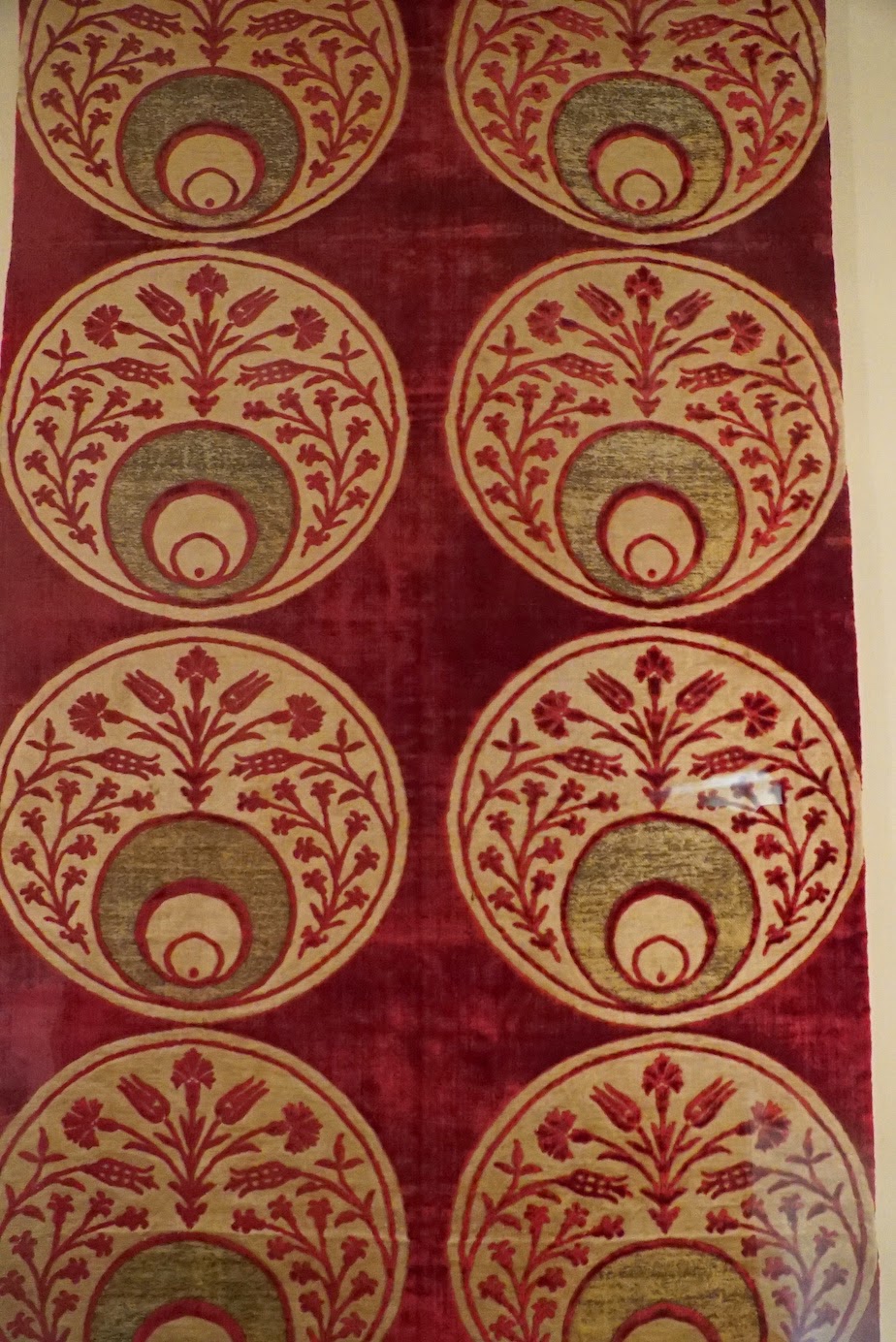
We visited two other excellent museums in Lisbon. The Calouste Gulbenkian Museum, housing the collection of the late Armenian oil magnate, is like a mini Metropolitan Museum. It includes Egyptian, Greek, Asian, Islamic, and European art. The museum building itself is model of museum architecture, built in the 1960’s, with the emphasis on viewing art. I was most intrigued by the Islamic art, having the Alhambra, etc. on the brain. There were Turkish textiles, glass vases, Persian miniatures, and illuminated manuscripts.
Turkish velvet:
Vases:


Turkish velvet:
Vases:
I also visited the Portuguese equivalent of a national gallery. It was a great pleasure, again without crowds, just a few people here and there. (On our last trip to Paris I managed to avoid going to the Louvre, the Orsay, and the Pompidou; why do Paris art museums have to be such mob scenes?) They have a well known Bosch there, the “Temptation of St. Anthony”. Contemplating such a painting in a silent room with virtually no one around is truly inspiring.

A few other things that caught my eye:
detail of a St. Luke by Hugo van der Goes from around 1480:

A Salome by Lucas Cranach the Elder, painted in 1510; that's quite a fashion statement :

A very dour looking church figure:

And proof that Bosch was not the only one to have visions, "Hell" by an unknown Portuguese master:

A few other things that caught my eye:
detail of a St. Luke by Hugo van der Goes from around 1480:
A Salome by Lucas Cranach the Elder, painted in 1510; that's quite a fashion statement :
A very dour looking church figure:
And proof that Bosch was not the only one to have visions, "Hell" by an unknown Portuguese master:
Friday, 13 March 2015
Walking in Paris, February 2015
Paris is just about my favorite place in the world to walk. I am sure a lot of people would agree with me. While part of the pleasure is in the streetscapes and vistas near and far, another part can be memories. These can be both personal, connected to one's own experiences in Paris, and historical. Whenever I walk into Notre Dame, I think of the number of people in the last 700 or 800 years who have walked through those doors. For me, my memories are usually associated with particular places and times, and they are primarily visual (though quite a few are of sounds). At the same time, Paris likes to tell us its own memories, with the various plaques on buildings, etc.
Walking, we saw this one day:

And, in addition, anyone who has seen (and heard) a lot of French films that are set in Paris has their own memories from those films. Whenever I sit in a cafe and hear all the sounds of the cafe, I always think back to the Godard films of the 60's, when Godard made a point of capturing the actual sounds of the cafes; but unfortunately one rarely sees the old fashioned pinball machines that often dominated the soundtrack (and which I spent a lot of time playing in my youth).
My memories, for example. I was walking on Rue Linné when I suddenly remembered that my favorite French writer Georges Perec had once lived on the street. Looking in his biography on my iPhone, I found the street number and went to look. Then, looking at the building, I realized that many years ago, we had stayed in a hotel a few buildings down, and had taken our young jet-lagged daughter to dinner at "Pizza Roma" which is in the same building that Perec had lived in, without knowing that he had lived there.

Perec's building, with Pizza Roma:

My first encounter with Paris was in the early 1960's. It was the tail end of a epic family vacation through the Mediterranean, with stops in Cairo, Damascus, Athens, Rome. etc. We arrived in mid January, checked into the Hotel France et Choiseul on Rue St. Honore, and went out into the Tuileries gardens, and it was snowing and very magical. I remember the sloping floors and low ceilings in the hotel, and everything being dark and red. I was hooked. Then, many years later, I remember being with Ada and her friend Elise in Louvre in January, and looking out the window and seeing the snow coming down hard. The paintings could not compete, and soon we were out building a snowman in the Tuileries. This time, Vera and I walked through the Tuileries on a very grey and blustery February day.

My maternal grandmother was brought by her mother to Paris in 1912 at the age of 16 to be "educated". (My great grandfather had just died.) I don't know what prompted my great grandmother to do such a thing, but, courtesy of the internet, I have a copy of her consular registration form, which shows that they lived at 1 Rue Boularde in Montparnasse and specifies the purpose of their stay (to educate her daughter). So naturally I went to see the building, which was new at the time my grandmother lived there, and has recently been restored so that it looks very much like it did back then. It is almost Gaudiesque in its sinuous curves. So here I am, looking at the door, and thinking that my grandmother some one hundred years ago was walking in and out that door.


In addition, we know that she served as a model for the American impressionist painter Richard Miller, whose studio was a few blocks away at 16 Rue Boissinade. Here it is, probably looking not much different than it did back then:

And here she is as painted; I guess this was part of her education.

The painting is entitled "Girl with a Chinese Statuette". I found the image on the internet, but I have no idea where the painting is.
And, speaking of memories; here is bed of the high priest of memory, Marcel Proust:

I found Proust's bed along with his other furnishings in the Musee de Carnevalet, Paris's own museum of history (and memory). And they have Marie Antiontette's hair, too.

I remember going to the Musee Carnavalet when Ada was in a French school, learning about the French Revolution. We were looking for a guillotine, and had to settle for a model of one.
In another walk I found an interesting church, St. Pierre de Chaillot, that I had never seen before. It was built in the 1930's in a Neo-Byzantine style, which also seemed to have elements of Art Deco.


In a very high end auction house on the Champs Elysee, I saw an exhibit of airplane stuff, about to be auctioned:


We stayed in an apartment on the edge of the Marais this time; with this view of pipes out our window:

We also did something we haven't done for a long time; we took a walk through Montmartre. Normally I would avoid the tourist-encrusted Montmartre area, but if you go outside the few main areas where the tourists congregate, its actually quite interesting, especially when you think of it as a place where sheep were grazing until the 20th century.
And it's very colorful:

Speaking of colorful, some windows from that very large apartment building in Montparnasse:


And a shop window in the Palais Royale:

I also went on a long walk on the Canal St. Martin, which still has functioning locks, and which also brings forth memories of French movies of the 1930's (Hotel du Nord, etc.)


Walking, we saw this one day:
And, in addition, anyone who has seen (and heard) a lot of French films that are set in Paris has their own memories from those films. Whenever I sit in a cafe and hear all the sounds of the cafe, I always think back to the Godard films of the 60's, when Godard made a point of capturing the actual sounds of the cafes; but unfortunately one rarely sees the old fashioned pinball machines that often dominated the soundtrack (and which I spent a lot of time playing in my youth).
My memories, for example. I was walking on Rue Linné when I suddenly remembered that my favorite French writer Georges Perec had once lived on the street. Looking in his biography on my iPhone, I found the street number and went to look. Then, looking at the building, I realized that many years ago, we had stayed in a hotel a few buildings down, and had taken our young jet-lagged daughter to dinner at "Pizza Roma" which is in the same building that Perec had lived in, without knowing that he had lived there.
My first encounter with Paris was in the early 1960's. It was the tail end of a epic family vacation through the Mediterranean, with stops in Cairo, Damascus, Athens, Rome. etc. We arrived in mid January, checked into the Hotel France et Choiseul on Rue St. Honore, and went out into the Tuileries gardens, and it was snowing and very magical. I remember the sloping floors and low ceilings in the hotel, and everything being dark and red. I was hooked. Then, many years later, I remember being with Ada and her friend Elise in Louvre in January, and looking out the window and seeing the snow coming down hard. The paintings could not compete, and soon we were out building a snowman in the Tuileries. This time, Vera and I walked through the Tuileries on a very grey and blustery February day.
My maternal grandmother was brought by her mother to Paris in 1912 at the age of 16 to be "educated". (My great grandfather had just died.) I don't know what prompted my great grandmother to do such a thing, but, courtesy of the internet, I have a copy of her consular registration form, which shows that they lived at 1 Rue Boularde in Montparnasse and specifies the purpose of their stay (to educate her daughter). So naturally I went to see the building, which was new at the time my grandmother lived there, and has recently been restored so that it looks very much like it did back then. It is almost Gaudiesque in its sinuous curves. So here I am, looking at the door, and thinking that my grandmother some one hundred years ago was walking in and out that door.
In addition, we know that she served as a model for the American impressionist painter Richard Miller, whose studio was a few blocks away at 16 Rue Boissinade. Here it is, probably looking not much different than it did back then:
And here she is as painted; I guess this was part of her education.
The painting is entitled "Girl with a Chinese Statuette". I found the image on the internet, but I have no idea where the painting is.
And, speaking of memories; here is bed of the high priest of memory, Marcel Proust:
I found Proust's bed along with his other furnishings in the Musee de Carnevalet, Paris's own museum of history (and memory). And they have Marie Antiontette's hair, too.
I remember going to the Musee Carnavalet when Ada was in a French school, learning about the French Revolution. We were looking for a guillotine, and had to settle for a model of one.
In another walk I found an interesting church, St. Pierre de Chaillot, that I had never seen before. It was built in the 1930's in a Neo-Byzantine style, which also seemed to have elements of Art Deco.
In a very high end auction house on the Champs Elysee, I saw an exhibit of airplane stuff, about to be auctioned:
We stayed in an apartment on the edge of the Marais this time; with this view of pipes out our window:
We also did something we haven't done for a long time; we took a walk through Montmartre. Normally I would avoid the tourist-encrusted Montmartre area, but if you go outside the few main areas where the tourists congregate, its actually quite interesting, especially when you think of it as a place where sheep were grazing until the 20th century.
And it's very colorful:
Speaking of colorful, some windows from that very large apartment building in Montparnasse:
And a shop window in the Palais Royale:
I also went on a long walk on the Canal St. Martin, which still has functioning locks, and which also brings forth memories of French movies of the 1930's (Hotel du Nord, etc.)
Tuesday, 10 March 2015
More Spain Photos
A church in Seville:

A giant mushroom structure in a square in Seville, supposedly the world's largest wooden structure. A folly of some kind, to be sure, and a delight to encounter.

Decorated walls and ceilings in a palace in Seville, in the same style as the Real Alcazar:


A small square at night in Seville:

In Cordoba, a garden. I thought the French were the only ones who liked to wrestle their gardens into unnatural shapes:


Many buildings in Seville have these very nice window/porches:

Trees in a garden in Cordoba:

The cathedral in Granada, painted white

Shiny pavements in Granada at night

The organ in the cathedral in Granada

The Royal Chapel in Granada, home to the tombs of Isabella and Ferdinand:

View of the Sierra Nevada from Granada:

In Cordoba, a restored 14th century synagogue:

Detail:

Subscribe to:
Posts (Atom)