Tuesday, 5 September 2017

Bucharest 2 - Art

Bucharest is not a world famous art museum destination, but we did spend a rewarding day in the Romanian National Gallery with our friends David and Sylvia, who are also here for the festival.  The museum is divided into two wings, one for Romanian art and one for European Art.   The Romanian one was by far the most interesting for me, especially for the collection of Medieval Art.   There were lots of icons.   (Romania's main religion is traditional Orthodox christianity, following the historical and geographical connection from Greece through to Russia.)   As usual, I was fascinated by the off the beaten path ways of representation, and the ways in which some of the art seemed to reflect a relationship with the traditional peasant designs.

Here are a few highlights and fragments:


This robe reminded me of expressionist woodcuts:


There were also tapestries:


And these astute students of a beautifully carved wooden iconostasis.  (Although their elbows give a good indication of what they are doing....


In fact, it appears that Vera dressed in geometric patterns to complement the icons


The collection also includes a large collection of Romanian painting from the 19th century to the mid 20th century.   While there are very few outstanding works, it's alway interesting to see how regional artists incorporate styles of painters from elsewhere.   So you see something that looks Matisse-like, etc.  

The major attraction for me was these three early paintings by Victor Brauner.   These paintings were actually hidden in Vera's basement for a period of time when the possession of such paintings would have been dangerous under the regime of the Communists.  Most of Brauner's works are found outside of Romania, as he left for Paris at an early age.


The European wing is mostly paintings that were in the collection of King Carol, with some excellent El Grecos and Rembrandts among them.

A detail of El Greco's brushwork:


And the occasionally oddity, like this trompe l'ceil frame;


The Museum is in the old Royal Palace, and parts have some interesting architectural details.


Monday, 4 September 2017

Bucharest 1

We flew from Vancouver to Bucharest.  Which is from the Pacific Northwest on the North American continent to the very Southeast corner of Europe.   Which is to say its a long flight! And a long distance both in physical terms and in cultural terms.   We came to Bucharest partially because we wanted to go to the Enescu Music Festival, which is probably Romania's biggest cultural event, a month long blizzard of classical music concerts of all kinds,   It was also Vera's xxth high school reunion.   Vera is from Bucharest, and I had been here once before, in 2002, when it was still in the transition period after the overthrow of the dictator Ceausescu.

Bucharest is a truly fascinating city.   While it's not on anyone's list of must-see touristic destinations, it is filled with interesting things to see.  The city itself has suffered from numerous degradations over the years, mostly from the totalitarian regime of Ceaucescu, whose narcissistic megalomania extended to the field urban planning.   So not only was he torturing and killing his citizens, but trying remake the city in his own vision of the "new socialist man".  But this was not a disciplined and organized process.   Apparently, in some cases, Ceausescu would be driven by a 17th century church, and immediately decree that it be demolished.  Many of Bucharest's historical buildings were thus destroyed, with whole historic neighborhoods being razed to make way for apartment blocks.   It's a wonder then, then, that anything survived.  This on top of bombings in World War 2, and severe earthquakes in 1940 and 1977.   But there are fascinating pockets of history that somehow seemed to have survived; one simply has to get used to the idea that a 17th century church can be nestled next to a decaying 1950's concrete housing block.    Speaking of decay, that is one of the perverse virtues of Bucharest, in that many buildings are in a state of decay, which in some ways is more interesting than in places where everything is pristine.   All of this is gradually changing, though, with Romania's membership in the European Union.  The place looks infinitely more prosperous that it did 15 years ago, and of course now you have all the outlets of contemporary global merchandising and eating.

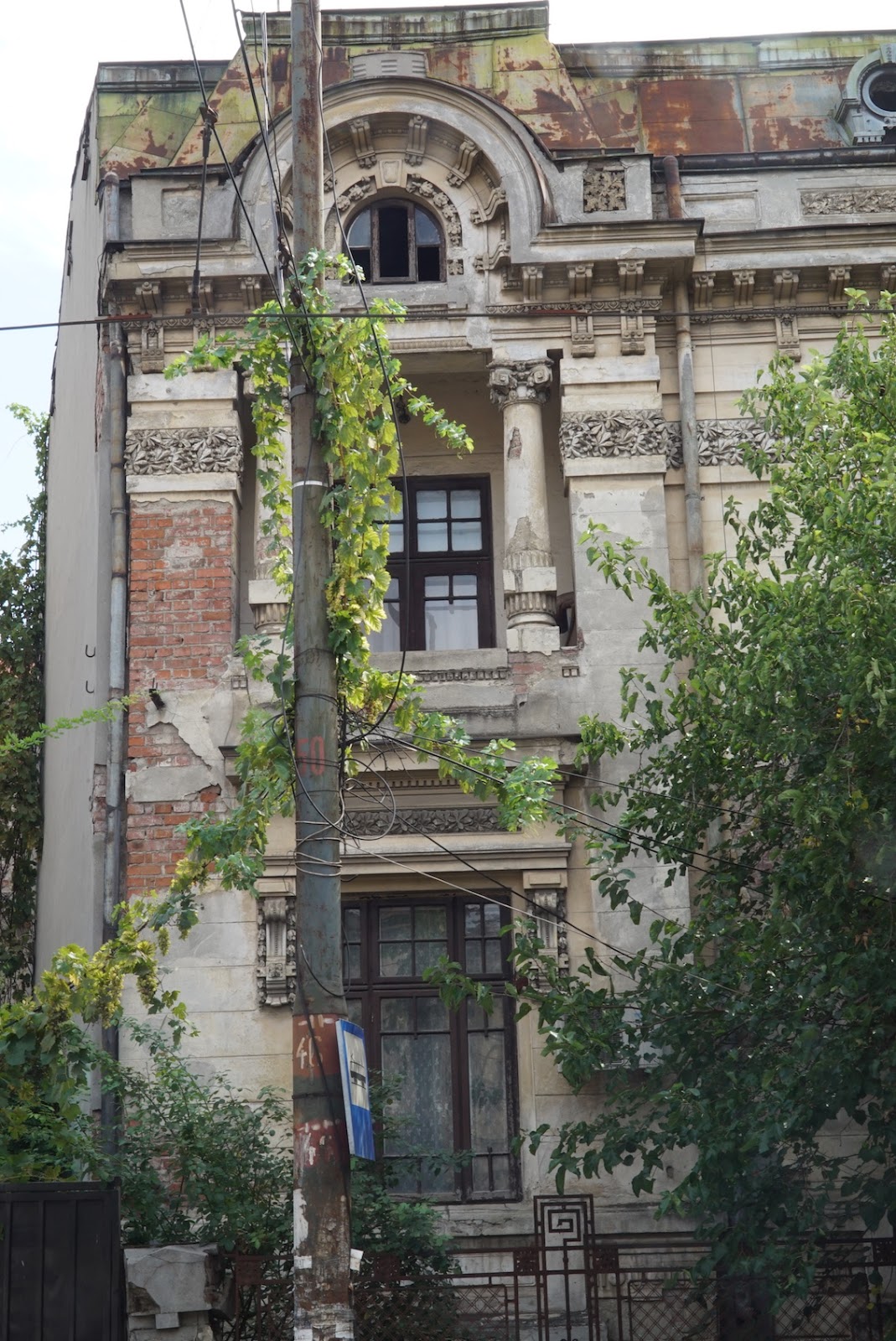
There are a number of large institutional buildings (state, banks, etc.), mostly built in the late 1800's, built in an extravagant style which looks very Parisian.   There are also numerous orthodox churches, mostly small ones, that have somehow survived, some dating back to the 18th century.   My favorites,  though, are the numerous residential villas, dating from the late 19th century to the 1930's.   Many of these are extravagantly eclectic mashups of French, Transylvanian, Turkish, and who knows what other styles.   Some have been restored and some are in a state of decay.

Here are numerous examples:


In a state of decay:


And while walking around the area of these houses, something line this suddenly pops up, an unfinished relic from who knows when:


The old with the new:


This is the Slovak Embassy; they love blue!:


If you look hard enough, you can even find something interesting in the concrete tower blocks:


Vera has always thought our house in Vancouver was too cluttered with plants in the yard.   She now knows it could be worse:


There is actually a house under there; there was actually someone doing some work on a window from inside.


Wednesday, 16 August 2017

Walking New York

The sociologist William Helmreich has written a book about walking every block in New York City.   It's about 6,000 miles, apparently.   That's like walking from New York to San Francisco and back, and more.  It took him four years of fairly steady walking to walk every block.  There are others, apparently, with the same goal.   An enticing idea, though at my age and with my knees, not a feasible one for me.   The book is a very interesting sociological study of New York, based on the experience of walking the streets, talking to people, and observing the scene.
My goals in walking, though, are not sociological.  I just like getting to know the different streetscapes and getting a feel for the contrasting neighborhoods in the city. You can do that without walking every street, fortunately, and I also feel free to choose only the neighborhoods and streets that interest me.   Which, actually,  is pretty much everything.   (Many years ago, during an extended stay in Paris, I tried to do the same thing in Paris, marking each walk with a blue marker on a large Michelin map of the city.  There is a lot more to Paris than the central Haussmann designed streets.)   I enjoy both getting to know a bit about each neighborhood and looking at things to photograph.   I enjoy seeing the architecture both beautiful and ordinary, residential and commercial, and the way people have created (or not created) their environment.   The photographs I have been taking, though, are not taken as a documentation of my walks, but rather as records of my various visual obsessions.    Many of them give no clue about the neighborhood they were taken in.   I am more interested in color, shape, and the juxtaposition of disparate things.   I love how the camera takes a three-dimensional scene and flattens everything to two dimensions.  The photographs are not necessarily "abstract" because they are actual photographs of real things.   But, I suppose, the photographs aspire to the condition of abstract art.  You could also say they are about finding beauty in unexpected places.

Here are some of my favorites from the last six months of wandering in New York City and parts of New Jersey: