I used to teach a course in film music a while ago, and one of my great pleasures was teaching Erich Korngold's score for the Errol Flynn adventure story, "The Sea Hawk". Korngold's score is a musical wonder, a kind of opera without voices that runs almost constantly through the movie. His music is truly sophisticated, with some very complex motivic development that follows the characters through the film and with fabulously orchestrated harmonies. Korngold was instrumental in defining the sound of the Hollywood score in the 1930's and 1940's. (Which then fell out of fashion in the 1960's and 1970's, until George Lucas and John Williams revived Korngold's music for Star Wars.)
My other great pleasure in teaching the film music course was in getting to know the music of Bernard Herrmann, who has frequently been called the greatest film music composer ever. His work with Alfred Hitchcock was one of the great filmmaker/composer collaborations of all time, and their "Vertigo" is one of the 20th centuries great music dramas.
So when I saw that Leon Botstein's "The Orchestra Now" was performing music of Herrmann and Korngold in Carnegie Hall, I bought a ticket. They were performing Herrmann's "Psycho Suite" and his symphony, and Korngold's symphony as well.
The music of "Psycho" is famous, of course, for the shower scene music. The suite is an arrangement of cues from the film; it is a series of 2-3-minute movements. The music is wonderful and expressive, but, because of the nature of the sequence of short cues, it doesn't really develop or work very well as concert music. I wanted to somehow refashion it into a continuous stretch of music. And, interestingly, the shower scene music, with its closely-miked harsh glissandi, sounded much blander in person. The symphony was written early in Hermann's career (around 1940), and is in the conventional four movements. The music has the general character of American symphonic music of the time; some of it seems fairly generic, while other moments are very striking. Not a masterpiece, but I've heard a lot worse, and was very happy to hear it. As it was early in Herrmann's career, I didn't really hear any echoes of the very individual style of his later film music.
Korngold wrote his symphony after he had more or less finished with Hollywood, in 1954. Unfortunately, the reception of Korngold's concert music was tarnished by both the fact that he had spent considerable time writing for Hollywood and that his music was rooted in the sound of the early 20th century. He was harshly criticized for both "selling out", and for writing music that was "old-fashioned", a cardinal sin at the time. (I can't help but think that he would be treated much differently nowadays.) I greatly enjoyed the piece, though; Korngold was truly talented composer who happened to be born at the wrong time. (Readers of this blog will know of my normal distaste for anything neoromantic.) In this case, though, the romanticism is the real thing. I think my pleasure in the music also has something to do with my love of the films that featured his music. (I am looking forward to watching the new Blu-ray of "The Sea Wolf", which has one of Korngold's most adventurous scores.)
"The Orchestra Now" is basically a master's degree orchestra at Bard college, and is made up of young musicians who have finished their undergraduate degrees. Their performances were excellent, I thought. Much like the Juilliard Orchestra, this orchestra makes up for its relative lack of experience with both energy and commitment, and most importantly, extended rehearsal time which (I assume) exceeds that of a conventional pick-up orchestra. I can certainly imagine a better performance, but in a era when most professional orchestras play it as safe as possible, playing the same pieces over and over again), it is so exciting to have someone not play the same pieces that are always played. Thank you Leon Botstein!
Saturday, 4 November 2017

Monteverdi and Bach
We went to hear Monteverdi's last two operas, in semi-staged performances at Alice Tully Hall. We heard "Il Ritorno de Ulisse en Patria" and "L'incoronatione di Poppea", both written the 1640's. The performances were conducted by John Eliot Gardiner, with the Monteverdi Choir and the English Baroque Soloists, and were part of a 6 month tour commemorating the 450th anniversary of Monteverdi's birth. Gardiner knows what he is doing; he founded the Monteverdi Choir in the 1960's an undergraduate. The performances were semi-staged and featured quite a large orchestra, with no less than three theorbos (a kind of giant sized lute at least 6 feet long), two harpsichords, two organs, and lots of other instruments.
Both evenings were extraordinary evenings of music drama; both operas are three and a half hours long, and conceived on a very large scale. Gardiner has compared Monteverdi to Shakespeare in his capacity as a dramatist (Shakespeare was from a slightly earlier era), and I think it's a apt comparison. Monteverdi might well be called the inventor of opera, and, as with many pioneers of forms and styles, he did things that in some ways later composers never did better. What struck me most in both operas was the juxtaposition of tragic laments with moments of comic buffoonery. And there were also moments of wonderful ambiguity. In fact, in Poppea, both Nero and his future bride Poppea are pretty despicable characters. Nero at point, when told he must think about his obligations as the leader of the people, says he doesn't care about anything or anyone but himself, and his only desire is to do what pleases himself. (The contemporary parallel was clear.) But the ending of the opera is a triumphal wedding and paean to the love of Nero and Poppea, a wondrous love duet in which the music seduces you into celebrating the love of these two problematic characters. (Imagine, if you will, and this is really stretching the point, a love beautiful love duet between Melania and her husband.)
Another striking thing about the dramas is that the gods (Greek and Roman, respectively) are pretty much in charge of how things go. So while dastardly deeds are contemplated, we are always assured that the gods will see that things turn out OK.
The singers were mostly superb. Nero was a young Korean-American countertenor with a striking voice and a pile of blond hair. And the operas were "semi-staged", which in this case, meant that they were fully acted in a totally convincing way; all that was missing was the sets, which I was happy to do without.
Photos from the web...

The gods intervene to save Poppea from being murdered:

Nero and Poppea:

As I was standing in line for the men's room, I happened to see Alan Gilbert, the former music director of the NY Philharmonic, standing right in front of me. I wanted to say we need him back at the NY Philharmonic, but I left him in peace.
The next day, we went to Montclair State University in New Jersey to hear and see a performance of a new dance work by Pam Tanowitz entitled "New Work for Goldberg Variations". (This involved traipsing through Port Authority Bus Terminal and taking a bus which dropped us off in the middle of New Jersey someplace. There was some reluctance.) The work was conceived for a live performance by the pianist Simone Dinnerstein (she is famous for her rendition of this work) and seven dancers. (The work was actually initiated by Dinnerstein.) Dinnerstein performed at the piano, which was situated at the center of the stage, with the dancers moving around her. The "Goldberg Variations" is an intimidating prospect for both performer and choreographer; an aria and 30 variations, which in this performance lasted 75 minutes without a break. It was a fascinating piece; Tanowitz is very sophisticated in her approach to the music. Again I felt the ghost of Balanchine hovering; Tanowitz knows exactly when to let the music speak for itself, and when the choreography should break away from following the music too closely. You really hear and see two parallel structures in the music and the choreography; They often follow each other closely, but not necessarily synchronously. It's like what Balanchine does when there is a canon in Stravinsky's music. Balanchine will normally not have the dancers dancing in a canon, but maybe 16 bars later, the canon will show up in the dance.
My description may make the dance seem like some abstract formal study; it's not. There are wonderful and very expressive moments in the choreography (just as in Bach's variations). Though I do have to say that a music/dance piece of 75 minutes in length is a bit extreme in its demands on the audience. But my attention rarely flagged. Between Bach's music and Tanowitz's choreography, there was always something interesting. Dinnerstein's performance was good, but she really does a more romanticized version of Bach. The opening aria was as slow and expressively played as possible; it's not really how I like to hear Bach. But all was forgiven in the context of a music/dance work.
I was pleased to see one of my other favorite living choreographers, Mark Morris, in the audience. Though I have no idea if he liked to or not...
Sunday, 15 October 2017
Boulez at the Armory and More
I went with our friend David M. to hear Pierre Boulez's "Repons" at the Park Avenue Armory. It was a truly memorable concert. Repons is composed for an orchestra of 24 musicians, located in the center of the performing space, and six soloists (2 pianos, vibraphone, marimba, harp, and cimbalom) stationed at the perimeters of the performing space. The music of the soloists is amplified and sonically transformed through the use of computer electronics, and then redistributed in varying ways through the space via a number of speakers hanging in the air. In other words, it is a hugely complex enterprise, and rarely done. (I actually heard the US premiere in 1986 in the Columbia University Gymnasium, whose acoustics and ambience left a great deal to be desired.) The people at the Armory, though, apparently have a lot of money, and the set up and the execution of the piece were first class. What you hear in the piece to a certain extent depends on where you are sitting, since all the soloist's sounds are moving around in space. The Armory people had a brilliant idea; they performed the 50 minute piece twice, and everyone in the audience sat in a different seat for the second performance. (I had anticipated that this would be a rather complex maneuver to execute, but the solution was quite simple. Everyone sat in the same named seat (Section B, Row F, Seat 9), but at intermission they moved all the section labels around. I was extremely grateful for the second performance. In a work of such dazzling complexity, things which seemed like chaos on first hearing suddenly seemed lucid on the second hearing.
But the work is an extremely dense and intricate web of sounds; there are short moments of sustained clarity which are suddenly interrupted by violent swarms of notes, ricocheting around the hall. Boulez thinks not just in terms of notes, but rather gestures and bursts of activity in sudden transformations. He aims for a kind of unpredictability. The spatial element is crucial; you really perceive the whole space as one giant resonating instrument. This was one case when the gigantic space of the Armory was wonderful. This cannot be experienced on YouTube, thank you. Afterwards, thinking about the piece, I remembered the young Boulez's famous statement in the late 1940's to the effect that the past must be destroyed and music reinvented from scratch. That he actually did that and remained consistently devoted to that aesthetic throughout is career is amazing; his music really doesn't sound like anything that came before it. (Though you certainly can hear traces of Debussy and Stravinsky if you really try hard.)
Here are some pictures of the stage setup in the Armory, courtesy of their Facebook page.
As you can see, the lighting design was amazing.


Wow!
(It is worth noting that as of a week after this concert, the New York Times has yet to review it. They do have space on their on line music pages, though, for an article about the sale of Jennifer Lopez's penthouse apartment. Enough said.)
The night before, David and I heard a concert of the music of another great 1950's modernist, Thelonius Monk. The concert was performed by the "Artist's Diploma Ensemble" at Juilliard, six young men from assorted countries around the world. The performers had arranged the music themselves, and the selections were from lesser known areas of the Monk repertoire, such as "Brake's Sake" and "Boo Boo's Birthday". The tune "Stuffy Turkey" was listed in the program, but I don't know if they played it. The concert was excellent; the ensemble had made some very unusual arrangements, frequently complex, and played them flawlessly. For example, the melody in "Ruby My Dear" was at times played by a bowed bass. At no times, though, did I feel they were violating the spirit of Monk. On the contrary, I think Monk's compositions benefitted from the arrangements. The pianist Addison Frei was consistently brilliant, channeling Monk's piano style, while also making it his own. His solos were always interesting. The bass player and the drummer were equally excellent. I loved how the drummer consistently played with the rhythm and kept things together while the pianist and others were venturing into contrarian rhythmic territories.
At the end of the concert, I did reflect on how the music composed by an African-American composer in the middle of the twentieth century was now being transformed by six young white men (from 5 different countries) enrolled at a prestigious school of music. I don't have the time or inclination to fully explore what this means, I mention it only in passing as something to contemplate. (This year is the centenary of Monk's birth, so we are hearing lots of Monk's music, played by virtually every instrumental combination imaginable. Well, maybe not a Japanese koto ensemble, though I could be wrong.)
A few days later, I went to see and hear the New York City Ballet in a program of three violin concertos. I went primarily because NYC Ballet is not doing their usual Stravinsky-Balanchine "Black and White" programs this fall. (I need my "Agon"!) The Balachine/Stravinsky "Violin Concerto" was on the program, and I was curious to see what Jerome Robbins had made out of the Berg Violin Concerto. The program began, however, with a ballet by Peter Martins, set to John Corigliano's violin concerto, based on his score for the movie "The Red Violin". The piece is mostly neo-romantic mush. Corigliano does write very effectively for orchestra, and parts of the scherzo were interesting, but on the whole, I disliked the music. And the choreography by Martins was mostly anodyne. The violin soloist, however, was excellent.
The second piece was choreographed by Jerome Robbins and set to Berg's wonderful Violin Concerto. Berg wrote the concerto after the death of young Manon Gropius, and is dedicated "to the memory of an angel". The performance of the music was quite good, and I was very happy to hear it performed live. The choreography took the implied musical program seriously, and there was a very moving pas de deux where the angel dances with death. I was impressed.
But the Balanchine/Stravinsky Violin Concerto was a knockout. Seeing Balanchine's choreography after others was like a breath of fresh air; such inventiveness, such musicality! Balanchine frequently referred to this piece as one of his favorites, and you can see and hear why. Like most of Balanchine's work with Stravinsky, the piece gets better and better the more you see it. It is at times very witty was well as being very moving. My only complaint about the performance would be that of the violin soloist, the NYC Ballet Orchestra's concertmaster, whose playing is really substandard. You would think with all the incredible young violin talent out there in the world, they could find someone better.
(It should also be noted that the downward spiral of the New York Times cultural coverage continues, as this fall's NYC Ballet performances were sketchily reviewed in one single wrap-up, rather than individually as has been the case in the past.)
I finished up a busy week of performances by going with David to hear the Juilliard Big Band Jazz Orchestra perform arrangements by Fletcher Henderson, Eddie Durham, and Bill Chalis. It was conducted by Vince Giordano, who may know more about 1920's and 1930's swing music the anyone else on the planet. It is a sheer delight to hear the meticulously recreated sound of the big band orchestras of that period played live. (The transcriptions were done by some people with very good ears who painstakingly listen to the recordings, as there is very little surviving written material from this period.) The sheer inventiveness of the arrangements is wonderful; all of the ideas are compressed, as the pieces were all about three minutes long, owing to the length restrictions of the 78 rpm recordings of the time. The quality of the music itself was not as high as that of a similar concert we heard last year of Ellington's music. Though I did enjoy an arrangement of Ravel's "Bolero", which lasted three minutes and which I think I prefer to original version. (It was often the case that an arranger would be asked to create a big band version of a popular song or melody that had nothing of a "swing" sound to it. The arrangers would always oblige.)
Sunday, 24 September 2017
Vienna Streets
Wandering around the streets of Vienna, you are constantly encountering the grandiose and the floridly overdecorated facades of the large imperial buildings.
Part of the Hofburg Palace:

The Neo-Gothic town hall:

The Neo-Classical Parliament with all its statues:


Put them together:

The imperial figures:

But, if you look harder you can see some more interesting newer architecture from the turn of the century, including this work by Adolf Loos, the Loos House, famous for its lack of window decorations. (In fact, he was required to add the window boxes to appease civic indignation about the lack of proper decoration.)


Otto Wagner's work is the most famous from this era, including his S-Bahn station:


And his postal savings bank:

Details:


I saw it on Sunday, so unfortunately I did not get a chance to go inside.
Other buildings and facades seen on my walks:


I saw a few decorative representations of workers:


And some peculiar things:
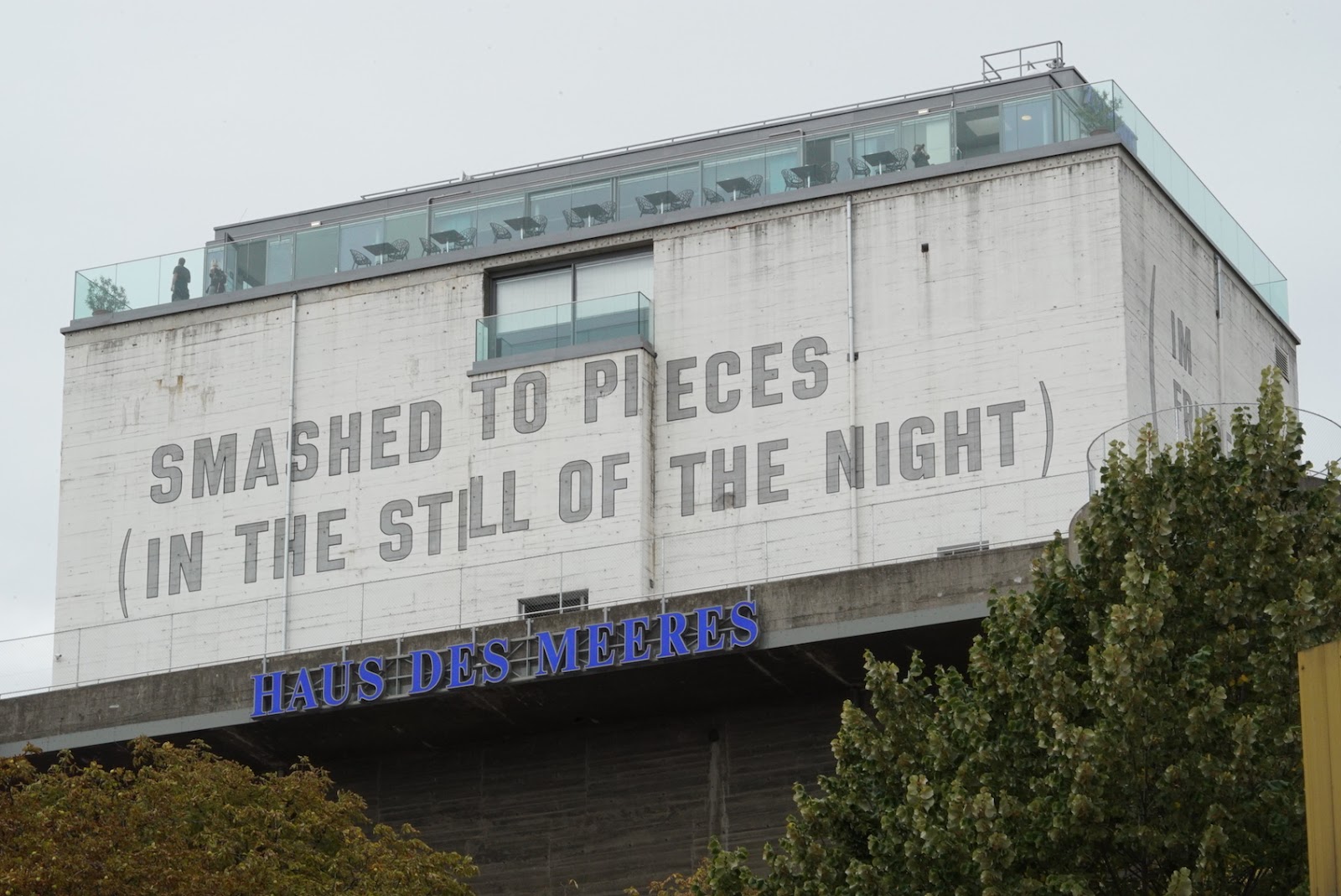
This is one of Vienna's flak towers, built during WW2 and virtually impossible to tear down. This one has been repurposed as an aquarium, and adorned with the commissioned conceptual art seen in this picture.


This looks like a building in Tokyo:


Eventually, I started to revert to old habits, and suddenly red, yellow, and blue appeared, even in Vienna:


Part of the Hofburg Palace:

The Neo-Gothic town hall:

The Neo-Classical Parliament with all its statues:


Put them together:

The imperial figures:

But, if you look harder you can see some more interesting newer architecture from the turn of the century, including this work by Adolf Loos, the Loos House, famous for its lack of window decorations. (In fact, he was required to add the window boxes to appease civic indignation about the lack of proper decoration.)


Otto Wagner's work is the most famous from this era, including his S-Bahn station:


And his postal savings bank:

Details:


I saw it on Sunday, so unfortunately I did not get a chance to go inside.
Other buildings and facades seen on my walks:


I saw a few decorative representations of workers:


This is one of Vienna's flak towers, built during WW2 and virtually impossible to tear down. This one has been repurposed as an aquarium, and adorned with the commissioned conceptual art seen in this picture.
This is the library of the technical university, and these are apparently owl sculptures. Meaning wisdom?

This looks like a building in Tokyo:

And this was the view looking up from the narrow street next to our apartment:


And the old and the new, and a red, yellow, and blue?

Vienna Churches
Vienna, unsurprisingly, has a large number of churches. For the most part, they are baroque churches, with very theatrical and over-the-top decorations. We saw quite a few of them. The most famous is the Stephansdom, which dates back to the 12th century. It is on a square which is the focal point for the entire city. Like Notre Dame in Paris, it is usually mobbed with tourists. And like most older cathedrals, it has various parts finished and unfinished that were added at various times. It does have a wonderful Gothic interior, but lacks the original stained glass windows that were destroyed in WW2. Though I kind of liked the 1950's style windows.


And the light from the windows:

The Karlskirche was constructed in the 18th century, and is about as Baroque as you can get. It has two columns in front modeled on Trajan's in Rome.


Unfortunately, the interior had a large scaffolding in place that is being used for restorations.
Looking up:


As always, there is extraordinary marble:


Eventually, I got tired of trying to avoid the scaffolding in the pictures, and went with the flow:


And here is Otto Wagner's Karlsplatz S-Bahn station, with the Karlskirche in background.
So things didn't change that much in 200 years:

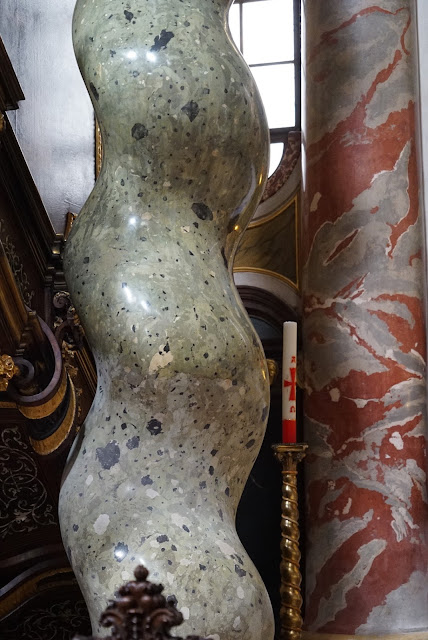
Another exceptional church was the Jesuit Church, just down the block from where we were staying. Again there were elaborate marble concoctions, and in this case a trompe l'oeil ceiling, which became more or less convincing depending on where you stood.


No square inch left unadorned:


The ceiling, with the troupe l'oeil dome:



And for all you organ fans out there, there was a very modest organ:

Sometimes I think about all the extravagant decoration that went into these churches. and the time, money, and craftsmanship that went into their creation. It's certainly not something that I can imagine happening in the present day. Take, for example, the Cathedral of St. John the Divine in the Upper West Side of New York. No one imagines that it will ever be finished, not in a world where people are suffering from lack of food and shelter. The church has even sold off part of the land of the church to help keep the church going.


And the light from the windows:

The Karlskirche was constructed in the 18th century, and is about as Baroque as you can get. It has two columns in front modeled on Trajan's in Rome.


Unfortunately, the interior had a large scaffolding in place that is being used for restorations.
Looking up:


As always, there is extraordinary marble:


Eventually, I got tired of trying to avoid the scaffolding in the pictures, and went with the flow:


And here is Otto Wagner's Karlsplatz S-Bahn station, with the Karlskirche in background.
So things didn't change that much in 200 years:

Another exceptional church was the Jesuit Church, just down the block from where we were staying. Again there were elaborate marble concoctions, and in this case a trompe l'oeil ceiling, which became more or less convincing depending on where you stood.


No square inch left unadorned:


The ceiling, with the troupe l'oeil dome:


Undulating columns:


Sometimes I think about all the extravagant decoration that went into these churches. and the time, money, and craftsmanship that went into their creation. It's certainly not something that I can imagine happening in the present day. Take, for example, the Cathedral of St. John the Divine in the Upper West Side of New York. No one imagines that it will ever be finished, not in a world where people are suffering from lack of food and shelter. The church has even sold off part of the land of the church to help keep the church going.
Subscribe to:
Posts (Atom)