Last spring, when we went to hear the Ring Cycle at the Met, there was a rather eccentric woman who shared our partial view box with us, and with whom we had the occasional scuffle regarding box space and the subtitle displays. She would always arrive about 1 minute before the curtain, carrying an number of bags, and was frequently on her feet to get a better look at the stage. We found out she had seen all three performances of the Ring.
When we got our tickets for the Tempest this fall, we ended up in exactly the same box. We joked as we arrived, at least our lady friend won't be here. At 1 minute before the curtain, she arrived. Maybe she goes every night?
Then, last night, as we stood up from our seats in Fisher Hall after the Mahler, there she was again, sitting in the seats right behind us! It turns out she goes to orchestral concerts too! (Edit: She was there for Wozzeck, too.)
Monday, 19 November 2012

Sunday, 18 November 2012
Mahler 9
Tonight we heard a performance of Mahler's 9th, with the Philharmonia Orchestra conducted by Esa-Pekka Salonen. It was amazing. Vera, who is rumored to know something about Mahler, thought it was the best Mahler performance she has ever heard. The orchestra played with fearsome intensity and precision, and Salonen's conducting brought out all the intricate details in Mahler's scores that others smooth out. Dissonant inner voices, jarring juxtapostions, and Mahler's unique orchestrations were all very audible. There is really nothing like hearing a work like this performed live by an orchestra of this caliber. I am becoming an orchestral junkie!
And tomorrow night, the same forces will be performing "Wozzeck".
And tomorrow night, the same forces will be performing "Wozzeck".
Williamsburg
Last week I went to Williamsburg in Brooklyn, which I haven't been to in years. Williamsburg is now known as the hippest area of NY, where all the younger types go to live and hang out, and where the latest restaurants are. How hip is Williamsburg? When I stopped to get a coffee at a coffee joint, the barista, after serving me, when over to the cafe's turntable, and put on an LP of the Rolling Stones "Beggars Banquet". How many coffee shops do you know that play vinyl? (Though it is debatable whether geezer rock can really be hip...)
Williamsburg is mostly very low rise architecture, with very little of the predominant historic details that characterize area like Brooklyn Heights and Park Slope. But a interesting mix of styles, nonetheless. Some Long Island style renovations...(vinyl siding?)
The most fun, though, was walking back to Manhattan on the Williamsburg Bridge, which was the longest suspension bridge in the world for 20 years, and lives in the shadow of its more famous neighbor. It has a great pedestrian walkway, for some reason painted in pink. You walk above the cars, and slightly parallel and above the subway lines. It lands you in Manhattan in the middle of the Lower East Side.
Some pictures (click to enlarge):
Graffitti, chain link fences and pink railings at the beginning:

The Empire State Building framed:

Strange metal things:

The walkway in pink, with decorations;

The end, as you descend to Manhattan:

The official nameplate for the bridge, as reconfigured by New Yorkers:

Some buildings in Manhattan, as you get off the bridge;

A building in Chinatown, with all windows filled with boxes:

Williamsburg is mostly very low rise architecture, with very little of the predominant historic details that characterize area like Brooklyn Heights and Park Slope. But a interesting mix of styles, nonetheless. Some Long Island style renovations...(vinyl siding?)
The most fun, though, was walking back to Manhattan on the Williamsburg Bridge, which was the longest suspension bridge in the world for 20 years, and lives in the shadow of its more famous neighbor. It has a great pedestrian walkway, for some reason painted in pink. You walk above the cars, and slightly parallel and above the subway lines. It lands you in Manhattan in the middle of the Lower East Side.
Some pictures (click to enlarge):
Graffitti, chain link fences and pink railings at the beginning:

The Empire State Building framed:

Strange metal things:

The walkway in pink, with decorations;

The end, as you descend to Manhattan:

The official nameplate for the bridge, as reconfigured by New Yorkers:

Some buildings in Manhattan, as you get off the bridge;

A building in Chinatown, with all windows filled with boxes:

Brahms, part 2
I heard the NY Philharmonic play Brahms 3rd and 4th symphonies in a concerto-free program on Friday night, conducted by the very frail Kurt Masur. Both symphonies were an absolute pleasure to hear; Masur's tempi were very, very slow, which is fine with me, as it gives more time to savour the details of Brahms's orchestral writing. It is music which I used to know very well, but haven't listened to in years. It still strikes me as a wonderful battle between romantic impulses and Brahms's painstakingly worked out details and construction in the symphonic tradition.
Thursday, 15 November 2012
Another Storm
Not really a storm; we saw the Thomas Adès opera, "The Tempest". We saw it first in the movie theater broadcast presentation, and then in live performance at the Met. This was my first experience of the Met HD broadcasts, and the difference with the live performance is striking. The sound is certainly lacking in the HD broadcast; what you hear is primarily the singing voices, with the orchestra more in the background. With closeup focus on the singers, what you get is primarily an experience of acting and singing. (It becomes more like a movie going experience.) In live performance, though the orchestra is much more present, and the singers and the acting are part of the overall experience. This is especially significant in "The Tempest", which Adès has described as a "symphonic opera". By that he means that the orchestra is the musical focus of the drama, working in parallel with the singers.
I was very much impressed by the opera, in both performances. It feels to me as legitimate descendent of the tradition of the great 20th century operas like "Lulu" and Wozzeck", a stunning musical vision. Adès music is both complex and expressive. As intense a musical experience as I have ever had in an opera house.
Prospero, with Ariel, who sings in Queen of the Night register exclusively...

I was inspired to get a copy of a recent book of conversations with Adès, published in 2012. He turns out to be very entertaining in conversation, and endlessly provocative in his opinions (and he knows it..) Both Vera and I were laughing out loud when reading it. He describes Wagner's music as "a fungus", and has harsh words for Mahler, Britten, and Brahms. But he is also very intelligent regarding his own music, and it is well worth reading.
I was very much impressed by the opera, in both performances. It feels to me as legitimate descendent of the tradition of the great 20th century operas like "Lulu" and Wozzeck", a stunning musical vision. Adès music is both complex and expressive. As intense a musical experience as I have ever had in an opera house.
Prospero, with Ariel, who sings in Queen of the Night register exclusively...

I was inspired to get a copy of a recent book of conversations with Adès, published in 2012. He turns out to be very entertaining in conversation, and endlessly provocative in his opinions (and he knows it..) Both Vera and I were laughing out loud when reading it. He describes Wagner's music as "a fungus", and has harsh words for Mahler, Britten, and Brahms. But he is also very intelligent regarding his own music, and it is well worth reading.
Tuesday, 13 November 2012
Art and Money
The other day, I went to Sotheby's auction house for their exhibit of postwar and contemporary art for their big fall auction. What was there was a dazzling selection of all the big names in postwar art, with major paintings by Rothko, Pollock, Bacon, and anyone else you can think of whose work hangs on the walls of MOMA's galleries of postwar art. As in all the "blue-chip" artists. But the atmosphere is very different from a museum, because all the art is for sale. Instead of art lovers and tourists, you see lots of very important looking people clutching their cellphones, or more likely, people who are busy catering to the needs of very rich people. Instead of descriptions, you get price estimates. (Rothko, estimated value $30 million, and in fact sold for $75 million). It is very disconcerting to see the extent to which the contemporary art world is wrapped up into the world of the one percent. As I staggered out of the 500 or so works on sale, I happened on an exhibit of Pre-Columbian Art (also for sale). Intriguing and beautiful and a welcome contrast.

A few days ago, Vera and I went to the Frick Museum to see a collection of drawings on loan from the Courtaud Institute (wonderful). What resonates with me is that Frick himself was one of the original predatory capitalists, a union buster who was often called the most hated man in America. He spent the last years of his life spending as much money as he could, buying the most expensive paintings he could find. (Three Vermeers, a late Rembrandt self-portrait, etc.) What is amusing is that these masterpieces are all hanging in the formal picture galleries, while the rooms for daily life have mostly pictures of English aristocracy, etc. to which he doubtless aspired to be one of.

A few days ago, Vera and I went to the Frick Museum to see a collection of drawings on loan from the Courtaud Institute (wonderful). What resonates with me is that Frick himself was one of the original predatory capitalists, a union buster who was often called the most hated man in America. He spent the last years of his life spending as much money as he could, buying the most expensive paintings he could find. (Three Vermeers, a late Rembrandt self-portrait, etc.) What is amusing is that these masterpieces are all hanging in the formal picture galleries, while the rooms for daily life have mostly pictures of English aristocracy, etc. to which he doubtless aspired to be one of.
Heiner Goebbels
Tonight we saw an interesting music theater work by the German composer/theatrical artist Heiner Goebbels. It featured texts by T.S. Eliot (Prufrock..), Maurice Blanchot, Kafka, and Beckett (Worstward Ho). Sung and acted by the Hilliard Ensemble (4 male vocalists), with some taped electronic accompaniment. It was a fully staged theatrical presentation, with elaborate sets. It could have been called some kind of opera, though Goebbels refers to it as "concert tableaux".
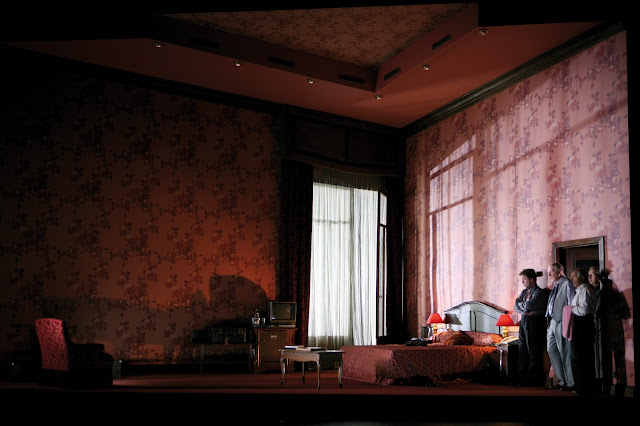

In the set above, each of the singers was in a different window in the house, singing at the same time.
The piece at times was very still. The first 10 minutes are done it almost silence, as the singers enact some very ritualistic packing up of all the materials on the set.
While I can't say that I loved the piece, I was consistently intrigued by the music theater implications of what he was doing. The chief problem was that the text was not often clearly understandable, which does make a difference, especially in the Beckett (""Ever tried. Ever failed. No matter. Try again. Fail again. Fail better.")


In the set above, each of the singers was in a different window in the house, singing at the same time.
The piece at times was very still. The first 10 minutes are done it almost silence, as the singers enact some very ritualistic packing up of all the materials on the set.
While I can't say that I loved the piece, I was consistently intrigued by the music theater implications of what he was doing. The chief problem was that the text was not often clearly understandable, which does make a difference, especially in the Beckett (""Ever tried. Ever failed. No matter. Try again. Fail again. Fail better.")
Sunday, 11 November 2012
Vera's Day
Vera had a wonderful day today. It was warm and sunny. She went jogging along the Hudson River in Riverside Park down to 79th Street, and then she walked over to Zabar's to buy her coffee, etc., and then walked home along Broadway. And she stopped on the way along Broadway and bought a purse! All New York was out and about enjoying the sunny weather, eating outside. What a pleasure!
Saturday, 10 November 2012
Brahms
Last night I did something I usually don't do; I went to the New York Philharmonic to hear a 19th century program. But in this case, it was a fluff-free all Brahms program, and they sent me discount invitations via email. (Vera and our friend Tina went to the movies instead.) In addition, the concert was to be conducted by Kurt Masur, a noted Brahms conductor. The Double Concerto, which I love, was the first half. It had a last minute substitute cellist, and, as well, they announced that Masur would not be able to conduct the piece, but would conduct the second half, Brahms 2nd symphony. So the Double Concerto was conducted by an assistant, and the result was pretty messy. Masur it turns out, is extremely frail, and can barely move. But in any case, the 2nd was a delight, and reminded me of how much I love Brahms, and love hearing it performed by a live orchestra. I thought only Wagner Ring cycles were subject to last minute cancellations.
I bought a ticket for the Brahms 3rd and 4th next week, too.
We still have gas lines out our windows, and car horns honking all day long as people battle over their place in line.
I bought a ticket for the Brahms 3rd and 4th next week, too.
We still have gas lines out our windows, and car horns honking all day long as people battle over their place in line.
Wednesday, 7 November 2012
Climate Change
Ten days ago, Vera and I were sitting outside having lunch on a warm day. Then came Hurricane Sandy. Now we have a classic Northeaster storm, with 40 mph winds and snow blowing sideways. Airports are shut down again, etc. I am not ready for this....
The view out our window:


A very confused pedestrian sign in the snow:

The view out our window:


A very confused pedestrian sign in the snow:

Tuesday, 6 November 2012
Morton Feldman
Last night we heard an extraordinary concert of works for very large orchestra and soloists by Morton Feldman, performed by a Czech orchestra from the town of Ostrova. It was supposedly the first all Feldman orchestral concert in the US, and featured the US premieres of two major works, "Flute and Orchestra" and "Violin and Orchestra". Both Vera and I were totally entranced; Feldman's ear for color is nowhere more apparent than in these orchestral works, and the imaginative variety of his timbres is astonishing. The orchestra played with extreme precision, and in the intimate space of Alice Tully Hall, every note was clear.
Feldman's music is not for everyone. It moves quite slowly, and eschews any kind of grand theatrical gesture or even regular pulse. Once you accept the scope of his music, the musical ideas are consistently interesting. Things are always changing, and musical ideas keep on returning in recognizable transformations. There were also even some very loud brass fortissimos!
The program featured one work written in the early 1960's, and then three works written in the later 1970's which showed Feldman's music evolving into his late style of the 1980's (best exemplified by his 6 hour string quartet!). The last piece, "Violin and Orchestra" was about an hour long, and eventually seems to make time stop. Those who know me know that I am not one to tolerate musical stillness for very long. But somehow, I was able to focus on this piece.
The only disappointment was the sparseness of the crowd; I had thought that we were in a Morton Feldman boom of some kind, and that the hall would be packed for an event this unique.
All in all, one of the most satisfying concerts I have been to in a long time.
Feldman's music is not for everyone. It moves quite slowly, and eschews any kind of grand theatrical gesture or even regular pulse. Once you accept the scope of his music, the musical ideas are consistently interesting. Things are always changing, and musical ideas keep on returning in recognizable transformations. There were also even some very loud brass fortissimos!
The program featured one work written in the early 1960's, and then three works written in the later 1970's which showed Feldman's music evolving into his late style of the 1980's (best exemplified by his 6 hour string quartet!). The last piece, "Violin and Orchestra" was about an hour long, and eventually seems to make time stop. Those who know me know that I am not one to tolerate musical stillness for very long. But somehow, I was able to focus on this piece.
The only disappointment was the sparseness of the crowd; I had thought that we were in a Morton Feldman boom of some kind, and that the hall would be packed for an event this unique.
All in all, one of the most satisfying concerts I have been to in a long time.
Sunday, 4 November 2012
Normal?
As I write, things are getting a bit back to normal in Manhattan, but the rest of New York is still in a desperate state. We now have subway service down to 14th Street! What has been noticeable walking around the last few days is how nice Manhattan is with fewer cars, as a consequence of driving restrictions and the gasoline shortage. It never really occurred to me how many people consider it normal to use their cars to get around Manhattan. They did try to introduce congestion charges a few years ago, as in London, but it was vetoed by the Albanians (the State Legislature).
Except that this morning, I heard another symphony of car horns honking, with loud, barking voices outside our window. It turns out that there is a gas station on 96th Street, and there was a long line of cars on West End Avenue waiting to get gas. So the police were there, with street barriers, and of course, fights between drivers trying to cut into the line at the intersections.
Update: We still have our gas queue, with its attendant police supervision. Whenever the police go away, the car horns start and chaos resumes. It feels like the 1970's. An energy crisis! Luckily, we are in NY, so it doesn't matter if all those in line for gas vote for Romney to drill more oil for them. And, hopefully, they don't have guns.
At 6 PM there were three policeman supervising the chaos.
Except that this morning, I heard another symphony of car horns honking, with loud, barking voices outside our window. It turns out that there is a gas station on 96th Street, and there was a long line of cars on West End Avenue waiting to get gas. So the police were there, with street barriers, and of course, fights between drivers trying to cut into the line at the intersections.
Update: We still have our gas queue, with its attendant police supervision. Whenever the police go away, the car horns start and chaos resumes. It feels like the 1970's. An energy crisis! Luckily, we are in NY, so it doesn't matter if all those in line for gas vote for Romney to drill more oil for them. And, hopefully, they don't have guns.
At 6 PM there were three policeman supervising the chaos.
Wednesday, 31 October 2012
Cacaphony
Today, people in NY were trying to get back to work. Which meant in their cars. Which meant that Manhattan was in a state of absolute gridlock. Which meant that, outside our window on West End Avenue, there have been car horns honking non-stop all day long. Varese would have been thrilled; me, not so much.
When I went out, I discovered that it was Halloween. I also discovered that, in NY, kids go trick-or-treating at stores along Broadway. So the local pizza joint hands out candy to kids, as does the dry cleaner. I wonder how long this has been going on?
Tomorrow we are supposed to get limited subway service...
When I went out, I discovered that it was Halloween. I also discovered that, in NY, kids go trick-or-treating at stores along Broadway. So the local pizza joint hands out candy to kids, as does the dry cleaner. I wonder how long this has been going on?
Tomorrow we are supposed to get limited subway service...
Tuesday, 30 October 2012
Hurricane Sandy
As I write on Tuesday afternoon, the storm is mostly over, but NY is a total mess. We spent the storm inside our apartment, looking out the windows. From our perspective, it was an unusually windy day, with some light rain. Which is why it was so strange to turn on the television, and see images of streets flooding, power outages, and general chaos 60 blocks to the south of us. In the Upper West Side, taxis were still driving around at the height of the storm (until the mayor kicked them off the streets..) We almost felt as if we were watching news from another city; a strange disconnect. It was also very disconcerting to see images of areas we had just walked in a few days ago now under water. (The Chelsea gallery area was flooded, too.) Today, everything is very quiet, things are still pretty much closed, even though our neighborhood has power. Still no public transportation, and it will be quite a while before the subways get going again.
Life in New York is never dull!
Subway steps, unused...

All the city parks are "closed", with yellow tape at all entrances. Which for New Yorkers of all ages, is certain provocation to enter. Many people were milling about, taking pictures of fallen limbs and trees. Here are some trees that didn't fall down in Riverside Park:

Life in New York is never dull!
Subway steps, unused...

All the city parks are "closed", with yellow tape at all entrances. Which for New Yorkers of all ages, is certain provocation to enter. Many people were milling about, taking pictures of fallen limbs and trees. Here are some trees that didn't fall down in Riverside Park:

Monday, 29 October 2012

Saturday, 27 October 2012
St. John the Divine
On a neighborhood walk the other day, I stumbled in to the Cathedral of St. John the Divine, by some measures the largest cathedral in the world, and perpetually unfinished. I have walked by in many times, but I haven't been inside in many years. The interior space is truly impressive. And entering into a gothic style cathedral from the streets of NY's upper west side is a totally incongruous experience.
Paris or New York?

The interior

The light through a stain glass window on a perpendicular wall:

Another church in the neighborhood. Where am I?

A favorite entranceway in our neighborhood:

Paris or New York?

The interior

The light through a stain glass window on a perpendicular wall:

Another church in the neighborhood. Where am I?

A favorite entranceway in our neighborhood:

A Long Walk
Vera and I decided to take a long walk today, considering that, with the imminent arrival of Hurricane Sandy, we might not be going anywhere for a few days, with heavy rains predicted and the possible shutdown of the subway system. (Vera wants to get some sandbags for our apartment!)
We started out just north of the World Trade Center, and walked through all the chic districts: TrBeCa, the Meatpacking District, The West Village, and the southern part of Chelsea, with a stop at a Belgian Brasserie for lunch, sitting outside in the still warm weather. New York is endlessly fascinating in its variety of architecture and people. All of these reclaimed industrial areas have a broad mix of all kinds of buildings, from clusters very small 2 or 3 story 19th century houses to mammoth industrial warehouses, with bits of modern architecture mixed in, both high end and plain. Chic restaurants and high end boutiques next to shipping warehouses still functioning. The people are equally mixed.
We also walked a bit along the seawall (they don't call it that here), the Hudson River Park.
Pictures:
The seawall with the new WTC in the background (and some serious black clouds):

(Update after Hurricane Sandy: this area was all under water during the storm..)
Some old houses:


And here is a self portrait in front of a store selling very chic black pumpkins:

We started out just north of the World Trade Center, and walked through all the chic districts: TrBeCa, the Meatpacking District, The West Village, and the southern part of Chelsea, with a stop at a Belgian Brasserie for lunch, sitting outside in the still warm weather. New York is endlessly fascinating in its variety of architecture and people. All of these reclaimed industrial areas have a broad mix of all kinds of buildings, from clusters very small 2 or 3 story 19th century houses to mammoth industrial warehouses, with bits of modern architecture mixed in, both high end and plain. Chic restaurants and high end boutiques next to shipping warehouses still functioning. The people are equally mixed.
We also walked a bit along the seawall (they don't call it that here), the Hudson River Park.
Pictures:
The seawall with the new WTC in the background (and some serious black clouds):

(Update after Hurricane Sandy: this area was all under water during the storm..)
Some old houses:


And here is a self portrait in front of a store selling very chic black pumpkins:

World Series: Mahler 8, Ives 4
Last night we went to hear the American Symphony Orchestra, conducted by Leon Botstein, in a program of Ives' 4th Symphony and Mahler's 8th. Either one of the pieces is an incredibly complex undertaking for both orchestra and listeners that would normally be the centerpiece of any evening. Sadly to say, Botstein and his orchestra would never be mistaken for the NY Philharmonic, and there were numerous flubs throughout the evening, including 2 false starts for the second movement of the Mahler. That said, it was a treat to hear Ives 4th, which is rarely performed, and one of the landmark pieces of the 20th century. I last heard it performed by the NY Phil. with Boulez conducting in the 1970's. All of Ives' crazy juxtapositions and startling dissonances were there, and it is inspiring to hear his way of hearing music, which is very different. We don't get expressionist climaxes of angst; things clash and then they stop. The Mahler had so many people on stage that parts of the chorus were on the second tier balcony, about 3 seats over from us. What the orchestra and chorus lacked in cohesion they made up for in sheer quantity of sound. It was a pleasure to hear Vancouver's Tyler Duncan as one of the singers, though they were not clearly audible as Botstein placed them in the back of the stage among the chorus.
It was the 50th anniversary of the orchestra's first concert, so all tickets were priced at their original price, as in 5 or 7 dollars.
It was the 50th anniversary of the orchestra's first concert, so all tickets were priced at their original price, as in 5 or 7 dollars.
Thursday, 25 October 2012
Asian Art
I saw several exhibits at the Metropolitan Museum of Art that featured Chinese and Japanese art devoted to depictions of nature and gardens. The Chinese art featured works starting from the 11th Century. I am beginning to think that I need to re-educate myself in the history of art. After a lifetime of viewing early European art centering around religion and portraits of important people, it is interesting to contemplate the very sophisticated traditions of Asian art. The Chinese works I saw were painted and drawn on silk, beginning in the 11th century, and are in a remarkable state of preservation. They come from a very different way of looking at the world. I especially like the very long scroll paintings, images that you simply can't take in without moving your eyes. Here are a few examples, dating from the 11th and 12th centuries (click to make them bigger):


The Morgan Library
I saw the exhibition of 100 drawings at the Morgan Library. They were from a Munich museum, and ranged from Renaissance to contemporary. The older drawings were fascinating; especially the Renaissance ones. One thing that struck me about these drawings was that both the technique and purpose of the drawings varied widely, even in the Renaissance. Some were sketched in just a few details in a way that seemed very modern (perhaps as studies for larger works, while others were fully detailed works of art, using a wide variety of techniques for manipulating chalk, ink and paper. In addition, the texture of the paper, in some cases 500 years old, lends an interesting texture to the work.
One example, by Pontormo:

The Morgan Library, of course, contains lots of other things in its collection, books and illuminated manuscripts, and the loot of J.P.'s acquisitions. As my friend Santa said, perhaps this is reminder of what we are in for in the future if indeed we enter the Age of Romney and the one percent.
One example, by Pontormo:

Subscribe to:
Posts (Atom)