One of our main reasons for going to Bucharest at this time was to go to the Georges Enescu Festival, which is a three week classical music festival featuring an astonishing number of high quality concerts. The festival brings in orchestras from all over the world, including the London Philharmonic, Concertgebouw Orchestra, Russian National Orchestra, etc. As well as the predictable line-up of classical music star soloists. There are usually four concerts a day. The programming, for the most part, is the same old repertoire, with the notable exception of a focus on the work of Enescu. The major event for us was to hear Enescu's opera "Oedipe" in a concert performance. It is a truly extraordinary work, and is rarely done. It should be recognized as one of the major works of 20th century opera; but it has never been done by the Metropolitan Opera as far as I know. The performance was spellbinding. Enescu's musical language is something quite original; it is relatively consonant and tonal, and yet the music moves in ways that always seem original and unexpected. He uses folk music elements along with some traditional avant-garde devices, but it all sounds coherent. It is however, quite dense, which perhaps explains the fact that the music is not more popular. We also heard some other Enescu works in the festival that were excellent; but I'm afraid that Enescu has fallen into that black hole of classical music categories, the composer known for one particular work (Romanian Rhapsody) which ends up being the only work that is ever played.
The festival is a very popular event, and many concerts sell out. Unfortunately, the only venue for large scale orchestral concerts is a very large hall seating 4,000 people, built during the Communist era as a place for party meetings. etc. While the sound is full and present, many other details get lost, particularly with soloists. When you hear the Prokofiev 3rd Piano Concerto and you can't hear the soloist very well, that's not good. The same was true for the Berg Violin Concerto, where the soloist was frequently inaudible.
Bucharest does have a wonderful smaller concert hall, the Romanian Atheneum, which seats 900 and is a visual wonder. Elaborately decorated, the auditorium is in a circular shape. We heard string octets there, but the sound was too reverberant for my taste.
Because the festival is a popular event, you see behavior that you might not see, say, in Vienna. Cell phones are frequently in use, and people come and go. But I'm happy they are there, and I just close my eyes.....
Monday, 11 September 2017

Sunday, 10 September 2017
Bucharest 5 - A Visit with Vera's First Piano Teacher
On a previous trip to Bucharest, Vera ran into the woman who had been her first piano teacher and a friend of her family. This time, we went to visit her in her house in the middle of Bucharest, where she has lived for more than 50 years. It was an fascinating visit. Vera spent a lot of time hearing about her family and the past. As she didn't really speak English, I spent a shorter time there. Her house was was extraordinary, filled with works of art and antiques, almost like a museum or time capsule. I took pictures.


This telephone was actually connected.


This telephone was actually connected.


Bucharest 4
After 6 days of walking the streets of Bucharest, I am more and more fascinated by what I see. Despite all the degradations I have described in an earlier post, there is a tremendous richness and variety of architecture. There are so many beautiful old buildings, some decrepit, some restored. There are dilapidated ruins next to glossy new buildings, concrete Communist era monstrosities next to 18th century Orthodox churches, and an amazing number of ornate late 19th century French style villas and very large commercial and governmental buildings. Apparently a newly prosperous and independent Romania in the 19th century sent all its would-be architects to France to be trained, and it shows. And like many Communist countries, the state never got around to tearing down old buildings in the same way that more prosperous democracies did. I think that if Romania becomes more and more prosperous in the next 20 years, Bucharest will become one of the more beautiful cities in Europe. Though the ugly parts will still exist.
Here are some more photographs from the streets;
This is the National Theater, an enormous edifice that was the pet project of Mrs. Ceaucescu:

A bank building from the late 19th century:


Most of the wiring seems to be outside on the walls:

I like these windows:


Examples of decay:


Paris, anyone?

This is the house that Vera grew up in:

Typical decaying concrete apartment blocks and wires:

Communist heros:

More overgrown:

Ceaucescu's "grand boulevard", with the palace in the distance. The sidewalks on the boulevard are quite empty, and there are few stores. People go elsewhere.

Bucharest also has many small Orthodox churches that have survived, along with several synagogues that have been restored. The interiors are striking; the Orthodox churches are all painted with frescoes inside, while the synagogues are decorated with non-representational patterns.
Churches:


After looking at this for a while, it started to turn into an Agnes Martin painting:


These are modern stain glass windows. Art Nouveau?


Synagogues:
This is the Great Synagogue of Bucharest. Ceaucescu tore down all the old buildings around it, and it is now nestled among parking lots and apartment blocks. At least it is still there!

The pictures below are from the interiors of two synagogues, the Great Synagogue and the Templu Corol:


I visited the George Enescu house, which was the composer's home. He had married the daughter of one of Romania's wealthiest men. This was his house:

Inside were a number of interesting mementos of his career. But the Enescus actually lived in a smaller house in the back. His room:

Their bathroom:

Here are some more photographs from the streets;
This is the National Theater, an enormous edifice that was the pet project of Mrs. Ceaucescu:

A bank building from the late 19th century:

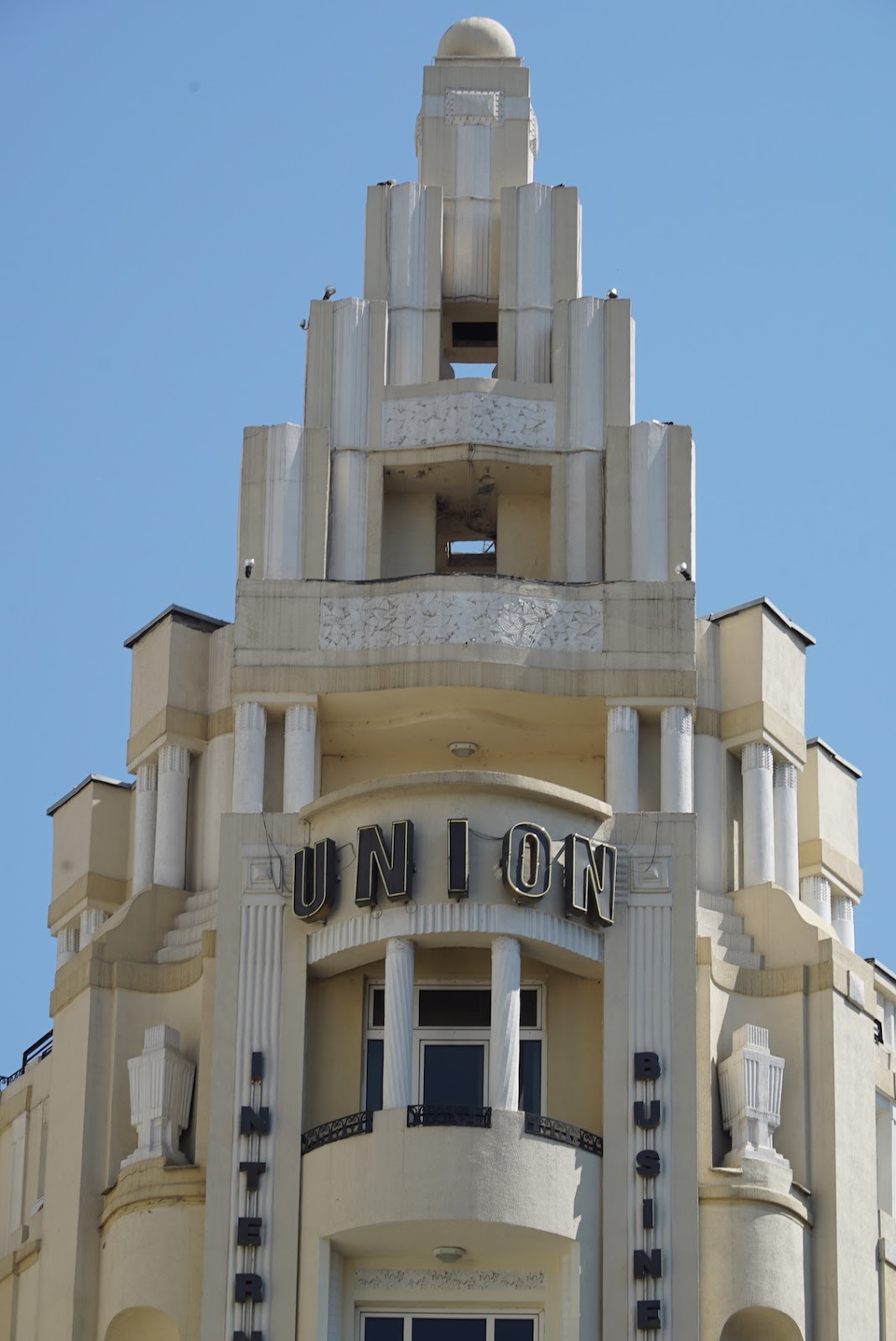
Most of the wiring seems to be outside on the walls:

I like these windows:


Examples of decay:


Paris, anyone?

This is the house that Vera grew up in:

Typical decaying concrete apartment blocks and wires:

Communist heros:

More overgrown:

Ceaucescu's "grand boulevard", with the palace in the distance. The sidewalks on the boulevard are quite empty, and there are few stores. People go elsewhere.

Bucharest also has many small Orthodox churches that have survived, along with several synagogues that have been restored. The interiors are striking; the Orthodox churches are all painted with frescoes inside, while the synagogues are decorated with non-representational patterns.
Churches:


After looking at this for a while, it started to turn into an Agnes Martin painting:


These are modern stain glass windows. Art Nouveau?


Synagogues:
This is the Great Synagogue of Bucharest. Ceaucescu tore down all the old buildings around it, and it is now nestled among parking lots and apartment blocks. At least it is still there!

The pictures below are from the interiors of two synagogues, the Great Synagogue and the Templu Corol:


Inside were a number of interesting mementos of his career. But the Enescus actually lived in a smaller house in the back. His room:
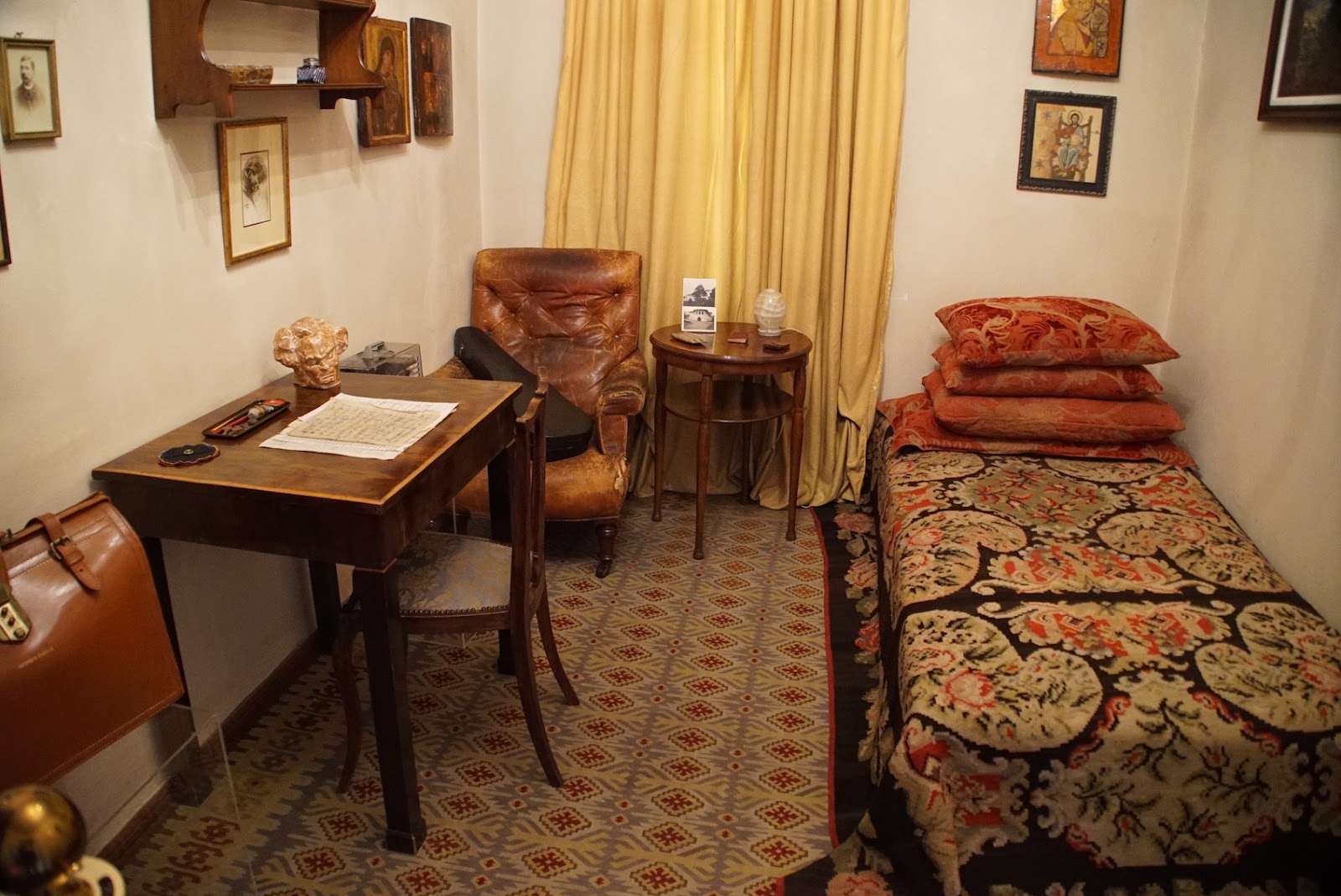
Their bathroom:

Wednesday, 6 September 2017
Bucharest 3 - The World's Second Largest Building
Today we saw the world's second largest building (the Pentagon is the largest). It's the Palace of Parliament, and was constructed (but not finished) under the regime of Ceausescu. It was a shattering and confounding experience. It's an appalling monument, created by a true megalomaniac tyrant, and a testimony to the extremes of fanaticism. The building was conceived by Ceausescu as a moment to himself, conceived on the scale of a Versailles or Winter Palace. It has 1,100 rooms, only 400 of which were ever finished. It required 700 architects, and 20,000 laborers working in shifts 24 hours a day for many years. It cost billions of dollars at a time when many Romanian people did not have enough to eat. It's one thing to read about the French kings building their palaces and bankrupting their nation, and its another thing to conceive of a man doing the same thing with such absolute power in our current age.
The building from the outside is quite ugly, littered with ill-proportioned neoclassical elements.

This is the side view, the front is much longer:

Entrance is via guided tours only, and done with a security process and byzantine bureaucracy worthy of the building's totalitarian origins. But what is finally confounding as you go through the tour is the sheer opulence and jaw-dropping size of the rooms. It really looks like a brand new (and larger) Versailles or Winter Palace. And in fact there is clearly a great deal of craftsmanship that went in to creating these state rooms. There are numerous enormous chandeliers, wood carvings, decorative plaster, grandiose marble stairways, etc. It's all truly unbelievable, as if you had been transplanted to some strange movie set. It's confounding because you are naturally awed by the place while at the same time appalled by its origins as the product of great tyranny. Ceausescu really was crazy. Our guide pointed out some ventilation spaces in the ceiling, and told us that Ceausescu refused to allow air conditioning to be installed because he was afraid it would be used to poison him.
Pictures cannot really convey the enormous size of the interior spaces.
This is the ceiling of the concert hall. There are enormous chandeliers everywhere in the building:


There are endless corridors, with state rooms that are mostly empty:


A ceiling:


A skylight:


Enough is enough! You get the picture..
At the end, you are taken to the balcony overlooking the "grand boulevard" created by Ceausescu to lead up to his palace. It's deliberately a few feet wider than the Champs Elysee. This was created by destroying entire neighborhoods of older parts of Bucharest.

A few details of the exterior;

At the end, I half wanted to see it destroyed, because if you admire it, you are in fact doing what Ceausescu wanted to happen. On the other hand, I also think the people that worked on it should be remembered, too. In the meantime, the Romanian government is using part of the building for its parliament. Other parts are used as conference centers, and another part has been turned into a contemporary art museum. And there are still 700 rooms, unused and unfinished!
The building from the outside is quite ugly, littered with ill-proportioned neoclassical elements.

This is the side view, the front is much longer:

Entrance is via guided tours only, and done with a security process and byzantine bureaucracy worthy of the building's totalitarian origins. But what is finally confounding as you go through the tour is the sheer opulence and jaw-dropping size of the rooms. It really looks like a brand new (and larger) Versailles or Winter Palace. And in fact there is clearly a great deal of craftsmanship that went in to creating these state rooms. There are numerous enormous chandeliers, wood carvings, decorative plaster, grandiose marble stairways, etc. It's all truly unbelievable, as if you had been transplanted to some strange movie set. It's confounding because you are naturally awed by the place while at the same time appalled by its origins as the product of great tyranny. Ceausescu really was crazy. Our guide pointed out some ventilation spaces in the ceiling, and told us that Ceausescu refused to allow air conditioning to be installed because he was afraid it would be used to poison him.
Pictures cannot really convey the enormous size of the interior spaces.


There are endless corridors, with state rooms that are mostly empty:


A ceiling:


A skylight:


Enough is enough! You get the picture..
At the end, you are taken to the balcony overlooking the "grand boulevard" created by Ceausescu to lead up to his palace. It's deliberately a few feet wider than the Champs Elysee. This was created by destroying entire neighborhoods of older parts of Bucharest.

A few details of the exterior;

At the end, I half wanted to see it destroyed, because if you admire it, you are in fact doing what Ceausescu wanted to happen. On the other hand, I also think the people that worked on it should be remembered, too. In the meantime, the Romanian government is using part of the building for its parliament. Other parts are used as conference centers, and another part has been turned into a contemporary art museum. And there are still 700 rooms, unused and unfinished!
Subscribe to:
Posts (Atom)