Sunday, 14 April 2013

Bedford-Stuyvesant

On Saturday I took a long walk through the Bedford-Stuyvesant neighborhood in Brooklyn.  I was curious to see the architecture, but I also wanted to find the home of my great-grandparents, who lived at 101 Hancock Street.   This was the house that my maternal grandfather grew up in.  His parents were Henry Nelson Meeker and Clara Jones Meeker.  The house was originally owned by my great great grandfather, one John Wesley Jones, who was known as a photographer in the mid 19th century.
And there it was; nothing particularly distinctive, looking just like the neighboring houses, and without even an identifying number. But interesting for me to think that my grandfather, whom I knew when I was a child, grew up there. He was born in 1889.
Here is the house:


After that, I went wandering through the neighborhood, which has all kinds of beautiful homes, including a historical district.  Bedford-Stuyvesant is a predominantly African-American community; it was known in the 60's and 70's as an area of great poverty and frequent racial conflicts.  It is now slowly gentrifying, with a more affluent population, both black and white,  moving in, and many of the older homes being restored.   Here is a selection of photographs of buildings in the area.  (Click to enlarge)


Two churches:


A former movie theater:


More houses:


and things in need of restoration:


Tuesday, 9 April 2013

A Carter Sandwich

On our last night in Berlin, we went to hear the Staatsoper Orchestra conducted by Daniel Barenboim.  The program was three Mozart pieces, framing two works by Eliot Carter, (both written after the age of 100), "Sunbeam's Architecture" and a bass clarinet concerto.  We were eager to hear the Carter, as his music is never, ever performed in Vancouver, and in fact quite rarely in New York, now that the novelty factor of his advanced age has worn off.  The major disappointment, though, was that the tenor who was to sing both some Mozart arias and the first Carter piece was not feeling well. Thus the Mozart was terrible, and the Carter piece was canceled at the last minute.   I loved the bass clarinet concerto; it still sounded like the Carter I know of his earlier periods, but with more clarity and relative simplicity.  I wish I could hear more of this music!   With the Mozart, I found Barenboim's conducting overly idiosyncratic and impossible to watch.  He sometimes does nothing, leaning with one hand on the railing in front of the podium, waiting for something which he abruptly decides to emphasize.  Vera liked his Haffner Symphony alot, though.

We woke up at 6 AM to catch our plane to New York, dodging the few remaining piles of snow, and arrived in New York to find summer in full swing, with the temperature 82 degrees.

Berlin Mitte

Yesterday, our last in Berlin, I took a long walk through the central area of "old" Berlin, while Vera did Vera things.   I started out in Prenzlauerberg, where we had rented an apartment.  Prenzlauerberg has made the transition from being an area where post-reunification squatters first settled, then to being the hip Williamsburg of Berlin, and now it is more like Park Slope, with baby strollers abounding.  It has lots of nice cafes and restaurants, and has more of the untouched flavor of the old city.   (We were staying in a building which had once been one of the famed workers barracks of Berlin, now nicely renovated.)   I saw this historic former water tower, which had been turned into apartments.


I also saw these three accordion players at Alexanderplatz, who were doing a very lively and precise version of the storm music from the Four Seasons:


I then walked on to the central part of the Mitte area, which is the heart of the old Imperial Berlin.  This area, of course, was mostly destroyed in WW2, and has been under construction/restoration/redestruction for the past 60 years.  And from the looks of it, its going to take another 60 years to finish.   The whole area is still a vast construction site:


The opera house is being renovated, and they are apparently going to rebuild the original Schloss, the home of the Hohenzollerns, which was torn down in an anti-imperialist frenzy by the East Germans after the war.  It makes for a bizzare landscape, where fragments of original facades abut against simulated facades, or totally modern facades.
And those pipes are everywhere!  Fun pictures for me to take:


The left building is a fake facade on a framework, the right is an old church.


The Berlin town hall, with that pesky Fehnsenturm:


Berlin is still striking for its vast amounts of unbuilt space, and, in some cases, abandoned buildings that look like contemporary Detroit abut brand new flashy constructions.  And, this being Berlin, when there are empty buildings, squatters move in.   Here, in a view from the window of a very nice apartment, is a squatters habitation, along with a clearly expressed opinion of the next potential stage in gentrification:


A fascinating city, always transforming itself,,,

Sunday, 7 April 2013

A day with friends

Today we met with our friends Richard and Odette, and their daughter Maia, who are staying in Berlin for 3 months.  We had a nice leisurely lunch, catching up, and then spent the rest of the afternoon wandering around the Museum Insel.  This island, home of some of Berlin's most beautiful museum buildings, has been in a constant state of reconstruction and restoration since the end of the war.  And they still have a ways to go.

Vera with our friends:


Here is a facade that still has bullet marks from the war:


I love the red marble on this facade:


And I still can't resist the colors of construction, especially combined with the old buildings:


The S-Bahn is on the left; it travels right through middle of the island:


The dome of the Berliner Dom, with the Fehnsenturm in the background.


Architecture in Paris

While in Paris, I saw this beautiful church facade:


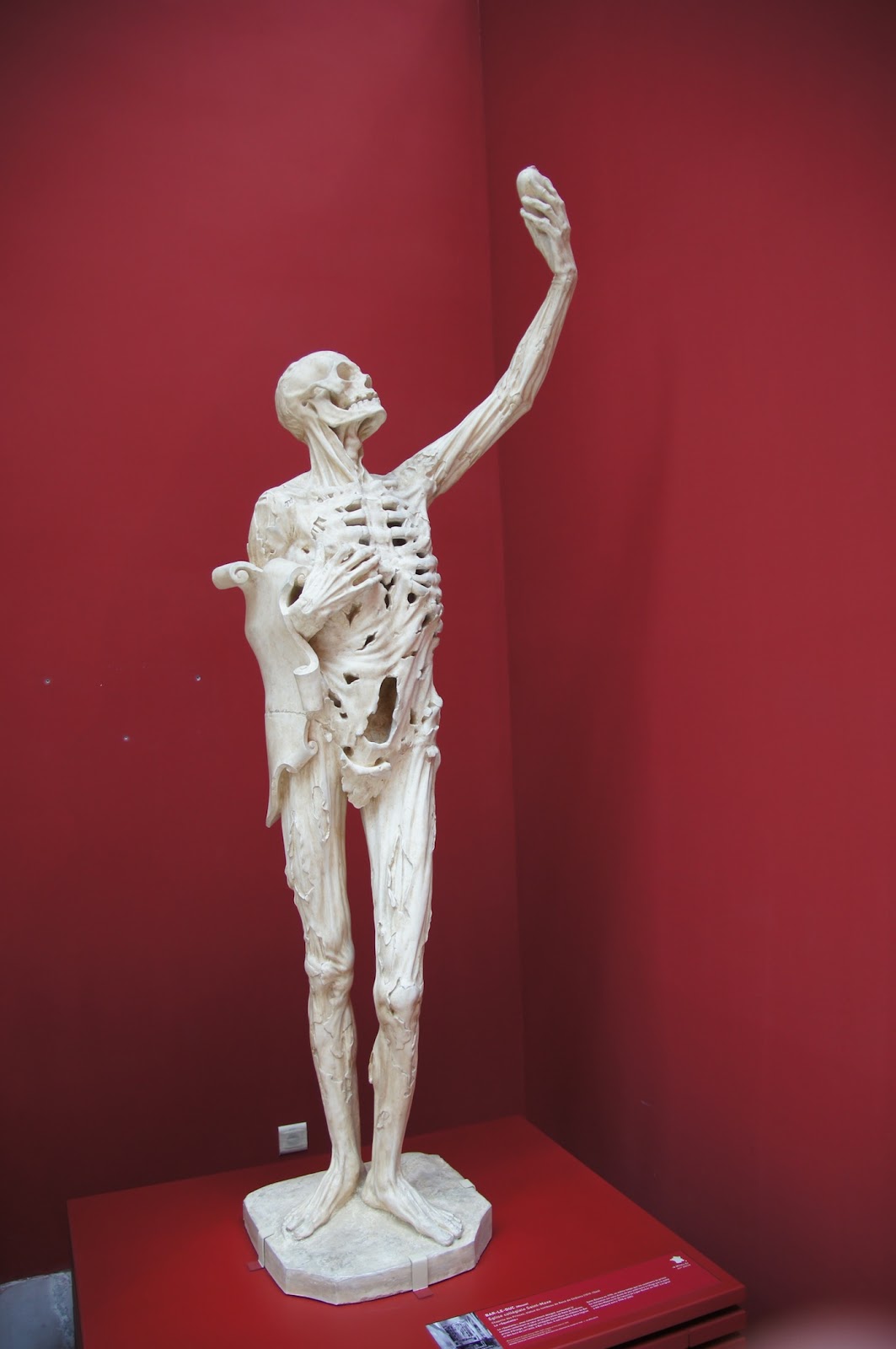
Actually, that's not really true.  On was on my way to the museum of Asian art, but when I got out of the metro, there was the museum of architecture in the Palais Chaillot, and in I went.   What they have is a large number of plaster casts of the facades of old buildings in France, some of the casts dating back to the nineteenth century, and all of them looking quite realistic.  While it was interesting to see all of the works in close up detail, the overall effect was rather bizarre, seeing all the facades jumbled together in a single space.


Plus this guy:


Paris Wrapup

Even though we are in Berlin, I still have a few more Paris things to talk about.

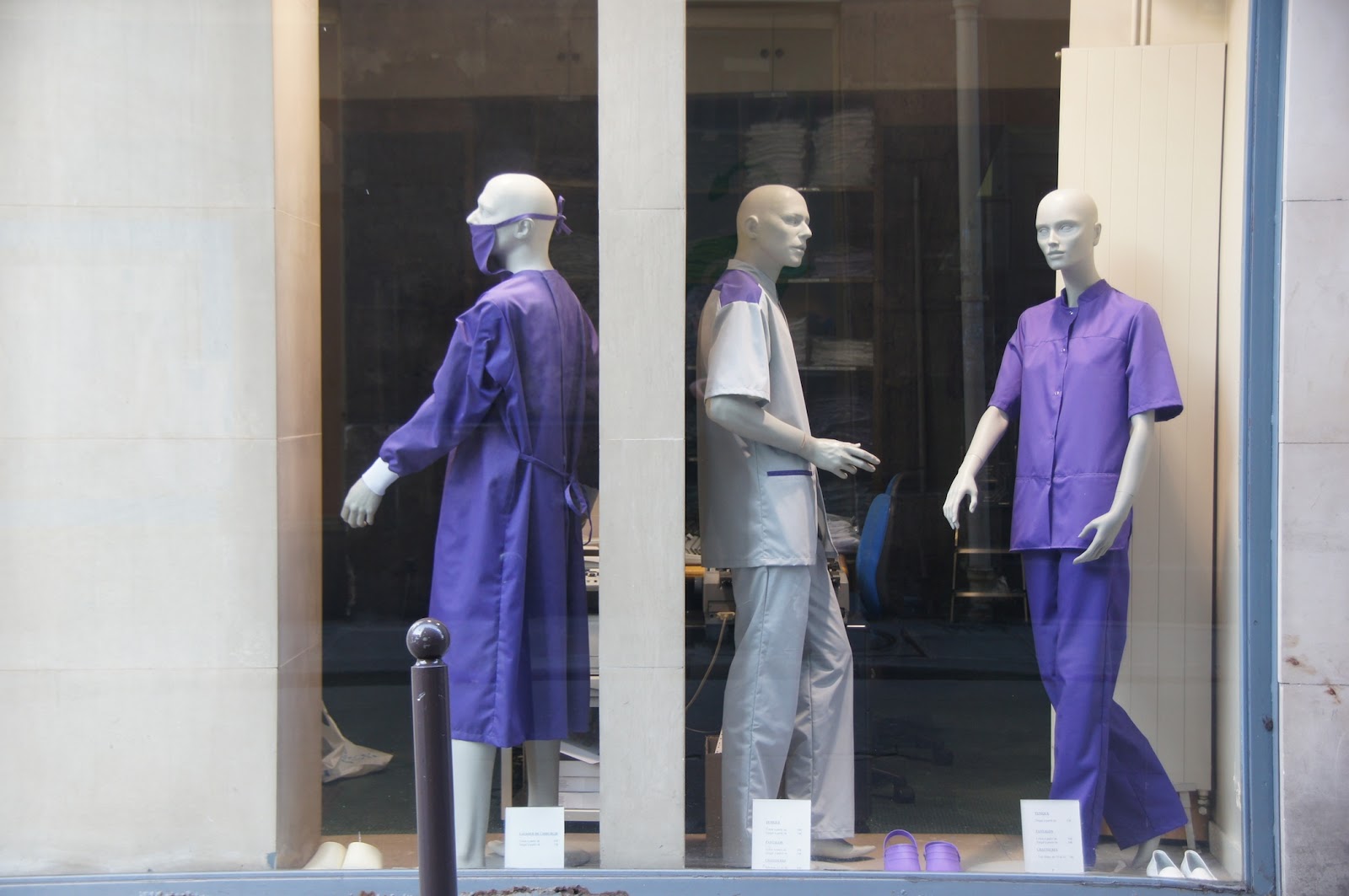
One of the things I love about Paris is the sheer variety of stores and storefronts that you encounter as you walk about. I don't know of any other city which sustains such a variety of seemingly marginal retail establishments; I don't know how it is possible.   I know of at least 5 different stores that sell the kind of wooden games and puzzles that I love; this time I noticed a store that sold nothing but things made out of pistachios, and, an old favorite, a store which sells only corkscrews, old and new.   And, of course, coming from a culture where bookstores are almost extinct, there is the seemingly infinite number of bookstores, devoted to anything obscure and with no air of any kind of profitability.   What a treat!

A store for very chic medical uniforms:


On one of the last days I went to see a show at the Fondation Cartier-Bresson, established by the late photographer.  The show was from the collection of Howard Greenberg; a stunning collection of prints from the 1930's onwards.   In an age of the increasing quality of photographic reproductions in books, it is wonderful to be reminded of the visual qualities of a well done silver gelatin print.  There were several by Josef Sudek and others that I loved.

No reproductions.


The stairway in the Fondation:


While I was in Montparnasse, I ended up walking through the famous cemetery.  I wanted to see the grave of Samuel Beckett, but somehow the cemetery map was upside down, which upended my sense of direction, so I couldn't find it.   (What sort of a marker would he have?)   I did see the grave of Serge Gainsbourg, who clearly has an active fan base:


And the grave of someone who was clearly about turkeys:


Another thing I saw in Montparnasse was the Jardin Atlantique.  A kind of "conceptual" garden as only the French can conceive, it was built in the 1990's above the tracks of the Montparnasse Station as part  of a large development.  Now it looks fairly decrepit, especially in winter.  Odd sorts of sculptural elements abound, as do fenced off areas where things have fallen apart one way or another.


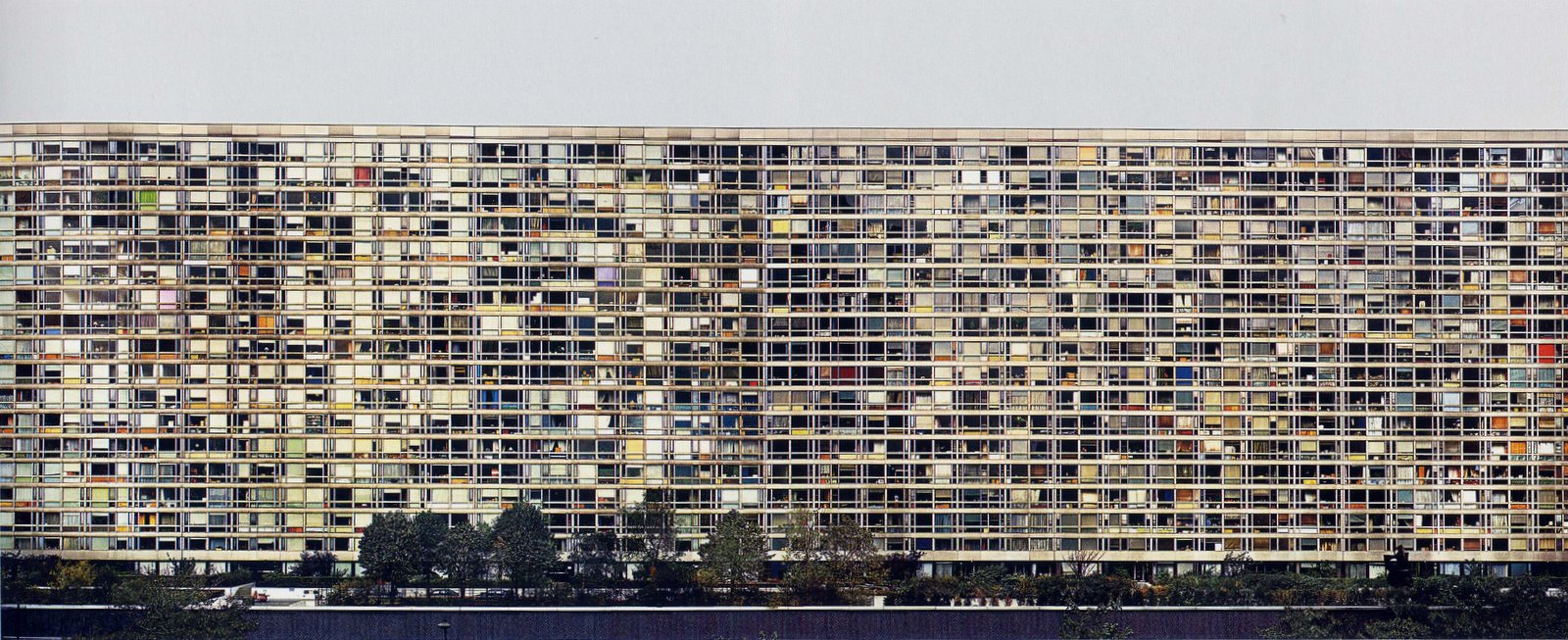
And there was the facade that I had seen portrayed at the Park Avenue Armory show and posted a picture of.   (A facade made famous in a photograph by Andreas Gursky).

Gursky:


Armory show:


  Taken by me, it looks like this:


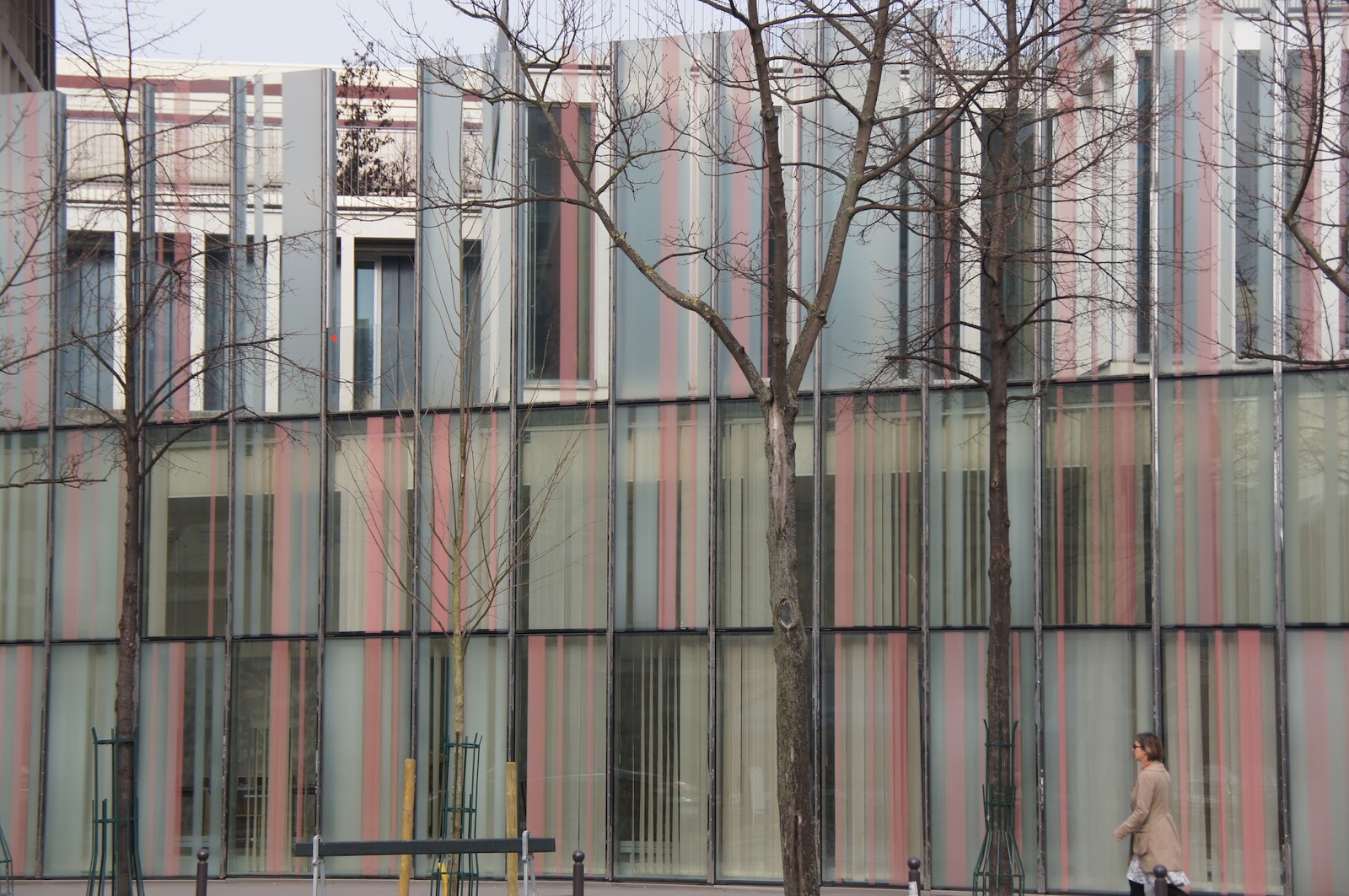
And here is another colorful facade of a non-famous building in Montparnasse, some sort of government building (they have those).


I also went one day to visit an exhibition at the Czech Institute.  The show was an homage to the work of the great Czech artist Jiri Kolar, primarily known for his collages  (and "crumblages").   100 different works by different artists, and I like some of them a lot.  Here is one from my iPhone:


On our last day in Paris, although it was still very cold, at least the sun came out, and people were suddenly sitting outside in cafes, even the blue-haired set:


Until the next time!

Saturday, 6 April 2013

More Berlin Pictures

I went to the outer fringes of Berlin to see a famous cinema, the Titania Palast.   Built in the 1920's, it was a beautiful example of modernism and "New Objectivity".
It looked like this:


Miraculously, it survived the war  As the only intact large theater space in Berlin, it was where the Berlin Philharmonic had its first postwar performances.  So I wanted to see it.   Alas, what Allied bombers failed to achieve, consumer capitalism has.  The front of the theater is now a clothing store, and the theater itself has been multiplexed.  A photo, avoiding the storefront:


I am going to remove those signs in Photoshop!


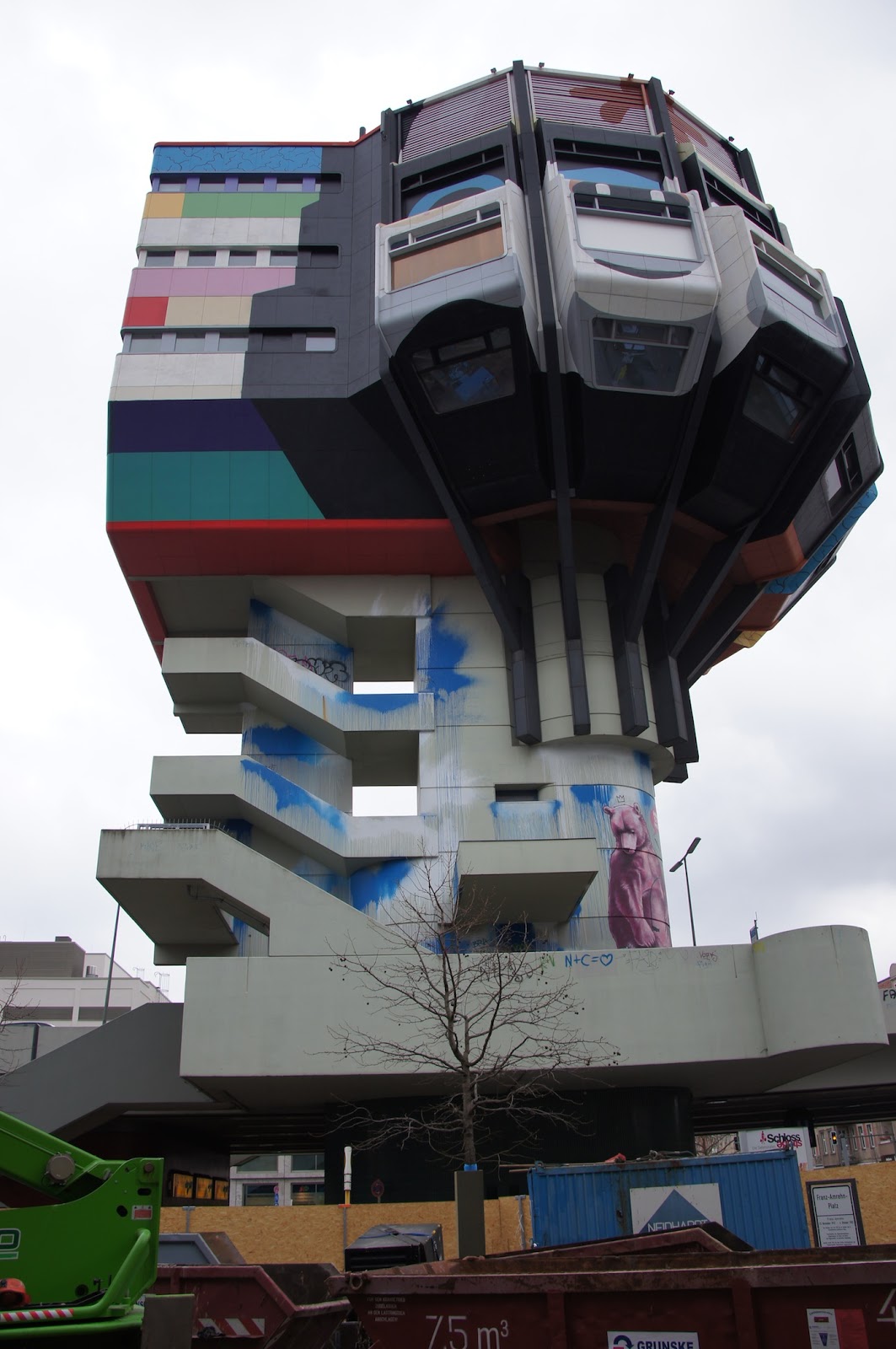
On the way, I saw this crazy structure; at first I thought it might be some war structure that couldn't be torn down (like the flak towers).  But it turns out that it was built in the 1970's as a beer hall/restaurant, and is now empty.  It became an art project for graffiti artists, hence the colors.


More pictures from the Mitte area, which is still being restored  (and more pink pipes).


The beautiful synagogue.   Unfortunately, the sidewalk in front of it is off limits; guarded by security guards.


I took some long rides on the S-Bahn. There were interesting views of all kinds of industrial and transportation structures in varying states of decay.


The famous Fehnsenturm, symbol of East Berlin:
(Somehow, whenever I see bulbous structures with windows, I think of the spaceship in 2001.)


The Hackesche Market S Bahn station: